



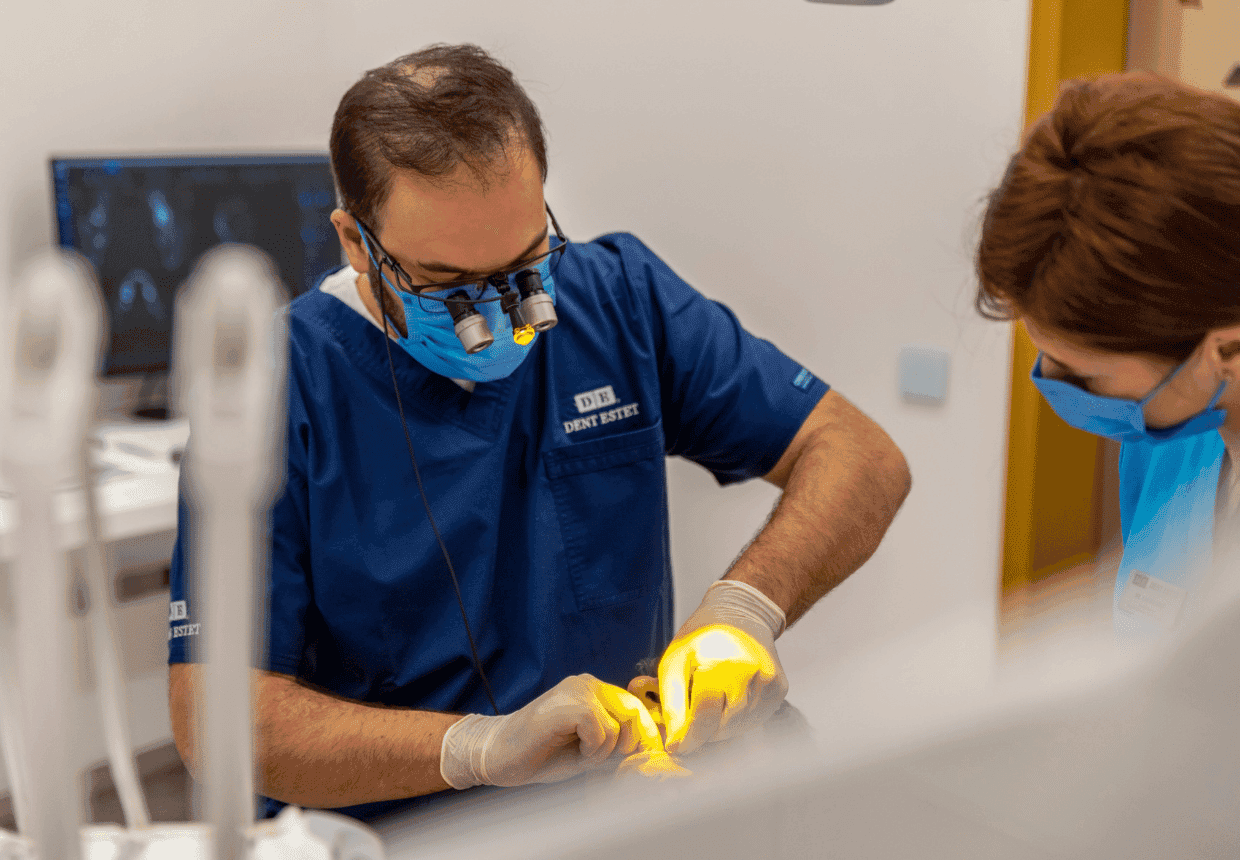
All-on-4® oral rehabilitation on two dental arches in Bucharest – a clinical case
 Author:
 September 30, 2026
Generalised periodontal disease can progressively compromise the teeth in both dental arches, to the point where they can no longer be preserved under predictable conditions. In this clinical case carried out at DENT ESTET Bucharest, the patient underwent complete oral rehabilitation using the Nobel Biocare All-on-4® system: four implants in the upper jaw and four in the lower jaw, temporary fixed restorations fitted on the day of the procedure and, following the healing period, final restorations with a titanium framework and zirconia crowns.
The clinical case in brief
| Initial situation | Generalised periodontal disease, with irreparably damaged teeth in both the upper and lower jaws |
|---|---|
| Objective | Restoration of masticatory function and aesthetic appearance of the smile through fixed restorations on both dental arches |
| Treatment | Extraction of teeth with a poor prognosis and All-on-4® treatment on both arches |
| Implants | 8 Nobel Biocare implants – 4 on each arch |
| Immediate restoration | Temporary fixed prosthetic restorations, fitted on the day of the procedure |
| Final restoration | All-on-4® restorations with a titanium framework and zirconia crowns |
| Investigations | Clinical examination, diagnostic photographs, panoramic X-ray and bimaxillary CBCT |
What was the initial situation?
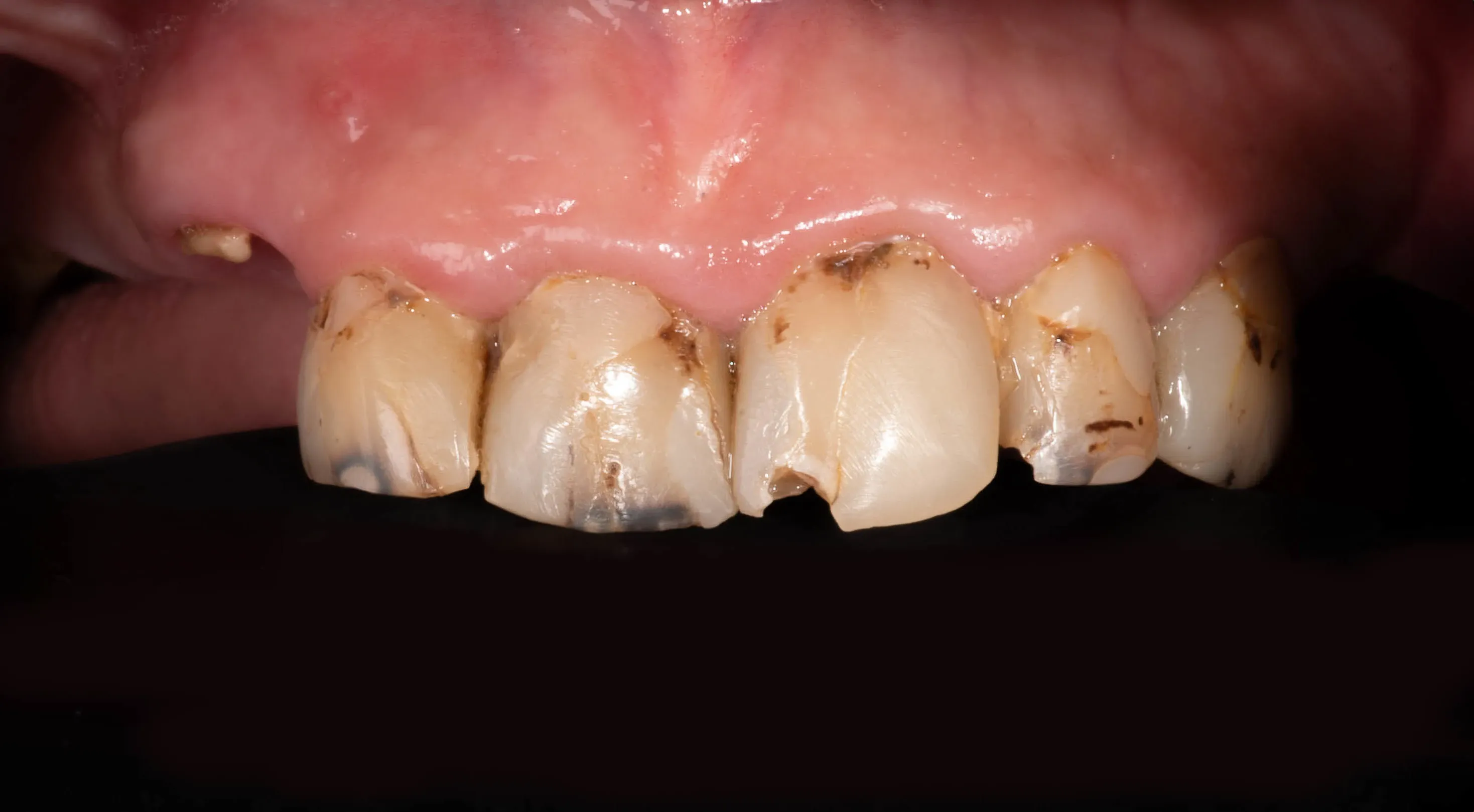
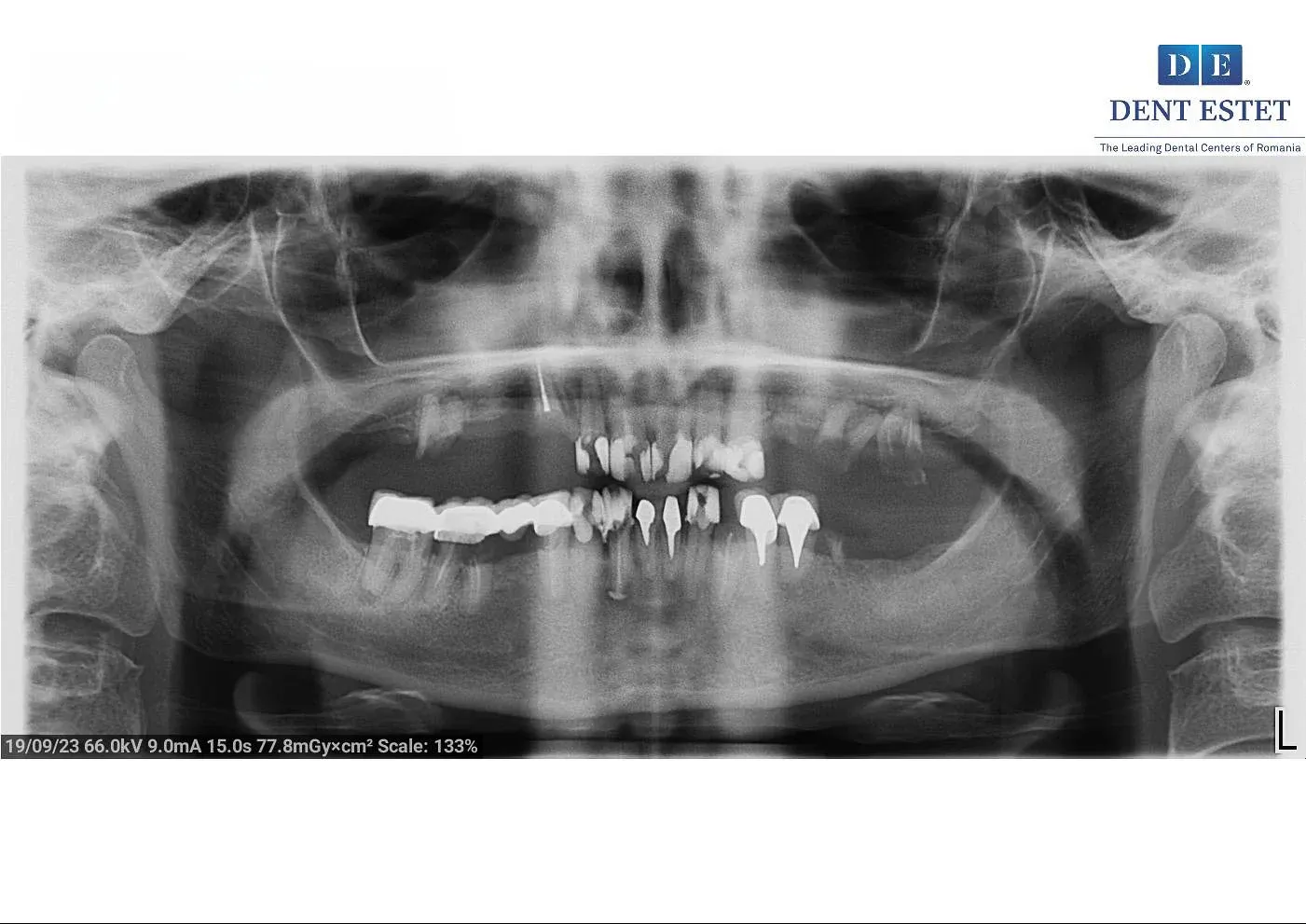
At the initial assessment, the patient presented with extensive dental damage across both dental arches. Generalised periodontal disease had irreversibly compromised the remaining teeth, and the clinical photographs and panoramic X-ray revealed tooth loss, root remnants and existing prosthetic work that could no longer support a predictable restoration.
In such a situation, the problem is not merely the absence of some teeth. The stability of the entire dentition, mastication, occlusion and the appearance of the smile must be analysed together. Therefore, the treatment plan was devised for both dental arches, based on the desired functional and prosthetic outcome.
What investigations were required?
The treatment plan was drawn up following a comprehensive consultation, photographic documentation and analysis of the imaging studies. The panoramic X-ray provided an overview of the dentition and bone structures, whilst the bimaxillary CBCT scan enabled a three-dimensional assessment of bone volume and its relationship to key anatomical structures.
This information is necessary to decide whether the teeth can be preserved, to plan extractions and to determine the position of the implants in relation to the available bone and the future prosthetic restoration. In a two-arch rehabilitation, the planning must take into account the relationship between the maxilla and the mandible from the outset.
Why was the All-on-4® system chosen for both dental arches?
All-on-4® is a protocol for the fixed rehabilitation of an edentulous arch or an arch with teeth of poor prognosis, in which a complete prosthesis is supported by four implants. In the case presented, the damage was widespread across both arches, and the remaining teeth could no longer provide reliable support. For this reason, the treatment aimed to restore the maxilla and mandible as a single unit.
Nobel Biocare implants for supporting fixed restorations
The treatment plan involved eight Nobel Biocare dental implants, four in each arch. The distribution of the implants provided the necessary support for the full-mouth prosthetic work and enabled the fixed restoration of both arches.
Immediate loading with fixed temporary works
On the same day as the extractions and the placement of the implants, the patient was fitted with temporary fixed prosthetic restorations. This immediate-loading implant protocol reduces the period during which the patient would be without teeth; however, its suitability depends on the stability of the implants, the quality of the bone and an assessment of the case as a whole.
Final restorations featuring titanium frameworks and zirconia crowns
Following healing and clinical assessment, the temporary restorations were replaced with final All-on-4® restorations. The titanium framework provides prosthetic support, whilst the zirconia crowns allow the shape, colour and proportions of the teeth to be restored in a functionally and physiognomically adapted arrangement.
What were the stages of the treatment?
1. Assessment and diagnosis
The first stage involved taking a medical history, a clinical examination, an assessment of dental status, diagnostic photographs, a panoramic X-ray and a bimaxillary CBCT scan. Based on this information, a personalised treatment plan was presented.
2. Preparation for the procedure
Professional dental cleaning was carried out prior to the procedure. For the patient’s comfort and safety, the surgical stage was performed under sedation and with anaesthetic supervision provided by a specialist anaesthetist.
3. Extractions and implant placement
On the day of the procedure, the teeth and root remnants with a poor prognosis were removed. Four Nobel Biocare implants were placed in the maxilla and four in the mandible, in accordance with the established plan to support the full dentures.
4. Temporary fixed restorations
Also on the day of the procedure, the temporary fixed prosthetic restorations were fitted. These provided a functional and aesthetic solution during the healing period, and were adjusted and monitored by the medical team.
5. Healing and check-ups
Over the following months, regular check-ups and imaging scans were carried out. The healing period allows the implants to integrate and the tissues to stabilise prior to the final restoration.
6. Fitting and placement of the final restorations
The final prosthetic stage involved the fabrication and try-in of the restorations, any necessary adjustments, and their permanent fitting. The final restorations were fabricated on a titanium framework, with zirconia crowns, for both arches.
What technologies and materials were used, and why?
- Panoramic X-ray – for an overall assessment prior to treatment and for follow-up checks.
- Bimaxillary CBCT – for three-dimensional bone analysis and implant planning.
- Nobel Biocare All-on-4® system – to support a complete fixed restoration on four implants in each arch.
- Titanium framework – to support the final prosthetic restorations.
- Zirconia crowns – for the functional and aesthetic restoration of the dental arches.
The outcome of the treatment
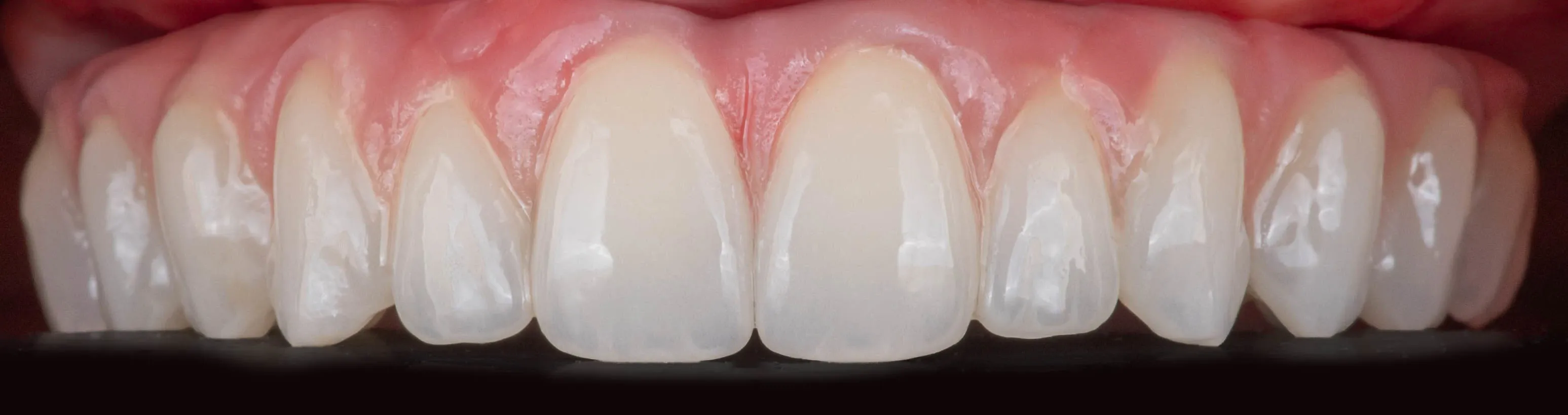
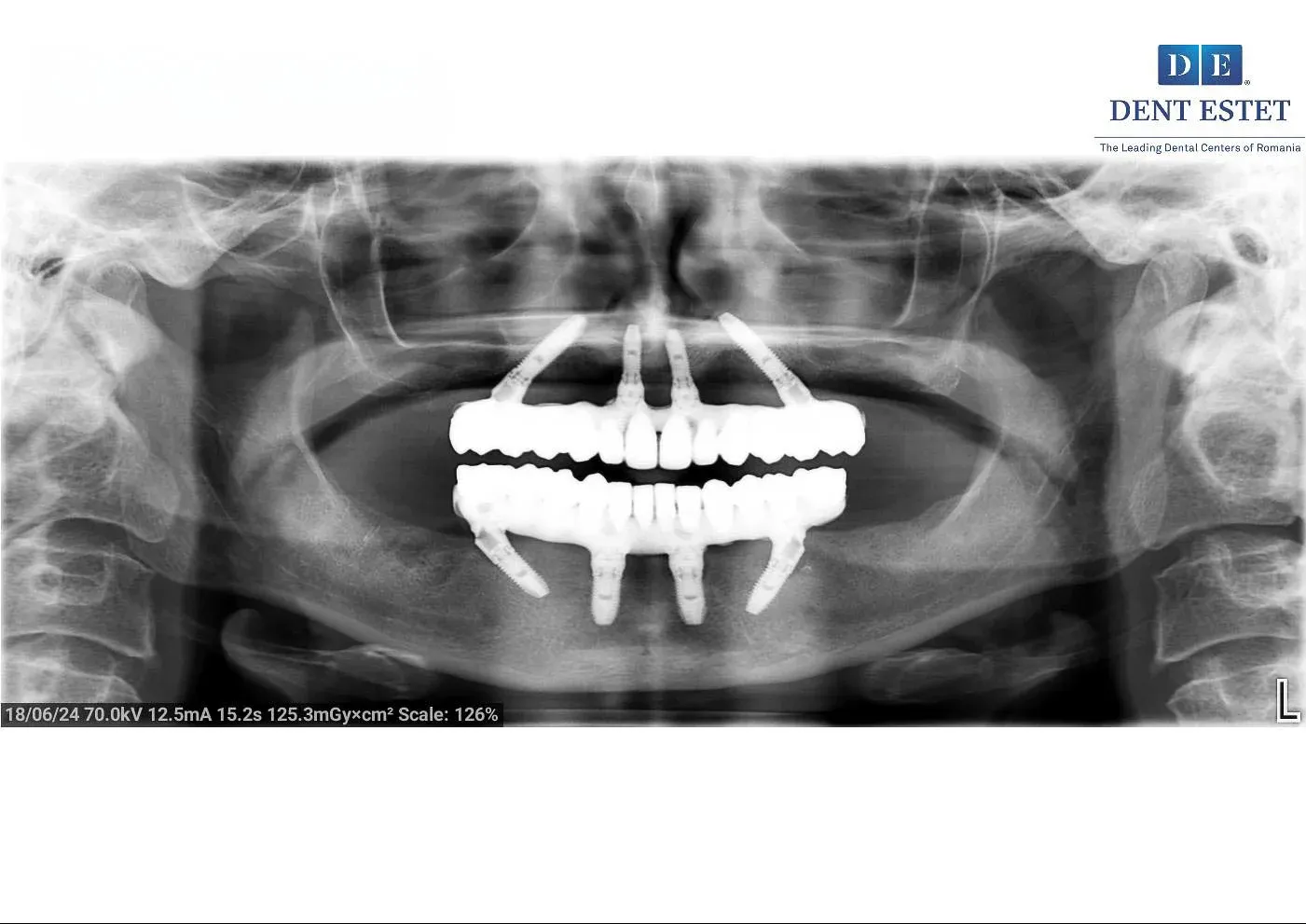
The restoration involved rebuilding both dental arches using fixed work supported by implants. A comparison of the initial and final images shows the change in the continuity of the dental arches, the shape and proportions of the teeth, and the integration of the smile into the patient’s facial features. The follow-up X-ray confirms the position of the eight implants and the prosthetic restorations on the maxilla and mandible.
In a comprehensive oral rehabilitation, the result is not limited to appearance. The work must integrate aesthetics, mastication, the relationship between the dental arches and the possibility of proper oral hygiene. It is precisely this relationship between function and natural appearance that defines the prosthetic planning of the case.
In what situations might the All-on-4® treatment be appropriate?
A fixed bridge supported by four implants may be considered for patients who have lost all or most of the teeth in one arch, or for those whose remaining teeth have a poor prognosis. It may be particularly relevant when complete restoration of an arch is required and the aim is to avoid a removable denture.
However, a diagnosis of periodontal disease, the presence of multiple affected teeth or a preference for a fixed restoration do not automatically lead to the same solution. The indication is determined only after a clinical examination, imaging investigations and an assessment of general health, available bone and the feasibility of long-term maintenance.
All-on-4® for both arches means eight implants
The term All-on-4® refers to four implants per arch. When treatment is carried out on both the maxilla and the mandible, a total of eight implants are used – four supporting the upper restoration and four supporting the lower restoration. The two restorations are planned together to achieve stable dental contacts and balanced masticatory function.
How to maintain the results after All-on-4® rehabilitation
Implants and fixed restorations require careful daily oral hygiene and professional monitoring. The spaces beneath the restorations must be cleaned in accordance with the instructions provided at the clinic, using suitable tools such as a mouthwash and the brushes recommended by the dentist or dental hygienist.
Regular check-ups, X-rays where indicated, and prophylaxis appointments help to monitor the implants, tissues and prosthetic restorations. In this case, the maintenance programme included check-ups and professional prophylaxis following completion of treatment.
The medical team
The case required the coordination of the diagnostic, implant surgery, prosthetic and follow-up stages. The prosthetic treatment and aesthetic integration were carried out by Dr Adelin Radu, a specialist in dental prosthetics, a PhD candidate and a certified practitioner in oral implantology. The surgical stage was carried out within the DENT ESTET Implantology Division, and the All-on-4® case was conducted in accordance with the protocol developed by Prof. Dr Paulo Malo.
Do you have a similar dental problem?
If you are experiencing loose teeth, extensive tooth loss, old dental work that can no longer be maintained, or damage to both dental arches, the first step is a comprehensive assessment of your situation. The consultation and imaging tests enable the medical team to determine which teeth can be preserved and whether All-on-4® treatment or another restorative solution is recommended.
Frequently asked questions about All-on-4® on two dental arches
How many implants are required for All-on-4® on both arches?
A total of eight implants are used: four in the upper jaw and four in the lower jaw. Each group of four implants supports a complete fixed restoration for the respective arch.
Is it possible to have fixed dentures fitted on the same day?
In cases that meet the clinical criteria, a temporary fixed restoration may be fitted on the day the implants are placed. The final restoration is then completed following healing and the necessary checks. The indication for immediate loading is determined on a case-by-case basis.
What is the difference between the provisional and the final version?
The temporary restoration is used during the healing period and may require adjustments. The final restoration is fabricated once the implants and tissues have stabilised, based on the functional and aesthetic data verified in the previous stages.
How long does All-on-4® treatment take?
The surgical stage and the temporary restoration can be carried out on the same day in suitable cases. However, the full course of treatment takes place over several months, as it includes diagnosis, healing, check-ups and the completion of the final restorations.
Does periodontal disease prevent implant treatment?
Not in all cases. Periodontal disease must be assessed and monitored, and risk factors must be managed both before and after implant placement. The decision depends on the condition of the tissues, the available bone and the patient’s ability to maintain rigorous oral hygiene and attend regular check-ups.
How do you clean an All-on-4® fixed prosthesis?
Oral hygiene involves brushing, cleaning the space between the teeth and gums using individually recommended products, and regular professional dental check-ups. The dental team determines the appropriate technique and frequency for each patient.