




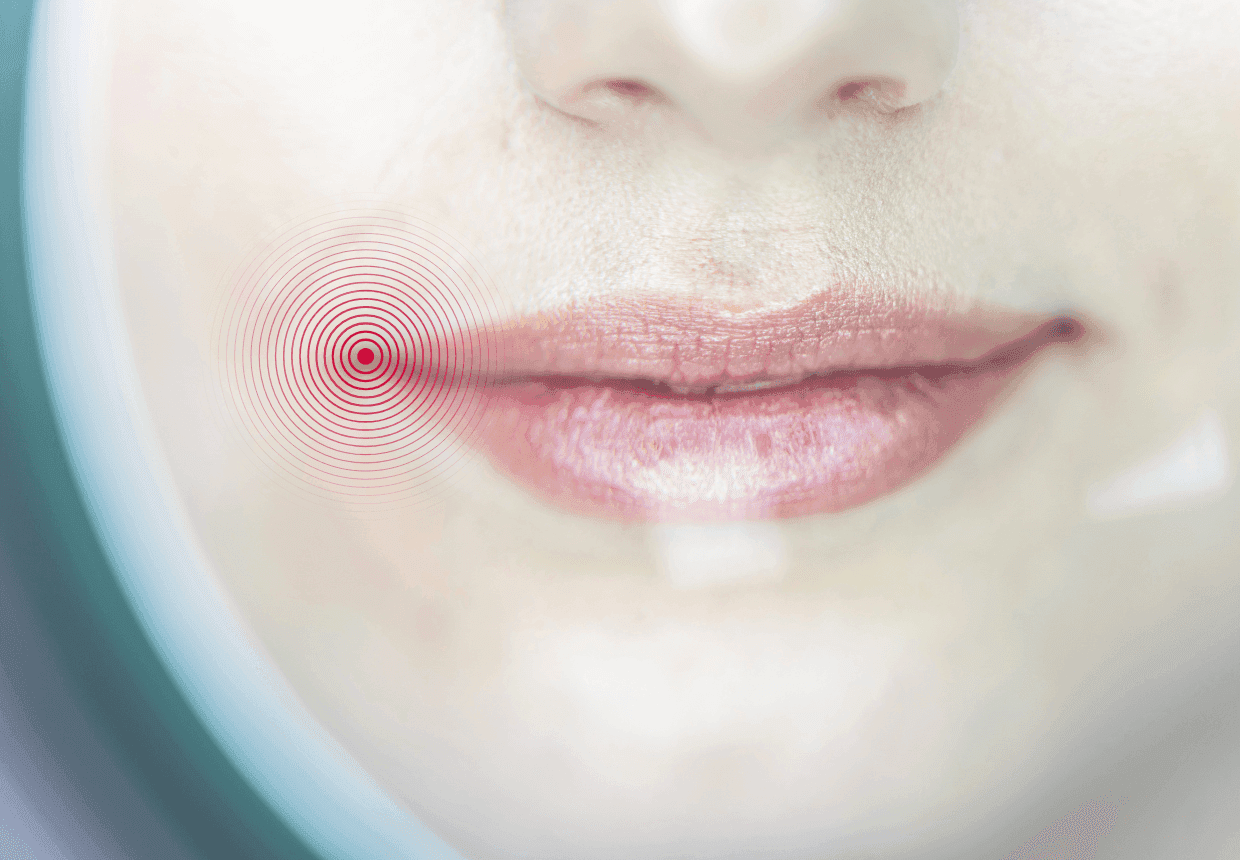
Angular cheilitis: why cracks appear at the corners of the mouth and how to treat them
 Author: Dr. Eliza Olarean
 July 8, 2026
Angular cheilitis: why cracks appear at the corners of the mouth and how to treat them
Angular cheilitis is an inflammation that occurs at the corners of the mouth and can cause cracks, redness, stinging, pain or a burning sensation. In Romania, a dental or dermatological consultation is recommended if the cracks persist, recur frequently, bleed or are accompanied by painful lesions.
What is angular cheilitis?
Although it is often mistaken for a simple irritation or cold sore, angular cheilitis is an inflammatory condition affecting one or both corners of the mouth (the corners of the lips). Lesions can range from superficial cracks and redness to painful fissures that bleed and cause discomfort when speaking, eating or opening the mouth.
The condition can occur at any age, but is more common in people who wear dentures, have lost several teeth or suffer from conditions that alter salivation or the immune system’s response. Although it may look similar to other lip lesions, the cause is different, which is why diagnosis and treatment must be determined by a doctor.
In short: Angular cheilitis is an inflammation of the corners of the mouth, most often caused by a combination of excessive moisture and factors such as Candida or bacterial infections, ill-fitting dentures, nutritional deficiencies or certain systemic conditions.
Why do cracks appear at the corners of the mouth?
Cracks at the corners of the mouth usually occur as a result of a combination of several factors, such as persistent moisture, local irritation, infections or certain nutritional deficiencies. Identifying the cause is important both for healing the lesions and for reducing the risk of them recurring.
Excessive moisture and local irritation
One of the most common causes of angular cheilitis is prolonged exposure of the corners of the mouth to saliva. When saliva remains in prolonged contact with the skin, it becomes macerated, loses its protective function and becomes more vulnerable to inflammation and infection.
This phenomenon is common in people who repeatedly lick their lips, sleep with their mouth open, salivate excessively or have pronounced folds at the corners of the mouth. Furthermore, cold weather, wind, dry air and the use of irritating cosmetic products can damage the skin’s natural barrier and aggravate existing lesions.
Fungal or bacterial infections
Once the skin barrier has been compromised, microorganisms that are normally present in the oral cavity can cause a local infection. The most common culprit is Candida albicans, a fungus commonly found in the oral flora, but which can multiply excessively when conditions are favourable.
“In some cases, a fungal infection is accompanied by bacteria, particularly Staphylococcus aureus, which can exacerbate inflammation and delay healing. As the appearance of the lesions does not always indicate the exact cause, treatment should not be started before a medical assessment has been carried out. Applying an unsuitable product may prolong the course of the disease or lead to recurrence.”

Dental problems or ill-fitting dentures
From a dentist’s perspective, dental factors are one of the most significant causes of recurrent forms. Old or unstable dentures, ill-fitting prosthetic work and the loss of several teeth alter the position of the lips and the vertical dimension of the face over time.
In these situations, folds form at the corners of the mouth where moisture lingers for longer, promoting irritation and the growth of microorganisms. For this reason, local treatment often provides only temporary relief if the dental problem is not corrected.
Nutritional deficiencies
When angular cheilitis recurs without an obvious local cause, the doctor may recommend tests to identify any nutritional deficiencies. Among the most commonly associated are deficiencies in iron and B-complex vitamins, particularly vitamin B2 (riboflavin), vitamin B9 (folic acid) and vitamin B12.
An unbalanced diet, certain digestive conditions or malabsorption disorders can contribute to the development of these deficiencies. Correcting the deficiency can help both to heal the lesions and to reduce the risk of recurrence.
General risk factors
There are also general medical conditions that increase susceptibility to developing angular cheilitis by impairing the body’s defence mechanisms or tissue regeneration. These include diabetes mellitus, impaired immunity, xerostomia (dry mouth) and treatments that alter the oral flora.
People who use antibiotics for prolonged periods, inhaled corticosteroids or immunosuppressive treatments may be more prone to developing fungal infections of the oral cavity, including angular cheilitis. In such cases, treatment of the lesion must be accompanied by management of the underlying condition and medical monitoring.
Symptoms of angular cheilitis
Clinical symptoms vary from one patient to another, depending on the cause of the inflammation and its severity. Sometimes they are mild and disappear once the irritant has been removed, but in other cases they persist or recur periodically.
The most common symptoms are:
- cracks at one or both corners of the mouth;
- redness and localised inflammation;
- a stinging, burning or prickling sensation;
- pain when opening the mouth, speaking or chewing;
- slight bleeding when the cracks deepen;
- scabs or flaking skin that repeatedly comes away;
- discharge or moist areas around the lesion;
- lesions that are slow to heal or recur frequently.
When you need to see a doctor
Sometimes, a minor irritation can clear up within a few days by avoiding irritants and keeping your lips properly moisturised. If the lesions persist, worsen or recur, it is advisable to seek an assessment from a dentist or dermatologist.
It is advisable to make an appointment with a doctor if:
- the cracks persist for more than a few days, despite taking care of them;
- the lesions recur frequently;
- you experience severe pain, bleeding or discharge;
- you wear dentures or have dental prostheses that are no longer secure;
- you notice changes in your bite or have lost several teeth;
- other oral symptoms occur, such as thrush, a sore tongue or a dry mouth.
In cases where a persistent fungal or bacterial infection is suspected, your doctor may also recommend microbiological tests.
How is angular cheilitis treated?
Treatment for angular cheilitis is determined by the underlying cause of the lesions. As the same symptom can have different causes, there is no one-size-fits-all solution, and self-medication is not recommended.
The aims of treatment are:
- to resolve the inflammation;
- to eliminate the infection, where present;
- restoring the skin barrier;
- correcting the factors that contribute to the recurrence of the condition.
Treatment depending on the cause
When the doctor determines that a Candida albicans infection is present, they may recommend topical antifungal treatment and, in certain situations, systemic treatment. If the lesion is secondarily infected with bacteria, antibacterial treatment may be indicated.
In addition to anti-infective treatment, products designed to protect and repair the skin barrier are frequently recommended. These reduce the skin’s contact with saliva, limit irritation and promote the healing of fissures.
It is important to note that the inappropriate use of antibiotics, antifungals or corticosteroids can alter the local flora and may lead to recurrence. For this reason, treatment should only be started following a medical assessment.
Correcting dental factors
In cases of missing teeth or dentures that no longer provide adequate support for the lips, saliva will continue to accumulate at the corner of the mouth.
Your dentist may recommend:
- checking the fit of dentures;
- adjusting existing prosthetic work;
- an assessment of the occlusion (bite);
- restoring lip support through prosthetic treatments or dental implants, where indicated.
In some cases, simply correcting these factors significantly reduces the risk of recurrence and contributes to the complete healing of lesions.
Recommendations for daily care
In addition to the treatment recommended by your doctor, daily care plays an important role in the healing of angular cheilitis and in preventing its recurrence.
During the recovery period, it is recommended that you:
- to avoid licking or biting your lips;
- to moisturise your lips with emollient products recommended by your doctor;
- to maintain rigorous oral hygiene and clean your dentures properly;
- to drink enough fluids to prevent dryness of the mucous membranes;
- to temporarily avoid very acidic, spicy or irritating foods;
- follow the treatment exactly as prescribed.
If episodes recur, treating the symptoms alone is not enough. Identifying and eliminating the contributing factor is the most effective way to reduce the risk of further episodes and maintain oral health.
What not to do if you have cracked corners of your mouth
If you have cracked corners of your mouth, avoid the following mistakes:
Do not use antibiotics, antifungals or corticosteroids without your doctor’s advice.
Applying a corticosteroid without a doctor’s advice may increase the risk of developing a fungal infection, whilst using a topical antibiotic without a prescription will not treat an infection caused by Candida albicans.
Do not pick at the scabs or try to remove the flaking skin.
This habit can cause bleeding, delay healing and increase the risk of a secondary infection.
Do not use irritating or perfumed cosmetics on the affected area.
Lipsticks, balms or creams containing perfume, alcohol or other irritants can exacerbate inflammation.
Don’t keep licking or biting your lips.
Although saliva provides a temporary sensation of hydration, it softens the skin and helps lesions to persist.
Don’t assume it’s just a dry patch or a cold sore.
Persistent cracks at the corners of the mouth can have various causes and require an accurate diagnosis to ensure effective treatment.
Do not delay seeing a doctor if the lesions keep coming back.
Recurrent episodes may indicate the presence of local factors, such as poorly-fitting dentures or occlusal problems, as well as general health conditions, such as diabetes, iron or B-complex vitamin deficiencies, or immune system disorders.
Frequently Asked Questions
Why do the corners of my mouth crack?
The corners of the mouth may crack due to excessive moisture, dryness, fungal or bacterial infections, ill-fitting dentures, nutritional deficiencies or certain general medical conditions.
What could a sore at the corner of the mouth be?
A sore at the corner of the mouth may be caused by angular cheilitis, local irritation, excessive dryness, a fungal or bacterial infection, or herpes. If the sore is painful, bleeds, spreads or recurs, it is advisable to seek medical advice for a correct diagnosis.
Is angular cheilitis contagious?
Angular cheilitis is not always contagious. If it is associated with a fungal or bacterial infection, your doctor may recommend hygiene measures and specific treatment.
Is angular cheilitis the same as cold sores?
No. Angular cheilitis appears at the corners of the mouth as cracks and inflammation, whereas cold sores usually cause painful blisters. A correct diagnosis can only be made by a doctor.
What treatment is available for angular cheilitis?
Treatment depends on the cause and may include antifungal or antibacterial products, restorative treatments, or the correction of dental factors such as ill-fitting dentures or bite problems.
When should I see a doctor about cracks at the corners of my mouth?
It is advisable to seek medical advice if the cracks persist, recur frequently, bleed, are painful or are accompanied by discharge, severe burning or other oral lesions.