




Whitening toothpaste: Pros and cons from the experts
 Author:
  April 24, 2025
Achieving a whiter smile is a goal for many people, and whitening toothpastes are often seen as a simple and affordable solution. But are they truly effective and safe for home use? In this article, the specialists at DENT ESTET analyse in detail the advantages and disadvantages of whitening toothpastes, offering an expert perspective on their role in achieving the desired aesthetic result.
How do whitening toothpastes work?
Whitening toothpastes differ from standard varieties in their specially formulated composition, which includes active ingredients designed to remove stains from the surface of the teeth. These ingredients range from fine abrasives, which work mechanically to dislodge stains, to mild chemicals that help break them down.
The most common active ingredients in whitening toothpastes are:
- Abrasives: fine particles that help physically remove surface stains. Examples include hydrated silica, calcium carbonate and hydrated alumina.
- Chemical agents: hydrogen peroxide or carbamide peroxide, in low concentrations, which help break down stains.
Active ingredients and mechanisms of action
Whitening toothpastes contain a variety of active ingredients, each with a specific role in the process of removing stains and restoring the teeth’s natural shine. These are the most common categories of ingredients:
- Abrasives: These are fine, insoluble particles that work mechanically to remove surface stains (extrinsic). They gently ‘polish’ the tooth enamel. Common examples include:
- Hydrated silica: One of the most widely used abrasive agents, valued for its cleaning efficiency and safety for enamel.
- Calcium carbonate: A mild abrasive that also helps neutralise acids in the mouth.
- Aluminium hydroxide: Another effective abrasive agent, used in various toothpaste formulations.
- Dicalcium phosphate dihydrate: Contributes to cleaning and the remineralisation of enamel.
- Chemical agents: These act at a molecular level to break down stains, including the most stubborn ones. Hydrogen peroxide or carbamide peroxide releases active oxygen, which penetrates the enamel and dentine, breaking down the pigments that cause discolouration. The concentrations in toothpastes are significantly lower than those used in professional whitening treatments.
The effectiveness of chemical agents depends on their concentration and the length of time they are left in contact with the teeth. Some whitening toothpastes may also contain fluoride (to prevent cavities), tartar control agents or ingredients to reduce tooth sensitivity.
The abrasiveness of toothpastes must be carefully monitored by a dentist, as excessive use of highly abrasive toothpastes can lead to enamel wear. Some whitening toothpastes may also contain fluoride (to prevent cavities), tartar control agents or ingredients to reduce tooth sensitivity.
The difference between chemical and abrasive whitening
Whitening toothpastes use two main mechanisms to remove stains and restore the shine of teeth: abrasive whitening and chemical whitening.
- Abrazive whitening removes surface stains (extrinsic stains) through mechanical friction, similar to a gentle ‘polishing’ of the tooth enamel. Whitening toothpastes that use abrasion contain fine particles, such as hydrated silica, calcium carbonate or aluminium hydroxide, which act as active agents. This type of whitening is effective for stains caused by food, drinks (coffee, tea, red wine) or smoking.
However, excessive abrasiveness can lead to enamel wear and tooth sensitivity. For this reason, high-abrasion toothpastes are not recommended for long-term use. - Chemical whitening uses chemical agents to break down stains, both on the surface and in the deeper layers of the tooth. Hydrogen peroxide or carbamide peroxide are the most commonly used chemical agents. These compounds release active oxygen, which penetrates the enamel and dentine, breaking down the pigmented molecules that cause discolouration. More effective than abrasive whitening for stubborn or intrinsic stains (caused by internal factors, such as medication or fluorosis). The concentrations in toothpastes are lower than those used in professional treatments, making them safer for daily use, but also slower-acting.
- Comparing the two methods, abrasive whitening is faster at removing superficial stains but has a higher potential for enamel wear. Chemical whitening is gentler on the enamel and more effective for deep stains, but takes longer to produce visible results.
The benefits of using whitening toothpastes
Regular use of whitening toothpastes can offer a range of benefits, contributing to both your smile’s appearance and your oral health.
- Removal of superficial stains. Using a whitening toothpaste helps remove extrinsic stains caused by external factors such as the consumption of coffee, tea, red wine, certain pigmented foods or smoking. These stains form on the surface of the enamel and can be removed by the action of abrasive or chemical agents in the toothpaste. Visibly improves the overall appearance of the teeth, restoring their natural shine.
- Improving the appearance of your smile. Whitening toothpastes can help achieve a brighter and more attractive smile. A whiter smile can boost self-confidence and self-esteem, having a positive impact on social and professional interactions. Furthermore, concern for the aesthetic appearance of one’s smile can motivate better dental care, as part of a general effort to maintain a well-groomed appearance.
- Role in maintaining oral hygiene. In addition to their whitening effect, these toothpastes provide the benefits of a standard toothpaste: they clean the teeth, removing plaque and food debris. Many of them contain fluoride, which helps prevent cavities by strengthening tooth enamel. Some formulas may include ingredients to combat tartar, gingivitis or tooth sensitivity. As a side effect, as part of a proper dental hygiene routine, they also contribute to fresh breath.
The disadvantages and potential risks of whitening toothpastes
It is also important to be aware of the disadvantages and risks associated with using whitening toothpastes:
- Tooth sensitivity. Long-term use of whitening toothpastes, especially those with a high degree of abrasiveness, can lead to tooth sensitivity. Whitening agents, particularly abrasive ones, can remove a thin layer of enamel, exposing the dentine, which is more sensitive to extreme temperatures (hot and cold) and to sweet or acidic foods.
This sensitivity may manifest as pain or discomfort when brushing or when consuming certain foods and drinks. People who already have sensitive teeth should use whitening toothpastes with caution and opt for variants specially formulated for sensitive teeth. - Damage to the enamel. Abrasive agents in whitening toothpastes can damage tooth enamel, particularly with excessive use or improper brushing technique (brushing too aggressively). Tooth
enamel is the protective outer layer of the tooth, and damage to it can increase the risk of tooth decay or tooth sensitivity. Paradoxically, incorrect use of whitening toothpastes can have the opposite effect to that intended, resulting in a dull or yellowed appearance of the teeth.
To avoid premature wear of the teeth, it is necessary to use the correct brushing technique, with gentle, circular movements, and to avoid excessive pressure. - Limited results compared to professional whitening. Whitening toothpastes offer less noticeable and less long-lasting results compared to whitening procedures carried out in the dentist’s surgery. The concentration of whitening agents in toothpastes is lower than that used by professionals, which limits their effectiveness in whitening intrinsic stains (stains from inside the tooth).
Professional whitening, carried out under the supervision of a dentist, can use stronger whitening agents and specialised techniques (e.g. laser or UV light treatment) to achieve more significant and long-lasting results. For more pronounced and faster whitening, it is recommended that you consult a dentist.
How to choose the best whitening toothpaste
Choosing the right whitening toothpaste is crucial for achieving the desired results whilst minimising risks. Here are some important factors to consider:
Ingredients to avoid
Avoid toothpastes with a high abrasiveness rating (RDA over 100). RDA (Relative Dentin Abrasion) measures how abrasive a toothpaste is. A high RDA value means the toothpaste is more abrasive and can wear down tooth enamel over time, leading to sensitivity and other problems. Check the list of ingredients and RDA values (if indicated) before buying a whitening toothpaste.
Use whitening toothpaste in moderation. Whilst hydrogen peroxide or carbamide peroxide are effective whitening agents, very high concentrations (exceeding 0.1–1%) or excessive use of these can lead to tooth sensitivity and gum irritation. You can alternate between a whitening toothpaste and a regular fluoride toothpaste to balance the whitening benefits with enamel protection.
Ensure that the toothpaste contains fluoride within the recommended limits. Usually in the form of sodium fluoride, it is used to remineralise teeth and prevent acid-induced damage. In recent years, however, fluoride has been the subject of controversy, and some toothpaste manufacturers are beginning to turn to other substances to replace it, such as hydroxyapatite, xylitol or strontium chloride, to protect against cavities and strengthen enamel.
Professional teeth whitening options at DENT ESTET
For superior results in complete safety, DENT ESTET offers a full range of professional teeth whitening treatments, tailored to each patient’s needs. We understand that a bright, white smile can boost self-confidence, which is why we provide advanced technologies and the expertise of our specialists to offer you the best experience and outstanding results.
Laser teeth whitening
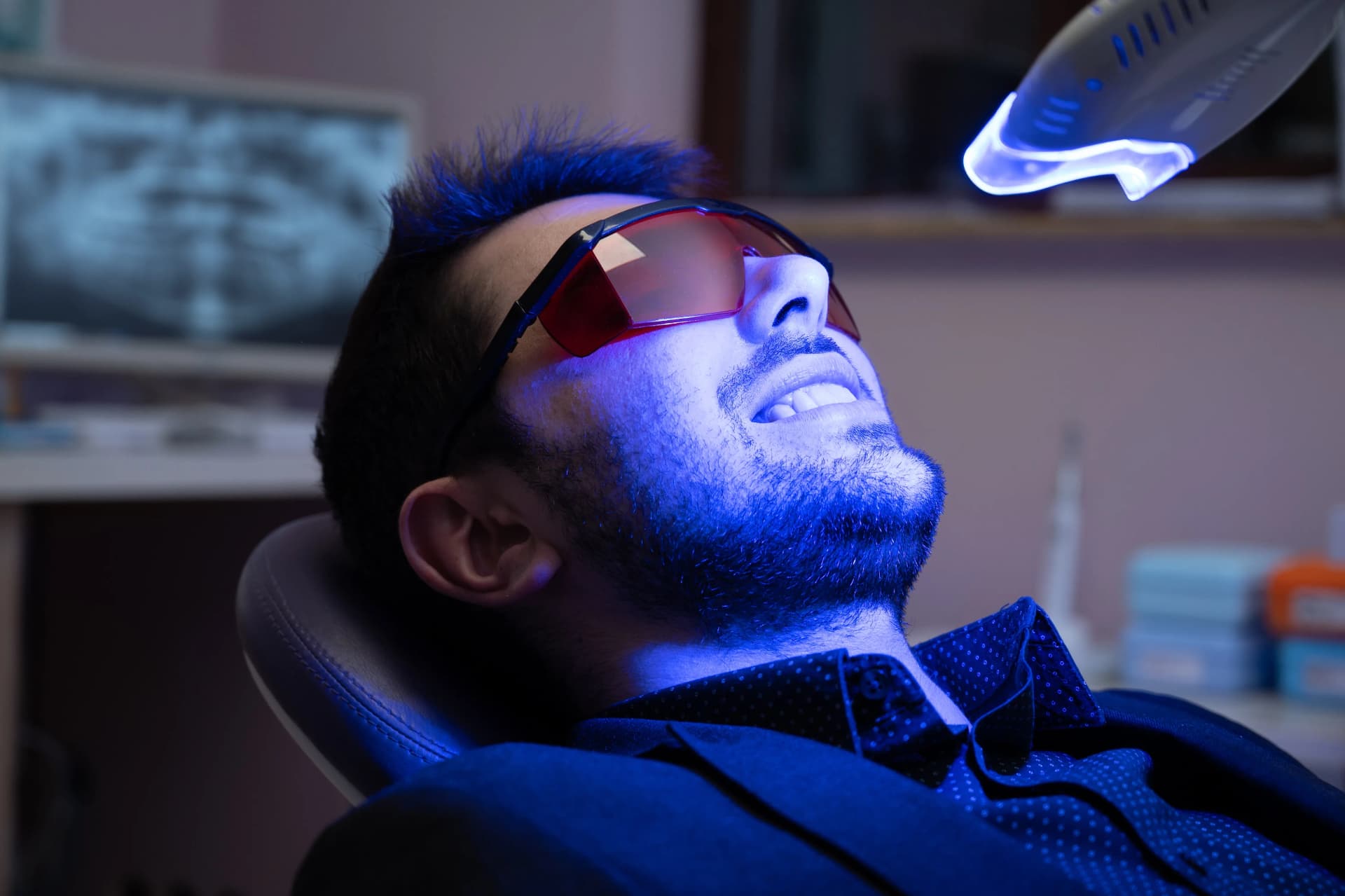
Laser whitening is a quick and effective procedure carried out in the dentist’s surgery, offering visible results in a single session. This method uses a special whitening gel, activated by a laser light source, to lighten the shade of the teeth by up to several shades. The procedure is minimally invasive and precisely controlled by the dentist, ensuring greater comfort and a minimal risk of sensitivity. The results achieved are long-lasting, with proper maintenance.
Whitening with custom-made trays
Whitening with custom-made trays is a flexible and effective method that involves the use of trays made from the patient’s dental impression, together with a professional whitening gel, for gradual and personalised results. Your dentist will create trays perfectly fitted to your teeth and provide you with detailed instructions on how to apply the gel and the duration of the treatment. This method allows you to whiten your teeth at home, under the close supervision of a specialist, offering comfort and control over the whitening process.
The advantages of professional whitening over over-the-counter toothpastes
Professional whitening offers numerous advantages over the use of toothpastes or other whitening products available without a medical recommendation. Firstly, professional treatments deliver faster, more effective and longer-lasting results, thanks to the higher concentration of whitening agents and the advanced technologies used. Secondly, professional whitening is carried out under the close supervision of a specialist, who can tailor the treatment to the patient’s specific needs, minimising the risks of sensitivity or damage to the enamel. Furthermore, the dentist can identify and treat any pre-existing dental problems, ensuring an optimal and safe result.
Whitening toothpastes can be a useful option for maintaining a brighter smile by removing superficial stains. However, it is important to use them in moderation and to choose high-quality products with a low abrasiveness rating. For optimal and safe results, the specialists at DENT ESTET recommend professional teeth whitening procedures, tailored to each patient’s needs. A healthy, white smile is achieved through a combination of proper oral care, regular visits to the dentist and, where appropriate, professional whitening treatments.
Frequently asked questions about whitening toothpastes
How soon will I see results?
The results of whitening toothpastes become apparent gradually, after a few weeks of daily use.
They remove surface stains, but do not significantly alter the natural colour of the teeth.
How often can I use whitening toothpaste?
Whitening toothpastes can be used daily, in accordance with the manufacturer’s instructions.
Excessive use may damage the enamel and cause tooth sensitivity.
Are there any contraindications?
Yes, whitening toothpastes are not recommended in all cases.
Avoid using them if you have severe tooth sensitivity, gum conditions such as gingivitis, or damage to the enamel, unless advised by your dentist.
Bibliography
- Vilhena FV, Frederico de Oliveira Graeff C, Svizero NDR, D'Alpino PHP. Effectiveness of Experimental Whitening Toothpastes Containing Colourants on the Optical Properties of Enamel. ScientificWorldJournal. 31 March 2022;2022:4576912. doi: 10.1155/2022/4576912. PMID: 35401059; PMCID: PMC8989585.
- Whitening toothpaste containing activated charcoal, blue covarine, hydrogen peroxide or microbeads: which one is the most effective?
- Müller-Heupt LK, Wiesmann-Imilowski N, Kaya S, Schumann S, Steiger M, Bjelopavlovic M, Deschner J, Al-Nawas B, Lehmann KM. Effectiveness and Safety of Over-the-Counter Tooth-Whitening Agents Compared to Hydrogen Peroxide In Vitro. Int J Mol Sci. 19 January 2023;24(3):1956. doi: 10.3390/ijms24031956. PMID: 36768279; PMCID: PMC9915942.
- Jamwal N, Rao A, Shenoy R, Pai M, Ks A, Br A. Effect of whitening toothpaste on surface roughness and microhardness of human teeth: a systematic review and meta-analysis. F1000Res. 11 January 2022;11:22. doi: 10.12688/f1000research.76180.3. PMID: 35265322; PMCID: PMC8874033.
- de Freitas MR, de Carvalho MM, Liporoni PCS, Fort ACB, Moura RM and Zanatta RF (2021) Effectiveness and Adverse Effects of Over-the-Counter Whitening Products on Dental Tissues. Front. Dent. Med. 2:687507. doi: 10.3389/fdmed.2021.687507
- Mohsen, Rania Osama M.. (2024). The effect of whitening toothpastes on enamel surface morphology, chemical profile and colour: An in vitro study. Odovtos International Journal of Dental Sciences, 26(1), 86–99.
- Aydın, Numan, Karaoğlanoğlu, Serpil, Oktay, Elif Aybala, & Ersöz, Bilge. (2022). Determination of the whitening effect of toothpastes on human teeth. Odovtos International Journal of Dental Sciences, 24(1), 67–75.
- Dionysopoulos, D., Papageorgiou, S., Papadopoulos, C., Davidopoulou, S., Konstantinidis, A., & Tolidis, K. (2023). Effect of Whitening Toothpastes with Different Active Agents on the Abrasive Wear of Dentin Following Tooth Brushing Simulation. Journal of Functional Biomaterials, 14(5), 268.