




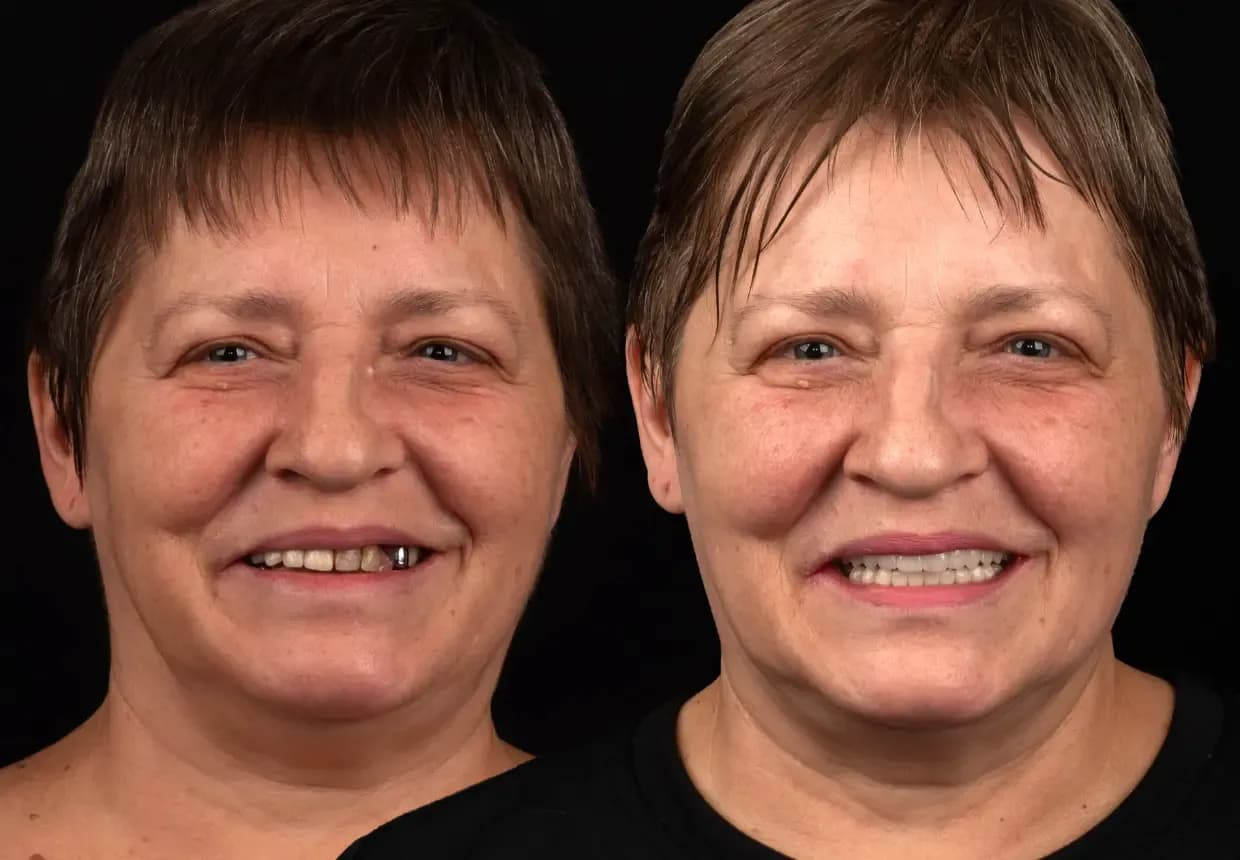
How much does a 24-hour fixed denture treatment cost?
 Author:
  April 15, 2026
| Fixed teeth in 24 hours is a rapid dental implant treatment in which a temporary restoration is fitted on the same day, supported by four dental implants. The cost of fixed teeth in 24 hours varies depending on the complexity of the case, the type of implants and the final restoration, and is determined through a personalised treatment plan. |
The 24-hour fixed teeth treatment is one of the most modern solutions for patients with missing or irrecoverable teeth, or who already wear dentures. The procedure allows a temporary restoration to be fitted on the same day, without long waiting periods.
In short, fixed teeth in 24 hours involves the insertion of 4 dental implants per arch, which support a fixed restoration and eliminate the need for removable dentures. The protocol has been in use for over 20 years and delivers predictable results when properly planned.
One of the most common questions relates to the cost of fixed teeth in 24 hours. The price is not standard and varies depending on the complexity of the case, the type of implants and the final restoration. These differences directly influence the stability and durability of the treatment in the long term.
Why is there no standard price for fixed teeth in 24 hours?
If you start searching for ‘fixed teeth in 24 hours’, you’ll soon notice one thing: prices vary wildly. From a few thousand euros to offers that sound almost too good to be true. And it’s only natural to feel confused.
Because, at first glance, it seems like the same treatment: implants, fixed work, quick results.
In reality, however, what lies behind these offers can be very different.
Every patient has a different history:
- years of bone loss;
- untreated infections;
- old restorations that have failed;
- bite adjustments.
None of these factors are apparent in a simplified quote. In practice, treatment begins with a question far more important than the price: what is required, in your case, to ensure the result remains stable over the years, not just in the first few months?
This is where the real difference between approaches lies.
In clinics that work with comprehensive protocols, treatment is not just about inserting implants and fitting a restoration. It involves:
- detailed digital planning;
- selection of a clinically validated implant system;
- correct occlusal adjustment;
- materials that stand the test of time.
All of this comes at a higher cost, but also delivers a different kind of result: a predictable one.
That is why price differences in the market actually reflect differences in approach, materials and the level of control over the final result.
Every case starts differently
Treatment with fixed teeth in 24 hours seems standardised: 4 implants, a fixed restoration, quick results. In reality, the starting point varies from patient to patient.
Some arrive after years of wearing dentures, with bone resorption. Other patients have teeth that can no longer be saved or old restorations that have affected their bite.
That is why it all starts with a personalised dental implant treatment plan. The dentist assesses bone volume, the need for extractions and the positioning of the implants. Find out more about the stages of dental implant treatment.
Depending on these variables, treatment can be simple or more complex — and this directly influences the cost.
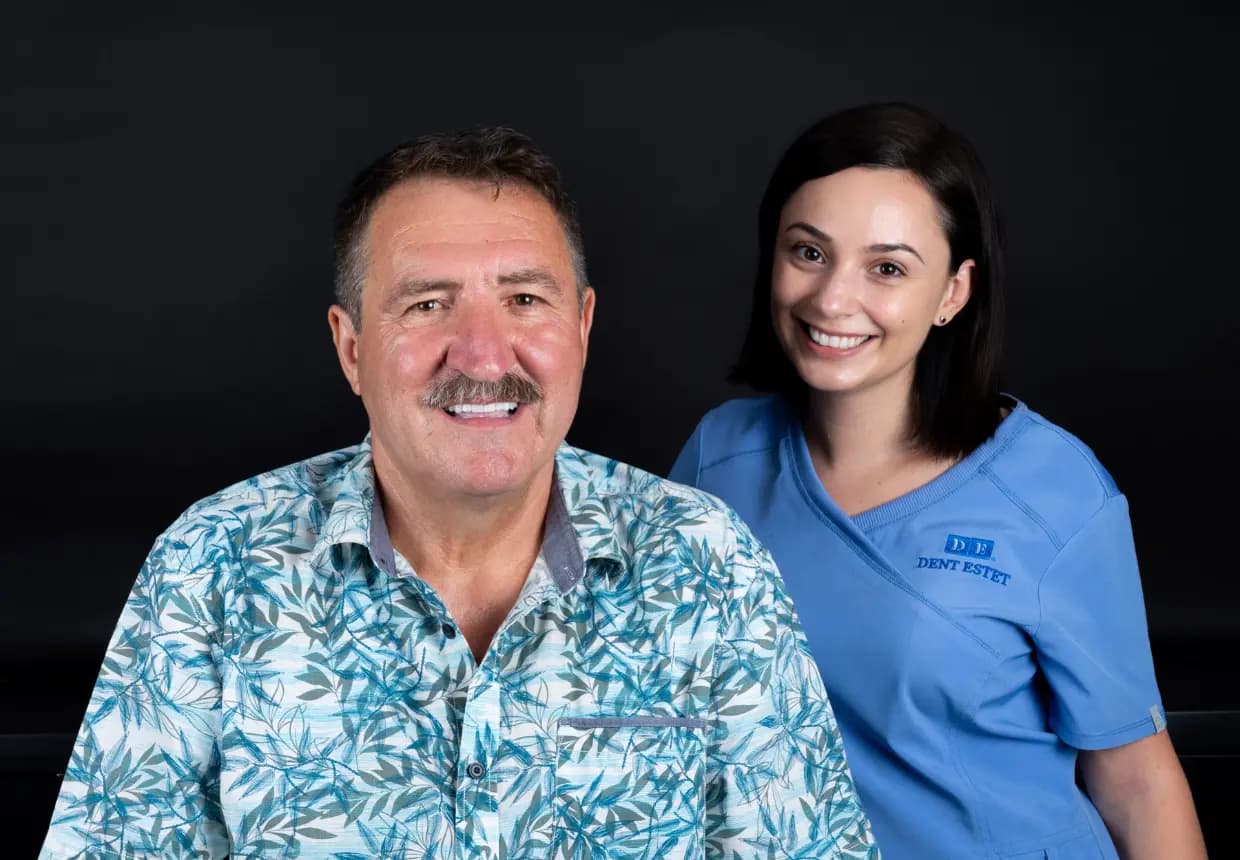
The final cost depends on the patient’s actual needs
One of the biggest differences in cost arises when treatment cannot begin immediately and an additional stage is required: bone augmentation.
This becomes necessary when there is insufficient bone to securely support the implants. Essentially, the foundation on which the implants will be fixed is reconstructed.
Depending on the case:
- the augmentation can be performed during the same procedure or separately;
- the healing period is usually between 3 and 6 months.
There are also situations where the All-on-4 protocol allows this stage to be avoided, but this is not possible for all patients.
That is why the cost of treatment reflects not only the final result but also what is necessary to ensure it lasts over time.
For this reason, we are talking about a dental implant with a customised price, depending on the clinical situation.
See details on dental implant prices.
What factors affect the cost of a 24-hour fixed denture treatment?
If you look solely at the prices, the differences may seem hard to explain. In reality, the cost of this treatment is the result of a number of medical and technical decisions made along the way.
It is not just about the implants or the procedure itself, but about the entire process: from diagnosis, through the procedure, to how the final result is achieved.
Two treatments may have the same name but be carried out completely differently — using different materials, different technologies and a different level of precision.
That is why, to understand the cost, it is important to look at what the treatment actually involves and how each stage influences the long-term result.
The complexity of the case and the condition of the teeth
The first factor influencing the cost is, in fact, the simplest: how complex the case is.
There are situations where implants can be inserted directly, without further intervention. But there are also cases where treatment begins with extractions, infections to be treated or advanced bone loss.
Depending on these factors, differences may arise such as:
- the number of implants required;
- the need for additional procedures;
- the total duration of treatment.
None of these are ‘optional’, but are essential for the safety and stability of the result.
All these factors directly influence the cost of the dental implant and the complexity of the treatment.
Investigations and digital planning
In implantology, it is not just the procedure itself that makes the difference, but how well it is planned.
A predictable treatment begins with comprehensive investigations:
- CBCT (3D dental X-ray) to assess the bone;
- digital scanning;
- computerised planning of implant positioning.
This stage of digital implant planning allows for precise positioning and a predictable result.
At DENT ESTET, these form part of a comprehensive digital implantology protocol, where every detail is determined before the procedure — including the position of the implants and the shape of the final restoration.
It is a stage that is not always visible to the patient, but it directly influences the final result and the durability of the treatment.
The type of temporary and final restoration
Treatment with fixed teeth in 24 hours does not mean a single restoration, but two distinct stages.
The first is the temporary restoration, fitted within 24 hours. It is aesthetic and functional, but is not intended for long-term use.
The second, and most important, is the permanent restoration — the one that must last for years.
This is where the biggest differences lie:
- restorations on a titanium-zirconium framework → very strong and stable;
- Cr-Co with zirconia → an intermediate option;
- composite (HIPC) → more affordable, but less durable.
At DENT ESTET, we often recommend the premium options, as they offer a more stable bite and a look closer to natural teeth.
In the long term, the type of final restoration influences the actual cost of treatment more than any other factor.
Technology and the medical team involved
In treatments of this type, cost differences often stem from factors less visible to the patient:
- the implant system used;
- the team’s experience;
- the level of control over each stage.
In clinics that work with premium systems (such as Straumann®, Nobel Biocare™ or Neodent®), there is greater predictability in implant integration and the stability of the restoration.
Another important detail is how the bite is adjusted.
At DENT ESTET, this is done using digital occlusal analysis with Modjaw, which allows for adjustment in real-time dynamics, not just statically.
The result is not immediately visible, but it becomes apparent over time: less tension, greater comfort and a longer lifespan for the restoration.
The assessment and preparation stage
It all begins before the procedure.
At this stage, decisions are made regarding aspects that cannot be corrected later: the position of the implants, the type of restoration and the long-term strategy.
It usually includes:
- a specialist consultation;
- CBCT (3D dental X-ray);
- digital scan;
- a personalised treatment plan.
This is when it is decided whether treatment can begin immediately or whether additional steps are required, such as bone grafting.
The better this stage is carried out, the more predictable the procedure will be.
The surgical procedure and the temporary fixed restoration
This is the stage that actually changes the patient’s experience.
Within 24–48 hours of the implants being inserted, the temporary restoration is also fitted. This means the patient does not have to wait for the implant to ‘heal’ without teeth and is no longer dependent on a removable denture.
The procedure includes:
- any necessary extractions (if required);
- insertion of the implants;
- fitting and securing the temporary restoration within 24 hours.
It is a restoration designed for the healing period: stable enough to allow normal function, but temporary.
For many patients, this is when the first real change occurs — not just in appearance, but also in the way they speak and eat.
Monitoring and the final restoration stage
After the procedure, a less visible but essential stage begins: healing.
Implants need time to integrate into the bone (osseointegration), and for this period the temporary restoration is specially made from softer, more flexible materials, so as not to put additional pressure on the implants.
This is followed by the final prosthetic stage, which aims to create the permanent restoration.
This is not merely a ‘better’ version of the temporary restoration, but a restoration designed for long-term use — made from more durable materials and offering superior aesthetics.
At DENT ESTET, this stage also includes adjusting the bite using digital technology (Modjaw), so that the restoration is not only stable but also comfortable for everyday use.
Find out more about the 24-hour fixed teeth procedure.
Frequently asked questions about 24-hour fixed denture treatment
Why does the cost of 24-hour fixed denture treatment vary?
Because every case is different. The cost depends on the bone volume, the number of implants, the need for additional procedures (such as bone grafting) and the type of final restoration.
What does a 24-hour fixed denture treatment usually involve?
Generally, treatment involves a consultation, diagnostic tests (CBCT), surgery, implants, a fixed temporary restoration and post-operative monitoring. The final restoration is a separate stage.
Is the cost of the temporary and permanent works the same?
No. The temporary restoration is provisional and made from different materials. The permanent restoration is more durable, more aesthetically pleasing and has a long-term impact on the outcome; it is charged for separately.
How much does a 24-hour fixed denture treatment cost?
The cost usually starts at a few thousand euros and varies depending on the complexity of the case, the type of implants and the materials used in the final procedure.
The exact price is determined following a consultation, based on a personalised treatment plan that takes into account the condition of the bone and the need for any additional procedures.