




Dental implants vs dental bridges: differences, costs and how to choose
 Author: Dr. Ionela Dumitru
 September 22, 2026
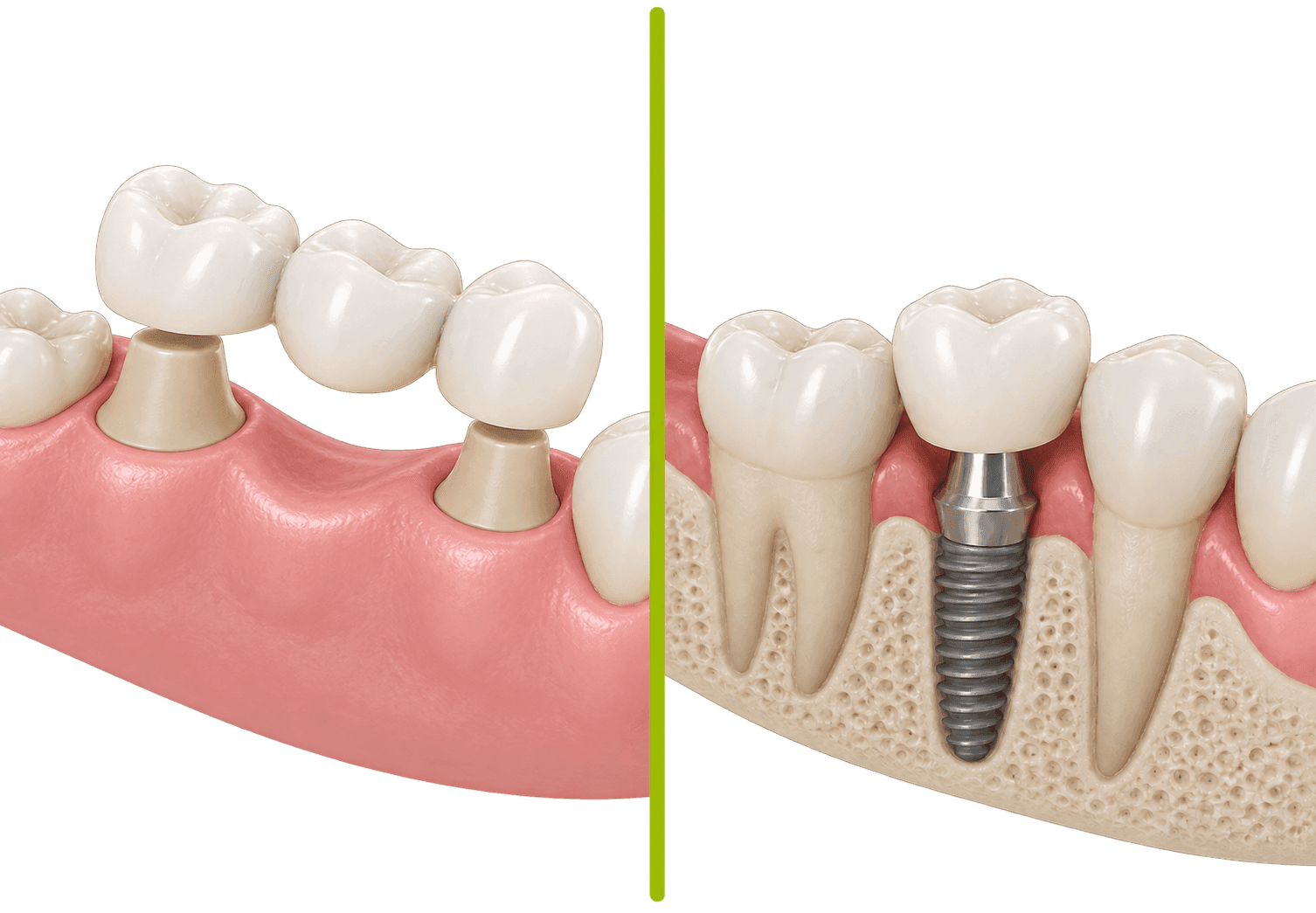
To replace a missing tooth, both a dental implant and a dental bridge can fill the gap. The key difference lies in how they fulfil this function. The implant replaces the root of the missing tooth and supports an individual crown, without the need to grind down the neighbouring teeth. A conventional bridge is usually supported by the teeth on either side of the gap, which must be prepared to support the restoration.
Dental implant vs dental bridge: what’s the difference?
The key difference is that an implant replaces the tooth entirely, from root to crown, whilst a bridge uses the neighbouring teeth to bridge the gap left by the missing tooth. From the perspective of preserving healthy tissue and bone, the implant is the preferred solution.
What is a dental bridge?
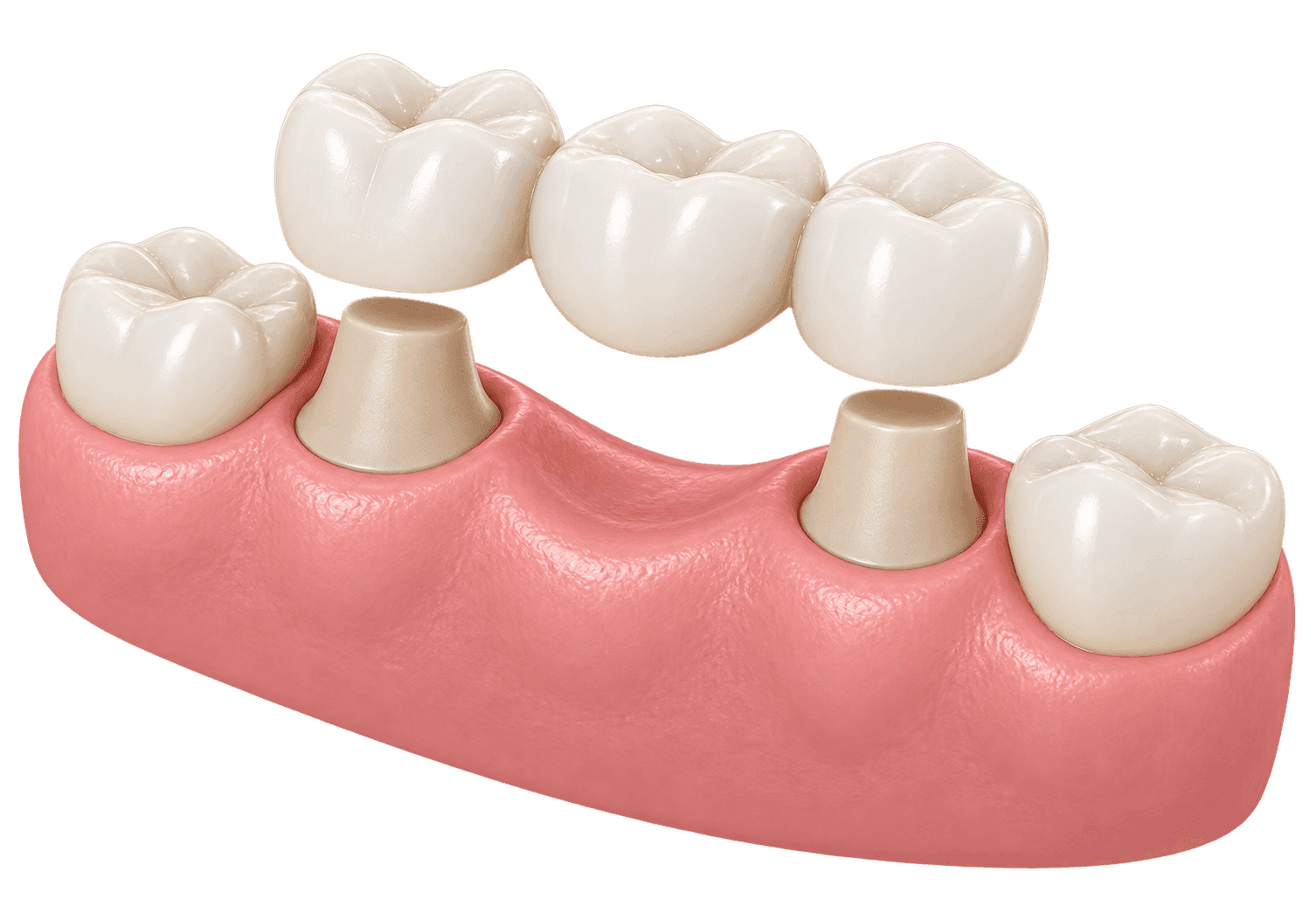
A conventional dental bridge is a fixed prosthetic restoration consisting of one or more crowns that replace missing teeth, supported by abutments fixed to the adjacent teeth. To fit the bridge, these teeth are ground down, even if they are healthy and have no extensive restorations. Once removed, healthy tooth tissue does not regenerate.
A dental bridge replaces the visible part of the tooth, but not the root. Because the bone in the area of the missing tooth is no longer stimulated, it may recede over time. As the bone recedes, the gum may also recede, and gaps may appear beneath the bridge where food debris can accumulate. In such situations, the restoration may require adjustments or even replacement.
What is a dental implant?
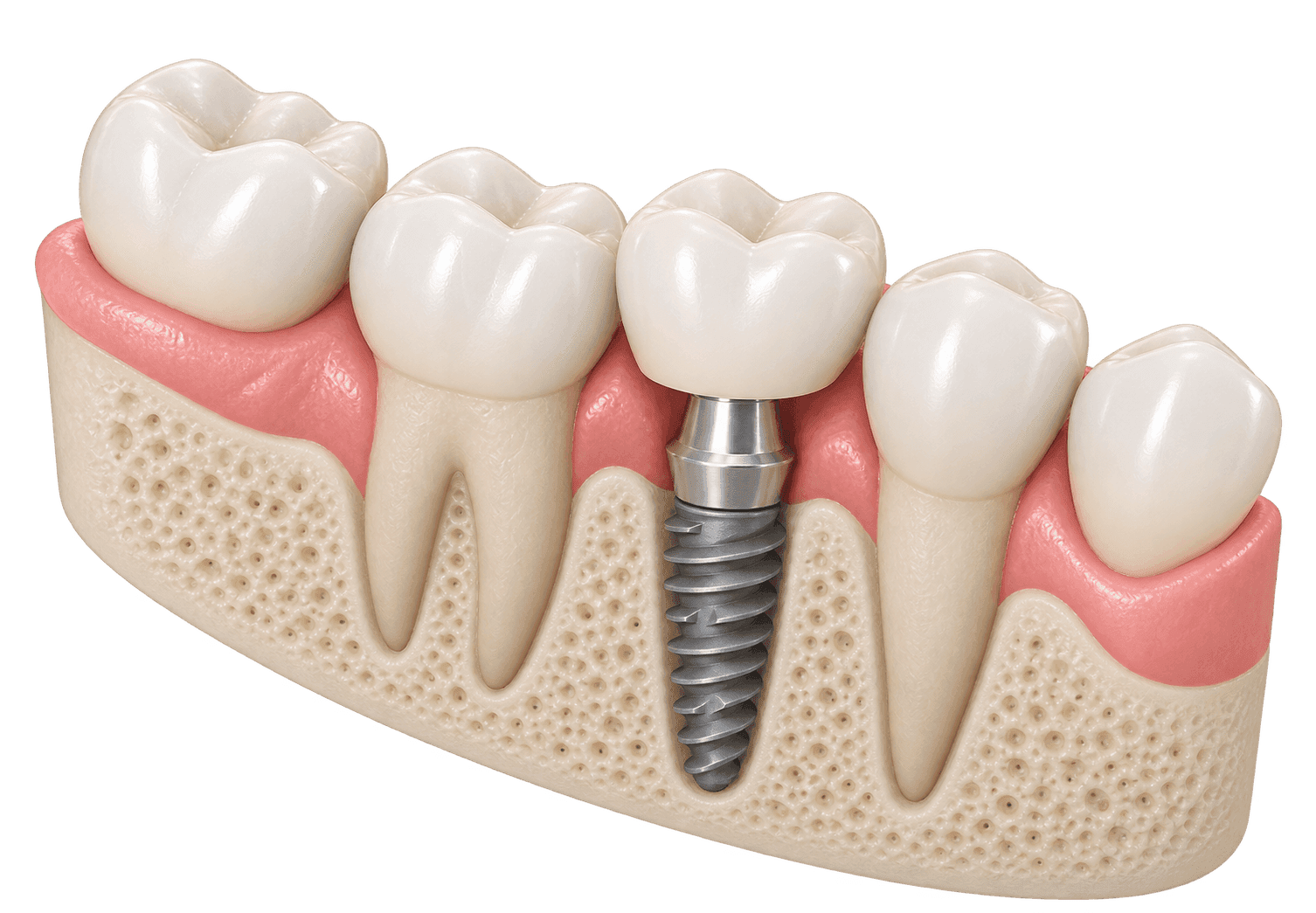
A dental implant is a component, usually made of titanium, which is inserted into the bone to replace the root of a lost tooth. Once it has integrated with the bone, the implant supports a custom-made dental crown. Neighbouring teeth remain untouched unless they require further treatment.
The dental implant replaces the missing tooth root and helps to preserve the bone in that area. At the same time, the neighbouring teeth remain untouched. This is one of the main advantages of an implant over a dental bridge.
| Criterion | Dental implant | Conventional dental bridge |
|---|---|---|
| Support | Directly into the bone; supports a single crown | On the adjacent teeth, which support the element replacing the missing tooth |
| Adjacent teeth | Do not need to be ground down if they are healthy | They are prepared for crowns |
| The bone in the area of the missing tooth | Receives load via the implant; a healthy implant can help maintain bone | It is not directly stimulated by the root or the implant |
| Type of procedure | Surgical and prosthetic | Prosthetic; usually without surgical insertion |
| Approximate duration | From a few months; may take longer if bone grafting is required | Usually a few weeks, depending on the case and the laboratory |
| Initial cost | Usually higher; includes distinct components and stages | May be lower initially, but retreatment of the abutment teeth and restoration of the work may increase the total cost |
| Hygiene | Brushing and interdental cleaning around the crown | Requires special cleaning, including beneath the bridge body |
Advantages and disadvantages: dental implants versus dental bridges
In the long term, dental implants offer several benefits for oral health. They replace the root of the missing tooth and do not require the adjacent teeth to be ground down. A dental bridge covers the gap left by the missing tooth, but it is supported by the neighbouring teeth and does not replace the root.
Advantages and disadvantages of a dental bridge
Possible advantages
- treatment can be completed more quickly than a staged implant procedure;
- it does not involve inserting an implant into the bone;
- it may be considered when the adjacent teeth are already indicated for crown restoration;
- it may have a lower initial cost, depending on the extent and material of the restoration.
Limitations
- it requires the removal of a certain amount of tissue from the abutment teeth;
- the prepared teeth may develop biological complications over time, such as secondary caries or pulp damage;
- it does not replace the root and does not directly stimulate the bone in the area of the missing tooth;
- it is more difficult to clean underneath the bridge;
- a problem with one of the abutment teeth can affect the entire restoration.
- Gum recession and ongoing bone resorption in the area of the missing tooth can create gaps beneath the restoration and may necessitate its replacement;
- tooth decay, pulp damage or a fracture of a supporting tooth may require root canal treatment, reconstruction or replacement of the bridge.
Advantages and disadvantages of dental implants
Advantages
- It replaces the missing tooth independently, without the need to grind down healthy neighbouring teeth;
- it provides direct support in the bone and transmits chewing forces to it;
- allows for an individual crown, with access for cleaning that is closer to that of a natural tooth;
- can have good long-term survival when the indication, placement and maintenance are correct.
Limitations
- involves surgery and a healing period;
- is not automatically suitable for all patients; general health, oral health, habits such as smoking and local anatomy are all factors;
- may require bone grafting or other additional procedures;
- the initial cost is often higher;
- biological or technical complications may arise, including peri-implant inflammation, bone loss or loosening of components.
How does the procedure for an implant differ from that for a dental bridge?
The implant procedure is more complex and requires a healing period, but it treats the edentulous space on an individual basis. A bridge can be fitted more quickly, but this speed is achieved by preparing the adjacent teeth and does not address the lack of a root in the bone.
Stages of dental implant treatment
- Consultation and diagnosis: clinical examination, X-ray and, where indicated, CBCT.
- Planning: assessment of the bone, gums, bite and position of the future crown.
- Site preparation: treatment of cavities, gum inflammation or infections; extraction and/or bone grafting, if necessary.
- Implant placement: the procedure is usually carried out under local anaesthesia.
- Healing and osseointegration: the bone fuses with the implant; the duration varies from case to case.
- Prosthetic stage: scan/impression, abutment and permanent crown.
For further details, see the Dental Implant page and the guide to the stages of dental implant treatment.
Stages in the fabrication of a dental bridge
- Assessment of the abutment teeth, gums, bite and edentulous space.
- Treatment of any problems with the teeth that will support the restoration.
- Preparation of the abutment teeth and taking a scan or impression.
- Fitting a temporary restoration, if indicated.
- Fitting, adjusting and cementing the permanent bridge.
If one of the abutment teeth has deep caries, an infection or an uncertain prognosis, the treatment plan must be reassessed. A bridge functionally connects several teeth, and the condition of each abutment tooth influences the entire restoration.
Dental implants vs dental bridges: cost differences
Comparing only the initial cost can be misleading. An implant may involve a higher initial investment, but it replaces the missing tooth on its own and avoids the need for treatment on neighbouring healthy teeth. A bridge may seem more affordable at first, but the long-term cost may include root canal treatment, reconstruction of the supporting teeth and the replacement of the entire bridge.
| Cost factor | Dental implant | Conventional dental bridge |
|---|---|---|
| What is included | Implant, abutment, crown, investigations and check-ups; sometimes bone grafting | Crowns on the abutment teeth and the intermediate element(s) |
| What can increase the cost | Bone deficiency, extractions, periodontal treatments, materials and complexity | Number of teeth, endodontic treatments, reconstruction of abutment teeth |
| Long-term outlook | Adjacent teeth remain independent; maintenance and possible crown repairs are required | Tooth decay, pulp damage, fracture or loss of a supporting tooth may require retreatment and replacement of the entire bridge |
The final price can only be determined following diagnosis and a treatment plan.
See the latest prices for dental implant treatments and the payment options available at DENT ESTET clinics.
How long does a dental implant last compared to a dental bridge?
Neither the implant nor the bridge has a guaranteed lifespan. Longevity depends on the diagnosis, the material used, the precision of the work, the position of the tooth, masticatory forces, oral hygiene, smoking, bruxism, general health conditions and adherence to regular check-ups.
The implant itself can remain functional for many years, but the crown on the implant is a prosthetic component and may require repair or replacement. In the case of a bridge, the prognosis depends both on the restoration itself and on the health of each supporting tooth.
What does the literature say?
A systematic review comparing fixed restorations estimated a 10-year survival rate of approximately 89 per cent for both conventional tooth-supported bridges and individual implant-supported crowns. However, the types of complications differed: caries and loss of pulp vitality were predominant with bridges, whilst more technical complications, such as ceramic chipping or loosening of screws, were reported with implant-supported restorations. These results show that the choice should not be reduced to the question ‘which lasts longer?’, but should be based on the biology and risks of the individual case.
The data are estimates based on patient cohorts and do not predict an individual’s outcome. Current standards emphasise risk assessment, correct implant placement, tissue health and maintenance.
How do you look after a dental implant and a dental bridge?
Both types of restoration require oral hygiene and check-ups, but a bridge is more difficult to clean beneath the component that covers the gap left by the missing tooth. An implant allows for the care of an individual crown and the separate monitoring of the replaced tooth.
Care of dental implants
- brushing twice a day, paying particular attention to the gum line;
- interdental cleaning using individually recommended methods: interdental brushes, dental floss or an oral irrigator;
- professional cleanings and check-ups at intervals determined by your dentist;
- attend a check-up if you experience bleeding, swelling, an unpleasant taste, looseness or discomfort.
Implants do not develop caries, but the surrounding tissues can become inflamed. Uncontrolled bacterial plaque can lead to peri-implant mucositis and, in some cases, peri-implantitis, associated with bone loss.
How to clean a dental bridge properly
- careful brushing of the crowns and the gum line;
- use of special floss or a flossing tool to pass floss under the bridge abutment;
- interdental brushes of the size recommended by your dentist;
- regular professional cleanings and checks on the abutment teeth.
Why regular check-ups are important
Some problems develop with subtle symptoms. The dentist can identify inflammation, changes in the gums, decay at the edge of a crown, changes in bite alignment or loosening of a component before these compromise the treatment. The frequency of check-ups is determined by individual risk, not by a standard rule that applies to all patients.
When is a dental implant recommended, and when might a dental bridge be the preferred option?
| Clinical presentation | Possible course of action | Why |
|---|---|---|
| The adjacent teeth are healthy, and the bone allows for treatment | Dental implant | Preserves the dental tissue of the adjacent teeth and independently replaces the missing tooth |
| The adjacent teeth already have crowns or there is a clear indication for a restoration | A compromise option, to be considered only on a case-by-case basis | Even in this situation, the prognosis for each abutment and the risk of retreatment must be carefully assessed |
| Reduced bone volume | Complex implant assessment or prosthetic alternative | Bone augmentation may be necessary; the decision depends on the anatomy and the patient’s preferences |
| Temporary contraindication or increased medical/surgical risk | Postponement, preparatory treatment or alternative | Patient safety and risk factor management take priority |
| Poor oral hygiene or active periodontal disease | Treatment and stabilisation prior to definitive restoration | Both the implant and the supporting teeth require healthy tissues and maintenance |
Dental bridge or implant? The dentist’s recommendation
“At DENT ESTET clinics, a dental implant is the recommended solution for replacing a missing tooth where there is a medical indication. A conventional dental bridge is considered a compromise solution and is not usually recommended: it involves the irreversible grinding down of neighbouring teeth, does not replace the root and does not prevent bone resorption in the area of the missing tooth. Over time, the abutment teeth may require further treatment, and damage to one of them may necessitate the reconstruction of the entire restoration.” – Dr. Ionela Dumitru

Conclusion: dental implant or bridge – how do you choose?
A dental implant is generally the healthier option in the long term. It protects neighbouring teeth and helps to preserve the bone in the treated area. If an implant cannot be fitted, the dentist will recommend a suitable alternative. The decision is made following a consultation and the necessary investigations.
Book a consultation at DENT ESTET clinics for a personalised treatment plan.
Bibliography
- International Team for Implantology (ITI), Effect of Dental Implant Therapy on the Preservation of Orofacial Tissues – Consensus Statements, 2023
- Pjetursson BE et al. Comparison of survival and complication rates of tooth-supported fixed dental prostheses and implant-supported reconstructions. Clinical Oral Implants Research, 2007.
- Avila-Ortiz G, Chambrone L, Vignoletti F. Effect of alveolar ridge preservation interventions following tooth extraction: systematic review and meta-analysis. Journal of Clinical Periodontology, 2019.
- Pulpal and Periapical Status of Vital Teeth Used as Abutments for Fixed Prostheses – systematic review and meta-analysis, 2021.