




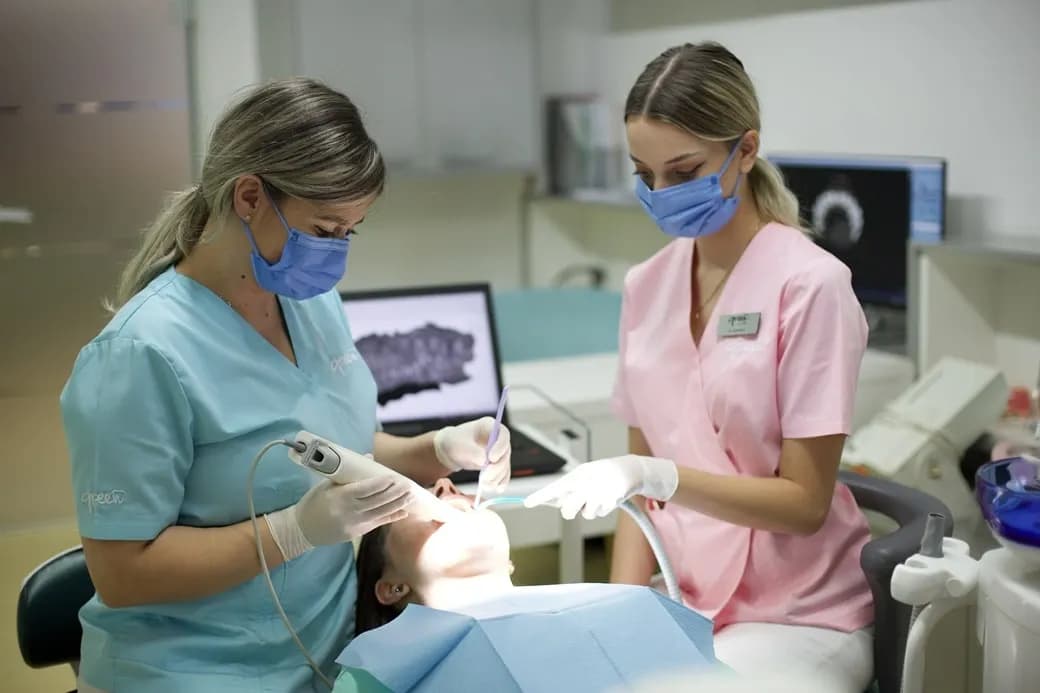
Dental implant treatment for patients with complete edentulism
 Author: Dr. Marina Băjinaru
 June 24, 2026
Total edentulism refers to the loss of all teeth in both jaws and is caused, primarily, by untreated dental conditions and systemic diseases that lead to the complete loss of teeth in both dental arches.
The most common causes of total edentulism are:
- periodontal disease;
- severe tooth decay;
- trauma;
- general and systemic diseases: diabetes, osteoporosis, immune disorders, which affect blood circulation and the quality of the jawbone
- lifestyle factors: smoking, poor oral hygiene and a diet low in nutrients significantly increase the risk of tooth loss.
Why is dental implant treatment important?
Total edentulism has a profound impact on quality of life, affecting essential functions such as chewing and speaking, as well as physical appearance.
Impact on chewing
As far as chewing is concerned, the absence of teeth reduces the ability to break down and fragment food. For this reason, people may end up avoiding solid, fibrous or hard foods (meat, raw vegetables, fruit).
Furthermore, swallowing food that has not been chewed properly puts a strain on the stomach and disrupts digestion.
Impact on speech
The absence of teeth also affects speech (phonation), as it prevents the tongue and lips from being positioned correctly.
Pronouncing labiodental (F, V) and linguodental (T, D, S) consonants becomes extremely difficult, and the uncontrolled flow of air through the oral cavity produces a hissing sound whilst speaking.
Aged appearance
In terms of facial appearance, missing teeth lead to resorption of the jawbone, sagging of the lips and a prematurely aged appearance of the face.
Treatment options for complete edentulism
Treatment options for complete edentulism fall into two main categories, depending on the method of attachment:
- fixed implant-supported solutions (the ideal method)
- removable or adjustable solutions (more affordable, but with many drawbacks)
Removable dentures
Traditional full removable dentures, commonly known as ‘denture plates’, are removable medical devices made entirely of acrylic, used to replace all the teeth in one arch. They are held in place by suction and can be removed and cleaned by the patient every evening.
| Advantages | Disadvantages |
| Affordable price – this is one of the most affordable solutions for replacing all the teeth in one arch. | Reduced stability – the lower denture in particular may shift whilst speaking, laughing or chewing. |
| No surgery required – no dental implants or bone healing periods are needed. | Less efficient chewing – chewing force can be reduced by up to 70–80% compared to natural teeth, making it difficult to eat hard or sticky foods. |
| Quick to fit – treatment is usually completed in a few appointments (impression taking, fittings and adjustment). | May affect taste and speech – the upper full denture covers the palate, which may reduce the sense of taste and temporarily alter the pronunciation of certain sounds. |
| Does not prevent bone resorption – in the absence of stimulation from natural roots or dental implants, the bone continues to resorb over time. In advanced stages, bone atrophy can make implant-supported prosthetic treatments more complex or may require additional bone augmentation procedures. |
Fixed implant-supported prostheses
Fixed implant-supported prostheses are permanent prosthetic solutions, either screw-retained or cement-retained, on a support consisting of several dental implants (usually between 4 and 6 implants per arch). They completely replace the missing teeth. The restoration is firmly fixed in the dental surgery and can only be removed by the dentist for regular professional cleaning.
| Advantages | Disadvantages |
| Absolute stability: The prosthesis does not move, slip or come loose whilst chewing or speaking. | The cost may seem high. |
| Natural chewing: Over 90% of chewing strength is restored, allowing the consumption of hard foods (meat, apples, nuts). | Surgical treatment: Requires at least one surgical procedure to insert the implants, with the associated risks and contraindications (e.g. decompensated chronic diseases). |
| Maximum comfort: Does not cover the roof of the mouth (palate), preserving the sense of taste, the temperature of food and a natural feeling. | Rigorous hygiene: Requires extremely thorough daily cleaning at home, with the mandatory use of a mouthwash to prevent infections (peri-implantitis). |
| Prevention of bone resorption: Implants stimulate the jawbone in exactly the same way as natural roots, halting its recession and atrophy. | |
| Exceptional aesthetics: They restore the natural appearance of the face and provide a genuine smile, significantly boosting self-confidence. |
Modern dental implant systems
Modern dental implant systems offer a fixed solution for replacing all the teeth in an arch. Depending on the clinical situation, the dentist may recommend treatments such as All-on-4® or All-on-6®, tailored to each patient’s needs.
The All-on-4 implant system
The modern All-on-4 system is a surgical technique that enables the complete restoration of an edentulous arch using just four dental implants.
Two implants are placed vertically in the front, whilst the other two are inserted at an angle (up to 45 degrees) in the side areas. This strategic angulation makes the most of the strong natural bone and avoids sensitive anatomical structures (such as the maxillary sinuses or the alveolar nerve).
The system allows a temporary fixed denture to be fitted within just 24–48 hours of surgery.
Advantages of All-on-4:
- Fixed dentures in 24 hours: The patient leaves the clinic the very next day with a functional and aesthetically pleasing fixed denture (temporary restoration), without spending a single day without teeth.
- Avoids the need for bone grafts: As the implants are placed at an angle in areas of maximum bone density, complex and costly bone augmentation or sinus lift procedures are avoided in most cases.
- More cost-effective than conventional systems: As it uses fewer implants and eliminates the need for bone augmentation, the total cost is lower compared to a traditional restoration using 6–8 straight implants.
Disadvantages of All-on-4:
- The All-on-4 implant system is not recommended for patients who suffer from bruxism or have very soft bone in the upper jaw.
The stages of dental implant treatment
Dental implant treatment is planned in stages, from the initial assessment through to the fitting of the final restoration. Each stage is designed to ensure the integration of the implant and a long-term functional and aesthetic outcome.
Consultation and CBCT (Computed Tomography)
Before deciding whether dental implant treatment is suitable for you, a clinical assessment is required. The dentist examines the condition of your gums, oral mucosa and remaining teeth (if any), as well as your medical history (chronic conditions, medication).
In the next stage, radiological investigations are recommended:
Three-dimensional digital radiography (CBCT), a mandatory examination, which provides accurate images of the jawbone, measuring its length, width and density.
CBCT allows for the precise localisation of the maxillary sinuses and the inferior alveolar nerve to avoid damaging them during surgery.
Digital planning
Using specialised dental software, the dentist uploads the computed tomography (CBCT) scan and the digital scan of the dental arches.
Based on this data, a surgical guide is created – a plastic template produced using 3D printing. This is placed on the patient’s gum during the operation and guides the insertion of the implant exactly into the position simulated on the computer, eliminating human error.
Implant placement
Dental implant placement is carried out via surgery under local anaesthesia. After preparing the bone, the dentist inserts the implant into the position determined during the digital planning stage.
Depending on the complexity of the case, the procedure can take between 30 and 90 minutes.
Temporary prosthesis
In certain situations, where immediate loading is recommended, the patient may receive a temporary restoration immediately after the implant is placed.
This serves both an aesthetic and functional purpose during the osseointegration period, allowing the patient to smile and carry out their daily activities with greater comfort.
Final prosthesis
Once the osseointegration process is complete, the implant is ready to support the final restoration.
The crown or final prosthetic restoration, in the case of treatment with the All-on-4 implant system, is custom-made to blend harmoniously with the rest of the dentition and ensure optimal long-term functionality.
Adaptation period
After the final restoration has been fitted, a settling-in period is required during which the patient gets used to the new dental restoration. Regular check-ups and following the dentist’s advice help to maintain the health of the implant and ensure the long-term success of the treatment.
Frequently asked questions about dental implants
Can I have implants fitted if I no longer have any teeth?
Yes. Treatment using the All-on-4 implant system is the treatment of choice for patients with complete edentulism.
How long does dental implant treatment take?
The actual surgical procedure for the All-on-4 system takes between 2 and 3 hours per arch.
Is the All-on-4 treatment painful?
No, the All-on-4 treatment is not painful during the surgical procedure, and any post-operative discomfort is fully manageable with medication.
What is the difference between All-on-4 and All-on-6?
The main difference between the two systems lies in the number of implants used (4 vs. 6) and in the way masticatory forces are distributed across the jawbone.
How long do dental implants last?
Under optimal conditions, a high-quality dental implant has a lifespan of 25 years or may even last a lifetime. Statistics show that the success and survival rate of implants after 10 years is over 93%–96%.
What is the warranty on dental implants?
The warranty for dental implants is the manufacturer’s warranty on the material. As the human body is a living organism, it is not possible in medicine to offer a 100% biological guarantee.