




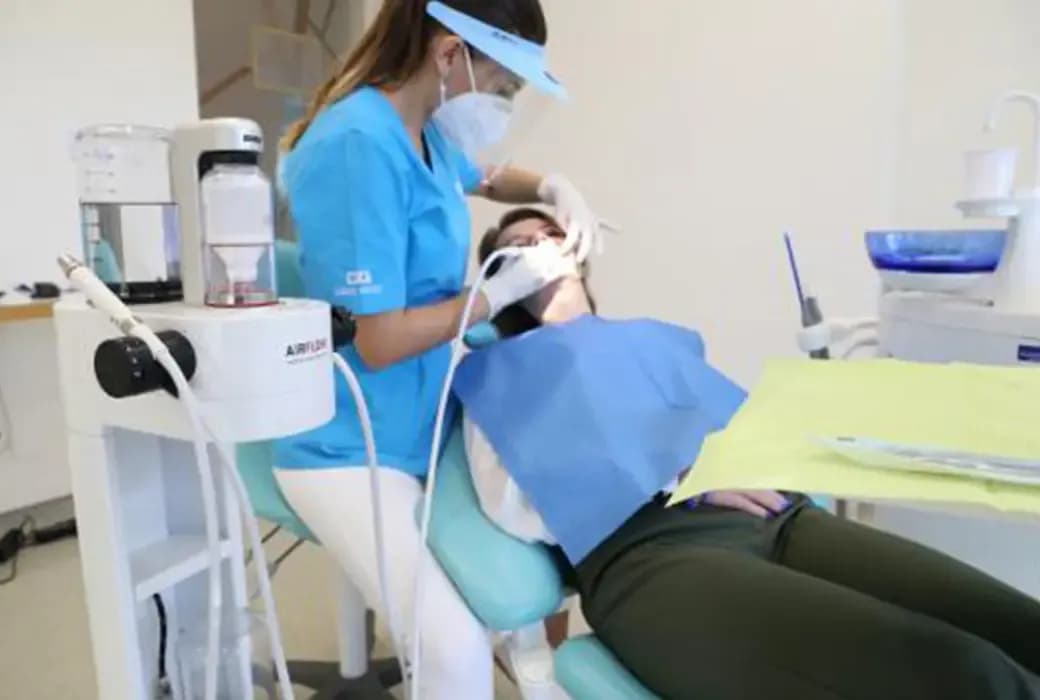
Innovation in dental care
 Author:
  November 8, 2022
The difference between GBT and traditional professional cleaning
If a smile is the universal language of happiness, the mouth is the gateway to overall health.
In fact, the mouth is an entire microbial ecosystem, known as the human oral microbiome, populated by over 6 billion bacteria, comprising 700 different species, in a single person, according to specialist studies.
These bacteria play an extremely important role in maintaining optimal oral and general health. Some of the bacteria in the oral cavity, namely pathogenic bacteria, once deposited on the teeth and in the supporting tissues (gums), can contribute to the development of dental caries and periodontal diseases (gum inflammation, cysts, abscesses) and, if left untreated, can even lead to the loss of teeth from the dental arch.
Furthermore, if an infection develops in the oral cavity, there is a risk that it may be carried into the bloodstream and to various vital organs, adversely affecting the body’s general health.
Therefore, to ensure we stay healthy, it is important to adopt a preventive approach to dental health. And the first step is a daily oral hygiene routine at home, carried out correctly by brushing twice a day for at least 2 minutes and using auxiliary cleaning methods such as dental floss, mouthwash and a water flosser.
However, even though we clean our teeth responsibly, we cannot completely remove bacterial plaque from our teeth. It is estimated that 1 mm of bacterial plaque contains over 2 million bacteria. Thus, if left unremoved, it will promote the formation of tartar and various conditions affecting the teeth and gums.
That is why it is important to include regular check-ups at the dentist and a professional cleaning session every six months as preventive measures, during which the dentist or dental hygienist carries out a professional cleaning of the mouth, removing tartar and leaving the teeth healthy and bright.
Although there are numerous specialist articles and information campaigns on the importance of the tooth-cleaning routine at home and at the dentist’s surgery, there are still many patients who visit the dentist due to severe toothache or a dental emergency caused by an infection.
Advances in dental technology offer patients the benefit of highly effective professional cleaning treatments that are completely pain-free.
What is GBT (Guided Bacterial Plaque Therapy)?
Developed by EMS Dental, Guided Bacterial Plaque Therapy (GBT) is a Swiss innovation that has enabled dental hygienists and dentists to transform the patient experience of professional prophylaxis, completely eliminating pain and discomfort.
GBT is a minimally invasive and gentle technology that can be successfully used for patients with periodontal conditions, those wearing braces, those with prosthetic treatments (crowns, veneers) and even those with dental implants.
The aim of GBT is to remove bacterial plaque from the teeth and gums to prevent the development of caries and periodontal disease.
The treatment protocols are safe, offer the highest level of patient comfort, have proven efficacy backed by international studies, and are performed using minimally invasive techniques under conditions of maximum safety for the patient.
GBT uses AirFlow technology to remove bacterial plaque from the oral cavity, ensuring maximum safety and a very comfortable experience for the patient.
The differences between GBT and traditional professional cleaning
GBT
- Painless, very useful for patients with sensitive teeth;
- The methods can be used on implants, prosthetic work and dental braces;
- The scaling tip is also coated with Teflon, allowing for the cleaning of implants;
- Airflow penetrates up to 9 mm subgingivally on teeth, implants or in interdental spaces;
- Airflow can be used on the mucosa and tongue, where large numbers of bacteria are found;
- Heats water to 25, 30, 35 and 40 degrees;
- Used in the treatment of mucositis or peri-implantitis;
- Minimal aerosol dispersion;
- Airflow effectively cleans interdental spaces and is recommended for teeth with exposed furcations;
- It begins with staining of the bacterial plaque, followed by the use of the airflow, and finally scaling, without the need for manual tooth brushing.
CLASSIC CLEANING
- Tooth sensitivity may occur during or after scaling;
- The use of airflow or scaling on implants is not recommended;
- Traditional scaling instruments cause damage to implant surfaces;
- Classic airflow can damage the gums if inserted subgingivally;
- Classic airflow is used only on teeth, not on soft tissues;
- It does not heat the water;
- It is not used on implants;
- Higher aerosol dispersion;
- Cleaning at the furcation level is reduced;
- Scaling is performed first, followed by Airflow, and finally tooth brushing.
How GBT works
- An assessment of the oral cavity is carried out to identify any dental caries or periodontal conditions. This enables the dental hygienist or dentist to determine the patient’s treatment needs.
- To identify all bacterial plaque on the teeth and below the gumline, a plaque disclosing agent is used. This allows both the hygienist and the patient to see exactly where the plaque is deposited and the surface area it covers.
- Depending on the patient’s needs, three types of technology are used in combination during the GBT procedure to ensure the success of the treatment: AIRFLOW®, PERIFLOW® and PIEZON® PS No Pain.
- The procedure concludes with a post-treatment reassessment, and the teeth are treated with a fluoride varnish.
- The next prophylaxis appointment will be scheduled on the dentist’s recommendation, based on the clinical oral examination and any conditions identified. This usually takes place every 6 months.