




 Author:
  December 22, 2025
For many of us, a visit to the dentist is associated with discomfort, but modern technology is completely transforming this experience. Laser dentistry offers minimally invasive, safe and highly effective procedures.
Today, dental treatments using lasers are far more precise and offer a higher level of comfort for the patient. Furthermore, the dental laser accelerates the healing process thanks to its extraordinary ability to achieve haemostasis and reduce inflammation.
Thanks to its benefits, the laser is now used in a wide range of dental treatments, from implantology and periodontology to cosmetic dentistry and paediatric dentistry.
What is a dental laser and how does it work?
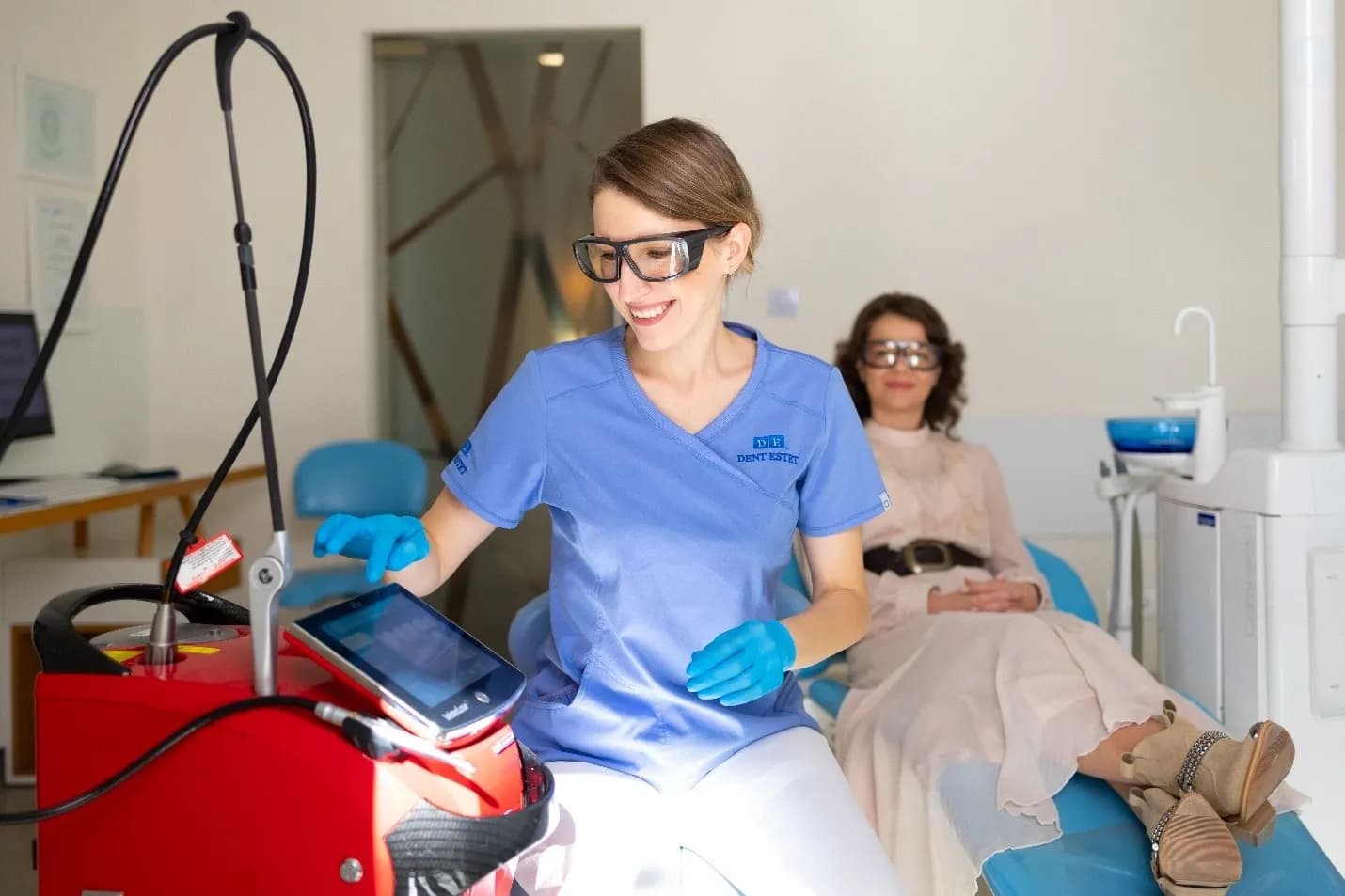
The dental laser is a modern technology used by DENT ESTET specialists for treatments involving both soft tissues (gums, oral mucosa) and hard tissues (teeth, bone). It works by emitting a controlled beam of light, which acts precisely on the treated area, allowing the affected tissue to be removed or reshaped and accelerating the healing process.
“The focused laser beam allows for extreme precision, targeting exactly the problem areas whilst protecting the healthy structure of the tooth and soft tissues. This means smaller incisions during surgical procedures and a lower risk of losing hard tooth structure during fillings. The laser’s precision means that in most cases anaesthesia is not required, thereby reducing post-operative discomfort,” explains Dr Cristina Stănescu, a specialist in periodontology at DENT ESTET clinics.
Waterlase and Biolase lasers
At DENT ESTET clinics, we use the world’s most advanced laser technologies – Waterlase and Biolase.
Waterlase is a dental laser designed to act precisely and gently on dental tissues. It features technology that combines light energy with a fine spray of water, allowing tissues to be cut and shaped without direct contact and without excessive heat.
“The Waterlase system allows us to perform various types of procedures without using a drill or scalpel, which means reduced discomfort for patients and a reduced need for anaesthesia,” explains Dr Cristina Stănescu.
The Biolase laser belongs to the diode laser category, which has a shorter wavelength than that used in Waterlase, and is recommended for soft tissue procedures, pain management and teeth whitening treatments.
Types of laser dental treatments
As mentioned, the benefits offered by the use of dental lasers make this technology widely applicable in periodontal, implant, surgical and cosmetic dental treatments, as well as in paediatric dentistry.
Laser teeth whitening
If a bright, white smile is on your wish list, laser teeth whitening is a safe procedure that offers immediate and long-lasting results.
The laser teeth whitening procedure involves applying a hydrogen peroxide-based gel, with a concentration of between 25–40%, which is activated by the laser. The time required to achieve long-lasting results is much shorter – just 30 minutes – compared to traditional techniques (UV lamp), and only a single session is needed.
The price of the laser teeth whitening procedure depends on the type of laser used and the kit recommended by the manufacturer. At DENT ESTET clinics, it can range from 1,700 to 1,800 RON.
Dental implants – laser treatment
The Waterlase laser can also be used successfully for dental implants, in the treatment of peri-implantitis, an infection affecting the soft tissues and bone surrounding the implant.
“In these cases, the dental laser effectively cleans and decontaminates the dental implant, protecting the adjacent soft tissues. Furthermore, studies have shown that, through its antibacterial and biostimulating effects, the laser can reduce bleeding and promote the remineralisation of the bone adjacent to the implant. In cases of advanced peri-implantitis, where implant removal is necessary, the laser helps us perform this procedure in a minimally invasive manner, to preserve as much of the bone support required for future rehabilitation as possible. Post-operative discomfort is reduced, and healing is rapid and pain-free,” explains Dr Cristina Stănescu.
The cost of treating an implant with a dental laser can range from 240 to 650 RON per implant and varies depending on the type of laser used and the extent of damage to the dental implant.
Dental laser surgery
The dental laser can also be used in certain surgical procedures, with the advantage of ensuring rapid healing with minimal discomfort.
“In periodontal treatments, the laser is used to decontaminate periodontal pockets and reduce inflammation and gum bleeding through its antibacterial effect. The American Academy of Periodontology supports the use of lasers in periodontal treatments, as they are able to eliminate bacterial load and stimulate the regeneration of periodontal tissues,” explains Dr Cristina Stănescu.
The dental laser also proves extremely useful in performing soft tissue biopsies. The procedures are quick, precise, do not require the use of a scalpel, and result in rapid healing for the patient.
Other dental laser treatments include frenectomy, exposure of impacted teeth, and gingival tissue remodelling for prosthetic purposes.
Minimally invasive treatments for sensitive teeth and dental caries
For patients with sensitive teeth or those suffering from tooth decay, laser treatments can make a visit to the dentist much more comfortable. In many cases, the laser allows tooth decay to be treated without a drill and, sometimes, even without anaesthesia, significantly reducing the discomfort associated with traditional procedures.
Another important advantage is the absence of the vibrations and noise typical of a drill, a factor that matters greatly to anxious patients or those who fear dental treatment.
By sterilising the treated area, the risk of the cavity returning is reduced, and the treatment process becomes safer and gentler. This is precisely why the laser is a modern and effective solution for patients seeking minimally invasive treatments with a high level of comfort.
Gum corrections and orthodontic treatments
The dental laser is a key ally when gum corrections are required, offering clear benefits in terms of comfort and aesthetics. Procedures such as gingivectomy, performed to reposition the gums and better expose the tooth, can be carried out using the dental laser in a much gentler manner compared to using a scalpel.
The dental laser allows for precise reshaping of the gums, with minimal bleeding, a reduced risk of infection and faster healing, so that patients can resume their normal activities almost immediately.
Furthermore, laser dental treatments offer superior aesthetic results, as the gum tissue heals smoothly, without inflammation or prolonged discomfort.
In orthodontics, the dental laser is used to support treatment with braces. It can help accelerate tooth movement and reduce the pain or sensitivity that occurs after the braces are fitted. This makes the patient’s experience more comfortable, and in some cases the total duration of treatment can be reduced.
How to choose the right type of laser
A visit to the dentist is essential before any procedure involving the use of a dental laser. The consultation with the specialist and the results of the diagnostic tests will help establish a diagnosis so that the type of treatment best suited to you can be chosen.
Whether you choose the Waterlase laser, which features advanced technology for treating periodontal conditions and cavities, or the Biolase laser, which delivers excellent results in teeth whitening and treating tooth sensitivity, it is very important to follow your dentist’s advice and the treatment plan they have drawn up.
Recovery following laser treatments
The main advantages of dental laser therapy are:
- minimal pain and bleeding during and after the procedure
- reduced inflammation of the treated tissues
- faster healing compared to traditional methods
- a quick return to daily activities, without further discomfort
For optimal results, it is important that patients follow the dentist’s instructions after the procedure. Particularly in the case of gum treatments, oral hygiene should be carried out gently to protect the treated area during the healing process.
Frequently asked questions about laser dental treatments
What types of dental treatments can be carried out using a dental laser?
Lasers can be used for a variety of procedures, ranging from treating tooth decay to performing surgical procedures such as gingivectomy, frenectomy and biopsy, as well as for treating periodontal conditions and for effective, pain-free teeth whitening.
Is laser teeth whitening painful?
Thanks to the precision of the laser beam and the short exposure time, laser teeth whitening carries a low risk of post-treatment sensitivity.
How much does dental laser treatment cost?
Laser treatments vary depending on the type of laser used, as well as the procedure being performed. Please see the price list on the dentestet.ro website.
What are the advantages of the Biolase laser compared to the Waterlase?
Both types of laser offer numerous benefits. The Biolase laser is highly effective for teeth whitening, reducing tooth sensitivity, and treating oral lesions such as cold sores or mouth ulcers. On the other hand, the Waterlase laser reduces the risk of tissue overheating and is used successfully in gum tissue remodelling, periodontal treatments, peri-implantitis, and also in the treatment of dental caries.
Can lasers be used for dental implants and dental surgery?
Yes, the laser is an extremely valuable tool in dental surgery, reducing bleeding, post-operative discomfort and the risk of infection. The tissues treated by the laser heal much more quickly.
Bibliography
- The Difference Between WaterLase and BioLase, published on birchfamilydental.com
- R. De Moor 1, J. Verheyen, P. Verheyen - Laser Teeth Bleaching: Evaluation of Potential Side Effects on Enamel and Pulp and the Efficiency In Vitro and In Vivo, Dentistry Journal, 2024
- M. Ting, L. Alluri, J. Sulewski - Laser Treatment of Peri-Implantitis: A Systematic Review of Radiographic Outcomes, Dentistry Journal, 2022
- L. Sachelarie, R. Cristea, E. Burlui, L. Hurjui - Laser Technology in Dentistry: From Clinical Applications to Future Innovations, Dentistry Journal, 2024
- Waterlase Restorative Dentistry, published on biolase.com
- R. Elgadi, Y. Sedky, R. Franzen - The effectiveness of low-level laser therapy on orthodontic tooth movement: a systematic review, published on www.researchgate.net