




Restorative dentistry
 Author:
  November 8, 2022
What is endodontic treatment and what types are there?
Restorative dentistry is the branch of dentistry that deals with the diagnosis and treatment of dental caries, as well as the restoration of teeth affected by trauma.
Tooth decay is the most widespread chronic disease in the world and is considered a major global public health problem.
According to the International Dental Federation, almost half of the world’s population, namely 44%, suffers the consequences of untreated dental caries. Furthermore, globally, between 60% and 90% of schoolchildren are affected by dental caries.
Tooth decay – a threat to general health
Tooth decay is caused by a combination of factors. A lack of proper oral hygiene allows bacteria in the mouth to convert food debris into acids that attack the tooth enamel.
If plaque and tartar are not removed through correct daily brushing and professional cleaning at the dentist’s surgery, this promotes the development of tooth decay and periodontal disease.
Tooth decay does not heal on its own. If not detected in time and left untreated, decay progresses rapidly, affecting the structure of the natural tooth and potentially leading to tooth loss.
What is restorative dentistry?
As early-stage tooth decay can only be detected by a dentist, regular visits to the dental clinic are the only way to prevent deep cavities from forming.
Restorative dentistry involves restoring the structure and function of teeth affected by decay, as well as by fractures, lesions or dental trauma.
Endodontic treatments carried out by dentists specialising in restorative dentistry involve the removal of affected hard tooth tissue, cleaning the decayed surface, placing fillings and restoring the tooth.
Restorative dentistry – types of treatment
Endodontic treatment is tailored to the reason for the patient’s visit to the specialist in restorative dentistry.
Endodontic treatments to save a tooth affected by dental caries.
If left untreated, caries can progress rapidly and affect the dental pulp and nerve, at which point pain occurs.
Symptoms may vary depending on the affected area. You may experience tooth sensitivity, mild pain when eating sweet, cold or hot foods, sharp spontaneous pain or severe continuous pain.
To treat tooth decay, a dentist specialising in restorative dentistry may opt for several types of treatment.
Restorative filling
A composite filling is the most common method of restoring a decayed tooth. The dentist will clean the area where the decay has set in by removing the affected tissue and will fill the space with a biocompatible composite, which will restore the tooth’s functionality.
In the case of restorations on front teeth, to preserve the aesthetics of the smile, the composite will be a colour similar to that of the natural tooth.
Microscopic restoration
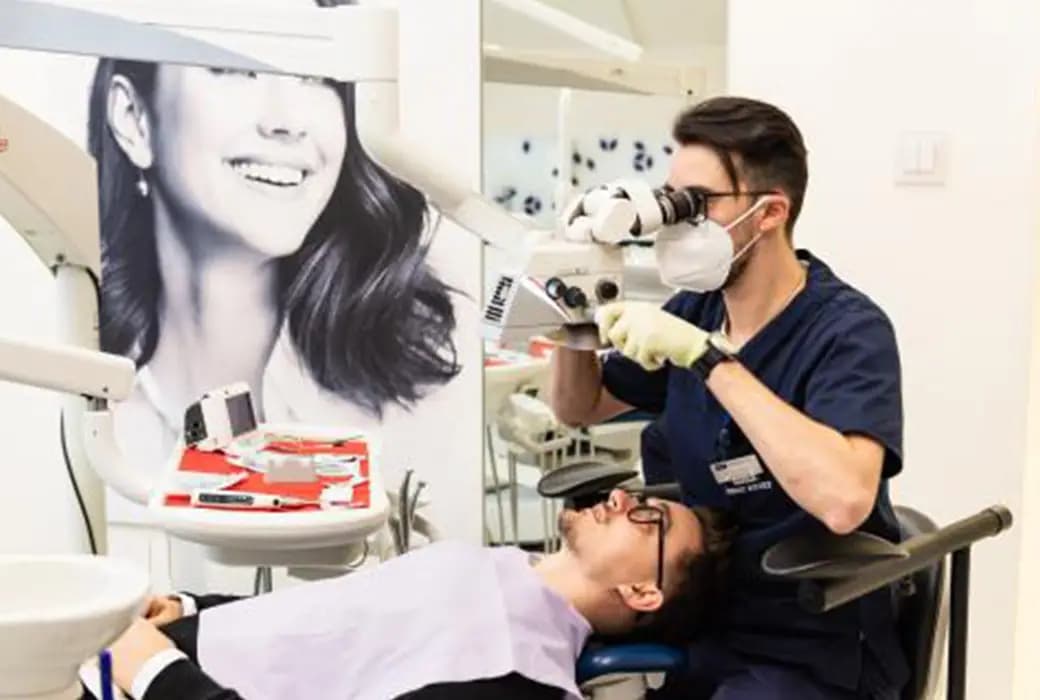
This type of endodontic treatment is performed using a dental microscope and allows the specialist in restorative dentistry to view the surface affected by caries with great precision, in order to accurately assess its extent and depth.
The Zeiss and Leica dental microscopes, used in DENT ESTET clinics, offer the possibility of magnifying the affected areas by at least 16 times, thereby increasing the success rate of root canal treatments.
Root canal filling under the microscope
When the tooth structure is destroyed by decay, this results in inflammation of the dental pulp and nerve. Root canal treatment primarily involves removing the nerve and sealing the tooth, with the specialist opting to restore the tooth using a prosthetic restoration such as a dental crown with a post or a dental inlay.
Dental treatments to save a tooth affected by dental trauma.
Dental trauma can be of three types:
- Fractures: enamel cracks, uncomplicated crown fracture, complicated crown fracture, root fracture, alveolar fracture;
- Dislocations: contusion, subluxation, extrusion, lateral dislocation, intrusion, avulsion;
- Injuries to the gums and oral mucosa: laceration (tissue tear), contusion, abrasion.
When dealing with enamel cracks or fractures, if the dental fragment is small, treatment involves smoothing the edges or filling them with composite material.
If the cracked or broken fragment is larger, with exposure of the dentine, the dental specialist will recommend medication to heal the wound and a stage of crown restoration.
The situation becomes more complicated in the case of root fractures (of the tooth root) or alveolar fractures, as endodontic treatment is required first. According to specialists, teeth with root fractures can rarely be saved. An apical resection, i.e. a surgical procedure to remove the affected portion from the tip of the root, may save part of the tooth.
If the tooth’s nerve is affected, an initial stage of endodontic treatment is also required. Subsequently, a root-crown device (pivot) can be fitted and a prosthetic restoration (dental crown) can be carried out.
The treatments used in restorative dentistry at the DENT ESTET clinic are supported by state-of-the-art, minimally invasive technologies, which aim to preserve as much of the natural tooth structure as possible.
Furthermore, these new technologies help patients to have a comfortable experience during dental treatment.