




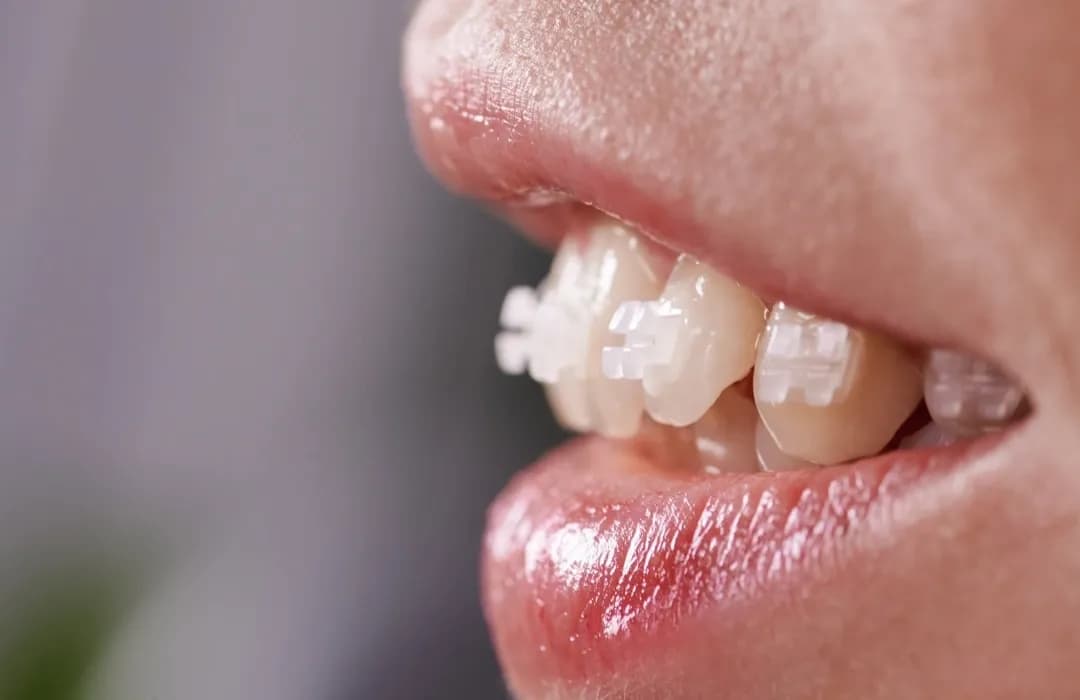
Sapphire braces: benefits, cost and recommendations
 Author:
  June 4, 2026
Sapphire braces are one of the most aesthetically pleasing fixed orthodontic solutions if you want to correct the position of your teeth without compromising the appearance of your smile during treatment.
Thanks to their benefits – transparency, precision and the effectiveness of a traditional fixed brace – sapphire braces are the preferred choice for adults and teenagers who prioritise aesthetics.
The benefits of sapphire braces
The main advantage of sapphire braces is their superior aesthetics compared to other types of fixed braces. Among the most significant benefits are:
- High transparency. Monocrystalline sapphire brackets are almost invisible on the teeth, making them ideal for patients who value aesthetics during treatment.
- Colour stability. Unlike ceramic brackets, sapphire crystals do not stain or discolour over time, maintaining a visually flawless appearance.
- Smooth and biocompatible surface. Sapphire is an extremely dense and durable material, with a fine texture that minimises the build-up of bacterial plaque and ensures comfortable contact with the oral mucosa.
- Orthodontic effectiveness. Like any fixed appliance, the sapphire brace applies a constant and controlled force to the teeth, enabling the correction of malocclusions ranging from moderate to complex, including crowding, rotations or bite problems.
- Discretion in everyday life. Thanks to its transparency, the sapphire brace is a popular choice amongst working adults who wish to undergo orthodontic treatment without any visible impact on their appearance. It is also a suitable option for teenagers who want braces that are as inconspicuous as possible, so they can feel more confident in their day-to-day interactions, at school or amongst their friends.
Sapphire vs ceramic braces
Both types of dental braces fall into the category of physiognomic (aesthetic) braces, but the differences are clear.
| Criterion | Sapphire braces | Sapphire braces |
| Material | Monocrystalline sapphire crystal | Polycrystalline ceramic |
| Transparency | High – almost invisible brackets | Brackets are white or tooth-coloured, but not transparent |
| Stain resistance | Does not stain or discolour over time | May stain with frequent consumption of coffee, tea or red wine |
| Mechanical strength | Durable, but more brittle on impact than metal | Similar to sapphire, slightly more prone to cracking |
| Comfort | Smooth surface | Slightly rougher surface |
| Price | Higher | Slightly more affordable |
| Recommended for | Patients who prioritise discretion | Patients seeking an aesthetic option at a lower cost |
Sapphire braces vs metal braces
Compared with metal braces, the differences are even more obvious:
| Criterion | Sapphire braces | Metal braces |
| Material | Single-crystal sapphire | Stainless steel or nickel-titanium alloys |
| Visibility | Very low – transparent | High – visible on the teeth |
| Strength | Strong, but more brittle on impact than metal | Very high |
| Comfort | Superior – smooth surface | May cause irritation to the cheeks and lips |
| Price | Higher than ceramic and metal braces | The most affordable option for fixed braces |
| Recommended for | Patients with aesthetic requirements, moderate or complex cases | Complex orthodontic cases |
Recommendations for use
Who is it recommended for?
Sapphire braces are suitable for most patients, but are particularly recommended in certain situations:
- Professionals who frequently interact with the public and for whom personal image is constantly important.
- Patients with moderate malocclusions who are not ideal candidates for clear aligners (mouth trays) or who prefer the stability and control of fixed braces to a removable device.
- Patients with metal allergies: As it is made from pure crystal, it is an excellent and safe option for people with various metal allergies or sensitivities.
A specialist in dento-alveolar orthodontics assesses each case individually and determines whether sapphire braces are the most suitable solution. The decision is made following a comprehensive orthodontic consultation, which includes a clinical examination, X-rays and a digital scan of the dental arches.
Care and hygiene recommendations
- Maintaining rigorous oral hygiene is essential throughout the entire course of treatment with fixed braces, including sapphire braces. Here are the most important recommendations:
- Brush after every meal – use a soft-bristled toothbrush or one specially designed to clean around the brackets and under the archwire.
- Dental floss and a mouthwash – dental floss with a stiff thread or a mouthwash are essential for cleaning the spaces between your teeth, which are inaccessible to a standard toothbrush.
- Avoid hard and sticky foods – such as nuts, hard sweets, toffee or crunchy biscuits, as these can put excessive pressure on the brackets and cause them to come loose from your teeth.
- Limit your consumption of coloured drinks – although sapphire brackets do not stain, the elastic bands holding the archwire in place may become discoloured over time. Even though these are replaced regularly during orthodontic check-ups, avoiding or reducing your consumption helps to maintain an aesthetic appearance.
- Regular professional cleaning – regular orthodontic check-ups and prophylaxis appointments every 3–6 months are essential for removing tartar and monitoring gum health throughout treatment.
- Do not use toothpaste containing whitening agents – this can cause a difference in shade between the area under the bracket and the rest of the tooth.
The price of sapphire dental braces
The cost of sapphire braces can vary depending on a number of factors, and drawing up a personalised treatment plan is essential for an accurate estimate.
Factors affecting the cost
- Complexity of the case – simple cases require a shorter treatment period and fewer adjustments compared to complex cases (severe crowding, malocclusions, multiple rotations).
- Preliminary orthodontic investigations – these include the initial clinical assessment and additional investigations such as X-rays, intraoral and extraoral photographs, or digital scans of the dental arches. These stages are essential for establishing a correct diagnosis and for drawing up a personalised, precise and predictable treatment plan.
- Estimated duration of treatment – this influences the number of visits required to the orthodontist, as a longer course of treatment involves regular check-ups and successive adjustments to the dental appliance.
- The clinic and the orthodontist’s level of expertise – at DENT ESTET, orthodontic treatments are carried out by the DE Smart Ortho Team, comprising doctors specialising in orthodontics and dentofacial orthopaedics, with experience in complex cases and digital orthodontics. Treatment plans are drawn up using an interdisciplinary and personalised approach, utilising advanced diagnostic and digital simulation technologies, which allow for greater precision and a predictable approach to results.
At DENT ESTET clinics, the price of sapphire braces generally ranges from 4,000 to 6,200 RON per arch.
By comparison, ceramic braces start at approximately 5,700 RON per arch, whilst metal braces start at 5,200 RON per arch. The price difference compared to the ceramic option is justified by the superior transparency and colour stability of sapphire crystals.
Frequently asked questions about sapphire braces
How much do sapphire braces cost?
At DENT ESTET clinics in Bucharest, sapphire braces cost 6,200 RON per arch. Check the price list to find out the cost of sapphire braces in your town.
What is the difference between sapphire braces and metal braces?
Metal braces are the classic option, made from highly durable metal brackets that are effective at correcting orthodontic problems. Sapphire braces work on the same principle, but the brackets are transparent or almost invisible, offering a more discreet appearance.
How long does treatment with sapphire braces take?
The duration of treatment varies between 18 and 36 months, depending on the complexity of the case. Simple cases can be resolved in approximately 1.5 years, whilst severe malocclusions or cases involving multiple rotations may require up to 3 years of active treatment. After the braces are removed, it is necessary to wear a retainer, which serves to keep the teeth in their new position in the long term.