




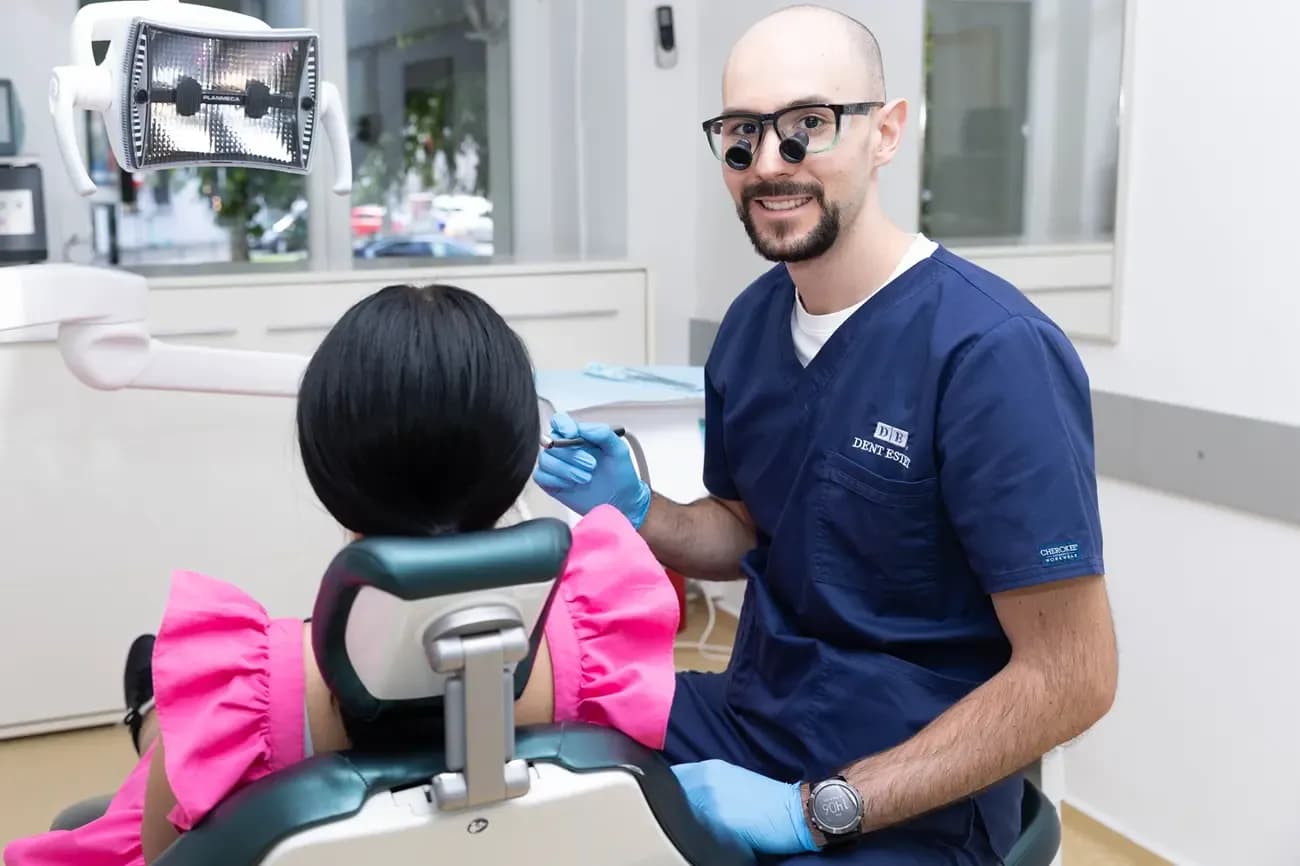
 Author:
  November 14, 2025
Dental implants are one of the most modern and effective solutions for replacing missing teeth. They offer stability, comfort and the restoration of a natural smile, but to keep them healthy in the long term, it is essential that the patient pays attention to oral hygiene and attends regular check-ups.
One of the most important preventive treatments is professional scaling, a procedure that helps remove bacterial plaque and tartar build-up around the implants and gums.
Without this regular cleaning, inflammation of the tissues surrounding the implant may occur, which over time can lead to a loss of stability.
Why is scaling necessary for patients with dental implants?
Professional scaling is not merely a cosmetic procedure; it is a fundamental step in maintaining the health of dental implants.
Even though cavities cannot form on the crown attached to the implant, the tissues surrounding the implant – the gums and the supporting bone – are extremely sensitive to the build-up of bacterial plaque.
If this plaque is not removed in time, it can cause gum inflammation, bleeding when brushing and, in advanced stages, peri-implantitis – a condition that leads to bone loss around the implant.
Professional scaling carried out by a dentist helps to completely remove tartar and bacteria from hard-to-reach areas, preventing these complications.
In addition to professional cleaning, the dentist can also assess the condition of the gums, the integrity of the crowns and the stability of the implants, ensuring that everything is functioning perfectly. If left untreated, and symptomatic treatment alone does not resolve the cause.
How is scaling carried out around dental implants?
The scaling procedure for patients with dental implants is carried out with particular care to protect both the prosthetic restoration and the soft tissues surrounding the implant.
"The authors of a study published in The Journal of Prosthetic Dentistry in 2022 propose standardised protocols for the care and hygiene of dental implants, emphasising that professional scaling with suitable instruments (Teflon, Airflow) is essential for preventing peri-implant diseases. Without maintenance, the risk of implant loss increases exponentially in the first 5 years after insertion," explains Dr Horațiu Dobre, Specialist in Oral and Maxillofacial Surgery.
Unlike natural teeth, where tartar can be removed with metal instruments, in the case of implants, Teflon instruments or special materials are used, which clean effectively without scratching the implant surface.
The dentist treats both the visible surface and the subgingival area, where bacterial plaque cannot be removed by ordinary brushing.
At DENT ESTET clinics, scaling is performed using the Airflow protocol – a modern hygiene system that gently cleans using a fine powder and a controlled water jet. This method is ideal for patients with implants, as it reaches hard-to-access areas without affecting the prosthetic work or the gums.
At the end of the scaling, the surfaces are polished, and the dentist provides personalised recommendations for daily hygiene: areas to pay attention to, the right type of toothbrush, and the use of special dental floss or a mouthwash, depending on the specific features of the restoration and the patient’s needs.
How often should scaling be carried out on patients with dental implants?
According to a study published in the British Dental Journal in 2024, patients who undergo regular professional dental hygiene treatments have a much lower rate of peri-implant complications compared to those who put off their check-ups.
"To keep dental implants healthy and stable in the long term, professional scaling must be carried out regularly, not just when unpleasant symptoms arise. A study published in the Dentistry Journal shows that regular check-ups every 4–6 months and professional cleaning tailored to each patient are key to maintaining peri-implant health," says Dr Horațiu Dobre.
In most cases, dentists recommend professional cleaning every 6 months, alongside a regular check-up.
However, there are situations where the frequency needs to be increased. Patients who smoke, those with extensive implant work – such as the All-on-4 dental implant system – or people who find it difficult to clean the spaces between the restoration and the gum may need scaling every 4 months.
This recommendation is determined on an individual basis, depending on hygiene habits, gum health and general health. The aim is to prevent the build-up of bacterial plaque around the implants and to maintain the balance of the tissues supporting them.
Regular scaling, carried out safely by a dentist, can extend the lifespan of implants and prosthetic work, keeping the patient’s smile healthy and stable for many years.
Common misconceptions about dental implant hygiene
Although dental implants offer a stable and long-lasting solution, they require the same care as natural teeth. Without proper oral hygiene, complications can arise that affect the gums and the supporting bone.
Myth – “Dental implants don’t need brushing”
One of the most common myths is that implants do not need brushing because “they cannot get cavities”.
In reality, daily brushing is essential. Although the implant itself does not decay, the gums and bone surrounding it can be affected by accumulated bacterial plaque.
The area should be brushed gently, using a soft-bristled toothbrush and a non-abrasive toothpaste.
Myth – “Dental implants last a lifetime without maintenance”
The lifespan of an implant depends largely on the patient’s oral hygiene and regular check-ups.
Smoking, untreated systemic diseases, or the build-up of bacterial plaque and tartar can accelerate bone loss and gum inflammation, compromising the stability of the implant.
Common mistake – neglecting the spaces between implants and neighbouring teeth
Many patients fail to clean the narrow spaces between the prosthetic work and the gum.
Over time, these areas become veritable ‘traps’ for food debris and bacterial plaque, which can cause inflammation, bleeding and gum recession.
To prevent these problems, dentists recommend using a mouthwash and special dental floss for implants.
Patients ignore inflammation or bleeding
Bleeding gums or sensitivity around the implant should not be ignored.
These symptoms may indicate early-stage inflammation which, if left untreated, can progress to peri-implantitis – one of the most common causes of implant loss.
Therefore, any discomfort should be reported to your dentist as soon as possible.
Signs that indicate the need for professional cleaning
In many cases, patients with dental implants do not realise in time that they are developing gum problems.
The first signs may seem minor, but they are a warning sign that a visit to the dentist is needed for professional scaling and an assessment of the implant’s condition.
The most common symptoms include:
- bleeding gums when brushing or flossing;
- swelling or redness of the gums around the implant;
- an unpleasant odour or persistent metallic taste;
- a feeling of pressure or discomfort around the prosthetic work;
- gum recession – when the implant threads are partially exposed.
Seeking prompt medical attention, even for a simple consultation, can prevent complications from arising.
"A scientific article published in RDH Magazine shows that patients who are educated and actively involved in maintaining oral hygiene retain their implants for a much longer period. Often, a properly performed professional cleaning and adjustments to the daily cleaning routine are sufficient to restore gingival balance and prevent bone loss around the implant,” says Dr Horațiu Dobre.
Recommendations for patients with dental implants
The long-term health of dental implants depends largely on the patient’s daily care and regular check-ups at the clinic.
Early detection of signs of inflammation and regular cleanings can prevent 80% of peri-implant conditions.
To avoid inflammation, bone loss or peri-implant complications, the specialists at DENT ESTET recommend:
- Professional scaling twice a year, or more frequently, as recommended by your dentist.
- Brushing correctly every day, using a soft-bristled toothbrush and non-abrasive toothpaste.
- Use of special dental floss, interdental brushes or a water flosser to clean hard-to-reach areas between the prosthetic work and the gums.
- Avoid smoking, which reduces tissue oxygenation and promotes gum inflammation.
- A balanced diet and adequate hydration to support the overall health of the gums and bone.
- Regular check-ups to assess the integrity of the implants, the prosthetic restoration and the condition of the surrounding tissues.
By following these simple recommendations, patients can prevent complications and enjoy a stable, functional and aesthetic dental restoration for many years to come.
Conclusion
Professional scaling is not merely a maintenance procedure, but an essential part of the care plan for every patient with dental implants.
By removing bacterial plaque and tartar, this procedure directly contributes to maintaining gum health, preventing peri-implantitis and ensuring the long-term stability of implants.
A well-maintained implant, regularly checked by the dentist and complemented by proper oral hygiene at home, can remain functional and aesthetically pleasing for decades.
From a financial perspective, the cost of a scaling is incomparably lower than that of treatment for peri-implantitis or a new implant.
Consequently, patients who choose prevention not only maintain their oral health but also avoid unexpected expenses and the discomfort of complex treatments.
"At DENT ESTET, every stage — from implantation to post-treatment care — is guided by the same philosophy: we protect the patient’s smile through prevention, education and constant care," explains Dr Horațiu Dobre, Specialist in Dental and Alveolar Surgery.
Bibliography
- Donos N. et al., Maintenance of peri-implant health in general dental practice: a narrative review of current literature on supportive peri-implant care - British Dental Journal, Vol. 236, 2024
- Van Witzenburg M., Implant maintenance update: early detection of peri-implant diseases and evidence-based maintenance techniques - RDH Magazine, August 2025
- Linkevičius T. (Guest Editor), Periodontal and peri-implant tissue health in implant dentistry - Dentistry Journal (Special Issue), 2025
- “Implant maintenance and the importance of oral hygiene: A review of the literature” - RDH Magazine, 2024
- “Implant and peri-implant tissue maintenance: Protocols to prevent peri-implant disease” - The Journal of Prosthetic Dentistry, 2022