




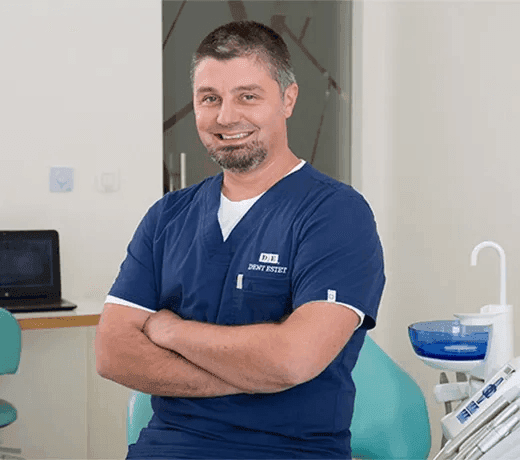
Dr Alexandru Georgescu
Senior Specialist – GENERAL DENTISTRY
Specialist doctor - DENTO-ALVEOLAR SURGERY
Specialist doctor - PERIODONTOLOGY
Medical Director, DENT ESTET
DOCTOR OF MEDICAL SCIENCES
About
Dr Alexandru Georgescu, currently Medical Director at DENT ESTET, was the first dentist to join the DENT ESTET team back in 2002, when the clinic was beginning to expand into the Romanian dental market. For Dr Georgescu, dentistry is more than just a profession; it is a way of life, as evidenced by the fact that his passion for the profession has remained unchanged even after 20 years.
Senior Consultant in General Dentistry (2008), Doctor of Medical Sciences from the “Carol Davila” University of Medicine in Bucharest, Specialist in Periodontology (2011), Dr Georgescu completed his training through the postgraduate programme in reconstructive surgery of periodontal and peri-implant tissues at the San Raffaele University of Dental Medicine in Milan (2019). In 2023, he completed the “Current Concepts in American Dentistry 2021–2023” post-specialisation programme, the Implantology and Oral Surgery Course at New York University (NYU).
With 18 years’ experience in performing dental implant treatments and complex oral rehabilitations using All-on-4 systems, he is the first dentist in Romania to be a member of the International Team of Implantology, the world’s most renowned association of implantology professionals.
A champion of innovation and digitalisation in dentistry, he is one of the mentors for the next generation of dentists in complex dental implantology techniques. Dr Alexandru Georgescu is actively involved in teaching, serving as Study Club Director of the International Team for Implantology Bucharest (ITI Study Club Bucharest) and as a Straumann mentor since 2016.
Dr Georgescu is also a Nobel Biocare Ambassador and a member of the DENT ESTET Implantology Division, which is coordinated by Prof. Dr Paulo Maló, the man who revolutionised global implantology through the development of the All-on-4® concept.
International conferences and congresses attended by Dr Alexandru Georgescu:
2023
- 4th International Symposium on Soft Tissue Management Around Teeth and Implants, Florence, Italy, 26–27 May 2023
2022
- Course “Immediate Loading Technique with GM Implants (Single & Bridge)”, Latin American Institute of Dental Research and Education (ILAPEO), 31 May – 3 June 2022, Curitiba, Brazil
2020
- 3rd International Symposium on Soft Tissue Management Around Implants and Natural Teeth, Florence, Italy, February
2019
- International Congress ‘Preparing for the Future, Promoting Excellence’, Iași, Romania
- Reconstructive Surgery of Periodontal and Peri-implant Tissues, San Raffaele University, Milan, Italy
- Bucharest Dentistry Summit – Aesthetic Dentistry and the Art and Science of Smile Design
- UNAS International Congress – 23rd edition, Bucharest, Romania
- National Conference on Periodontology – 14th edition, Bucharest, Romania
- National Congress of the Romanian Society of Dental and Maxillofacial Prosthetics – 8th edition, Bucharest, Romania
- National Conference of the Romanian Paediatric Dentistry Association, Bucharest, Romania
- Dental Implantology from the Prosthodontist’s Perspective, Bucharest, Romania
- Clinical Strategies to Maximise Success in Periodontic, Aesthetic and Implant Dentistry, Bucharest, Romania
2018
- Regional European Congress – Future Simplantology (Alpha Bio – The Convergence of Evidence & Digital Innovation), Monaco, October 2018
- Soul of Esthetics (15th European Society of Cosmetic Dentistry Annual Meeting), Lisbon, Portugal, September 2018
- Congress of the European Federation of Periodontology – Insights from the experts: How to master your soft-tissue procedures – 9th edition, Amsterdam, June 2018
- Straumann Congress, Basel, Switzerland, February 2018
- 2nd International Symposium – Soft tissue management around teeth and implants – Milan, Italy, February 2018
- Dentes Dental Medicine Congress – Modern dental medicine between imaging planning and orofacial rehabilitation, Târgu Mureș, Romania
- International Congress of the Faculty of Dentistry, University of Medicine and Pharmacy – 2nd edition, Bucharest, Romania
- Aesthetic Management Course, Basel, Switzerland
- UNAS International Congress – 22nd edition, Bucharest, Romania
- National Conference on Periodontology – 13th edition, Bucharest, Romania
- National Congress of the Romanian Society of Dental and Maxillofacial Prosthetics – 7th edition, Bucharest, Romania
- National Conference of the Romanian Paediatric Dentistry Association – 5th edition, Bucharest, Romania
2017
- Managing Aesthetic Challenges in Implant Treatment Strategy – Madrid, Spain, November 2017
- Urban International Hard and Soft Tissue Regeneration Symposium – Budapest, Hungary, October 2017
- Nobel Biocare Zagreb Symposium – Croatia, September 2017
- Medicalisation of the therapeutic act in dentistry – UNAS Bucharest, April 2017
- Speaker at the Alpha-Bio Tec. Symposium, Bucharest, Romania, May 2017
- Speaker at the Medlife National Conference, Poiana Brașov, Romania, May 2017
2016
- Alpha-Bio Tec. Symposium presented by Dr Gadi Schneider (ARTIS), Bucharest, Romania, 2016
- 10th Congress of the Romanian Society of Oral Rehabilitation, Current developments in the use of modern techniques in dental practice, ASRRO, Bucharest, Romania, 2016
- “Straumann Course on new trends in implantology and regenerative procedures”, Colfosco, Italy, 2016
- “Nobel Biocare Symposium – Immediate Function and Absolute Aesthetics in Implantology”, Bucharest, Romania, 2016
2015
- “Perspectives in Perio Implantology and Comprehensive Dentistry”, Szeged, Hungary, 2015
- “Bredent Group Dazs South-East Europe”, Bucharest, Romania, 2015
2014
- “Bredent Group Days SKY Meeting”, Berlin, Germany, 2014
- “Advanced Techniques in Implantology, Periodontology and Dental Aesthetics”, Bucharest, Romania, 2014
- “1st Annual NYU in Romania Programme – Advances in Implantology, Periodontics and Aesthetics – Dr Stephen CHU”, Bucharest, Romania, 2014
2013
- “Perspectives in Periodontology and Implantology”, Szeged, Hungary, 2013
- “Regeneration and Aesthetics in Periodontology and Implant Dentistry”, Bern, Switzerland, 2013
- “Surgical Techniques with GBR in various indications”, Bern, Switzerland, 2013
- “First Symposium on Membranes in Periodontology and Implantology”, Timişoara, Romania, 2013
- “Bredent Group Days Romania – 2nd SKY Fast and Fixed Forum”, Păltiniş, Romania, 2013
2010
- “Comprehensive Introduction to the STRAUMANN Dental Implant System”, Bucharest, Romania, 2010
- “Advanced Anterior Implant Surgery”, Zell am See, Austria, 2010
- “GBR Technique”, Zell am See, Austria, 2010
- “Regenerative Periodontal Surgery”, Zell am See, Austria, 2010
- “10th Anniversary of the ‘Actualităţi Stomatologice’ Journal: Adverse Drug Interactions in Dentistry”, Bucharest, Romania, 2010
- “State of the Art in Periodontology, Implantology, Endodontology”, Zell am See, Austria, 2010
2011
- “Amalgam vs. Composite in Clinical Dental Restoration”, Timişoara, Romania, 2011
- “Periodontics, Implantology and Preventive Care”, Edison NJ, USA, 2011
- “Periodontal Hard Tissue Regeneration Train the Trainer”, Belgrade, Serbia, 2011
- “The 6th National Conference on Periodontology – Periodontal Surgical Therapies Correlated with the Patient’s General Health”, Bucharest, Romania, 2011
- “Augmentation in Implantology and Periodontology”, Munich, Germany, 2011
- “Implant Dentistry – Basic, Advanced and Complex Level”, Varna, Bulgaria, 2012
- “BASS Congress Ed XV”, Thessaloniki, Greece, 2010 – 2011
2012
- “Bone Augmentation Procedures in Implant Dentistry”, Bucharest, Romania, 2012
- “5th UNAS National Dentistry Congress”, Bucharest, 2001 – 2012
- “Sales Course for Dentists – Andrew Jardine”, Bucharest, Romania, 2013
- “1st International Congress of the Romanian Society of Dental and Maxillofacial Prosthetics”, 2012
- “7th National Conference on Periodontology”, Bucharest, Romania, 2012
- “Perspectives in Periodontology”, Szeged, Hungary, 2012
- “Europerio”, Vienna, Austria, 2012
2009
- “Europerio 6”, Stockholm, Sweden, 2009
- “Periodontal Therapy through Plastic Aesthetics”, Timişoara, Romania, 2009
- “Romanian Geistlich Mucograft Pre-launch Roundtable”, Bucharest, Romania, 2009
2008
- “Live Surgery Course”, Turin, Italy, 2008
- “Alpha-Bio Implantology Course”, Tel Aviv, Israel, 2008
- “New Trends in Bone Periodontology”, A. Saadoun, Bucharest, Romania, 2008
2007
- “12th Congress of the Balkan Stomatological Society”, Istanbul, Turkey, 2007
- “2nd National Congress of Menopause and Anti-ageing”, Bucharest, Romania, 2007
- “Intensive Course in Regenerative and Aesthetic Plastic Surgery in Periodontal Therapy”, presented by A. Sculean, Timişoara, Romania, 2007
2006
- “Franco-Romanian Implantology Days”, Iaşi, Romania, 2006
- “First International Conference on Periodontology”, Bucharest, Romania, 2006
2005–2003
- LIVE-OP “Periodontal plastic surgery – new trends”, Timişoara, Romania, 2005 – 2006
- “The 8th Symposium of the Banat Dental Days”, Timişoara, Romania, 2003 – 2004 – 2005
2004
- “The 8th UNAS National Dental Congress”, Bucharest, Romania, 2004
- “The Joint Meeting of SSER and the ESED”, Bucharest, Romania, 2004
- “The First Congress of Aesthetic Dentistry in Romania”, Bucharest, Romania, 2004
2001
- “6th Congress of the Balkan Stomatological Society”, Bucharest, Romania, 2001
2000
- “5th Congress of the Balkan Stomatological Society”, Thessaloniki, Greece, 2000
- “The 5th International Symposium of the Banat Dental Days”, Timişoara, Romania, 2000
- “Periodontal regenerative treatment with guided tissue regeneration or enamel protein matrix. Biological considerations and clinical applications”, Timişoara, Romania, 2000
- “Tissue integration of oral implants”, Bucharest, Romania, 2000
- “Requirements in Conjunctive Prosthetics”, Bucharest, Romania, 2000
- “The wisdom tooth problem from the dentist’s perspective”, Bucharest, Romania, 2000
- “Reasoning in the theory and practice of modern periodontology”, Bucharest, Romania, 2000
Philosophy
For Dr Alexandru Georgescu, dentistry goes beyond being merely a profession; it has become a true way of life. Having joined the DENT ESTET team back in 2002, Dr Georgescu has demonstrated an unwavering passion for medical science over the past two decades. He believes that the true vocation in dentistry lies in the rigorous combination of science with new practices and technologies, with the noble aim of restoring patients’ health.
In his view, continuous development, both personally and professionally, is essential. Integrating cutting-edge technology and ethical principles into his daily practice enables him to build ethical and lasting relationships with patients. Alongside his professional dedication, Dr Georgescu finds balance and inspiration in nature, being a passionate yachtsman, which he sees as a way of life. This deep connection with nature gives him the energy and enthusiasm needed to excel in his career.
As a mentor and educator, Dr Georgescu takes on the role of guiding and inspiring the next generation of dentists. As a StudyClub Director and Straumann mentor within the International Team for Implantology (ITI), he consistently promotes innovation and excellence in implantology, thereby ensuring his patients receive the most advanced and effective treatments available.
Interview with Dr Alexandru Georgescu
What does the ITI mean to the dental community in Romania, and what are your plans for future ITI Study Club sessions in Bucharest?
For the dental community in Romania, the ITI represents a cornerstone of professional development and the exchange of expertise at an international level. Through the ITI Study Club meetings in Bucharest, dentists gain access to the latest implant treatment methods, scientifically validated by the international community. Attending these meetings offers a unique opportunity to present clinical cases, receive feedback and learn from the experience of fellow professionals. For future sessions, we are focusing on exploring and implementing innovations in oral surgery, with an emphasis on the revolutionary Smile in a Box™ concept from Straumann®, which promises greater comfort, precision and safety for patients.
What are the current topics of interest in implantology?
I am interested in everything to do with full-mouth rehabilitation using 4 or 6 implants. Each implant manufacturer has given this procedure a different name. For example, at Straumann, we refer to it as ProArch, whilst at Nobel, we refer to it as All-on-4. I shall limit myself to these two manufacturers, both of which currently have their headquarters in Switzerland, just like ITI, and I do not believe this is a coincidence. Both manufacturers invest considerable resources in research, and the implant systems they have developed are scientifically validated.
What have been the most memorable moments during your more than 22 years working alongside Dr Oana Taban and the DENT ESTET team?
I joined the team led by Oana Taban back in 2002 and have been part of the entire journey that has shaped what DENT ESTET is today. I really appreciated the openness to new ideas and innovation. She has always wanted us to have the latest technologies and to keep up to date with the newest treatment methods. As a doctor, you want to be part of a team that is constantly evolving, one that has never reached a plateau.
What does the emergence of a new technology mean to you?
Every time a new technology becomes available on the market, it presents both a challenge and an opportunity. It is a challenge because, whilst you may have had years of experience and the expertise to provide high-quality treatment using an analogue method up to that point, you suddenly have to start from scratch and learn a new system all over again. You embark on a new learning curve, which can take weeks or months before you reach a level of excellence with the new technology, during which time you may face frustration or a sense of regression.
However, we must put the efforts involved into perspective and keep in mind the greater good of the patient, who benefits from the increased comfort offered by digital technologies. For example, when the intraoral scanner first appeared, the advantage for the patient was clear – it is far more comfortable to scan digitally rather than take impressions with traditional impression materials.
Who are the colleagues you have worked with over the years at the clinic?
First of all, I’d like to mention Mari Grecu Pîrvan, who is the nurse I’ve been working with since the very beginning. Every doctor knows that the nurse you work alongside takes some of the weight off your shoulders—the things that wear you down and weigh you down little by little—which is why I really appreciate being able to rely on her.
As for the colleagues I work with across disciplines, over the years, as a periodontist, I have worked with orthodontists, but also with other colleagues, such as Erika Vasilescu or Vanda Popa, on endodontic treatments. Also, with my wife, Dana Georgescu, who handles the prosthetics in many of my implant cases.
What has changed in the field of dental implantology in Romania since you first started offering this treatment until now?
There is no doubt that the progress and development of implantology as a science has been an integral part of our professional development. I performed my first implant treatment in 2006, and prior to that, I trained through the implantology competency programme and by working alongside doctors more experienced than myself. My first mentor in implantology was Dr Puiu Nicolescu, who was part of the first generation of doctors trained to provide treatments using modern dental implant systems. I should mention that the first department of implantology in our country was established at the military hospital around the year 2000.
The available technologies have changed significantly. Whereas back then we had panoramic or retro-alveolar X-rays at our disposal and only had access to CBCT under special circumstances, today, dental radiology and imaging devices have diversified. Nowadays, CBCT is a must in implantology; instead of traditional impressions, we have the intraoral scanner at our disposal, and we can create digital guides for both the surgical and prosthetic stages. Furthermore, implant systems have evolved and are becoming increasingly sophisticated year on year.
How does a dual specialisation in periodontology and implantology help you?
Any periodontist can also be an implantologist, but every implantologist must be a periodontist.
Dentistry is already a medical speciality in its own right, distinct from general medicine, and the fact that we have divided it into even more specialised fields sometimes carries the risk of losing sight of the bigger picture when it comes to treatment. As an implantologist, I believe it is essential to view dental health holistically, because there is no point in placing an implant if you do not also examine the supporting tissue – that is, the gums – which must be healthy for the treatment to be successful in the long term.
What hobby gives you energy?
Spending time in nature always restores your balance and heals you. I chose yachting because, ultimately, it can be a way of life.
Dental Health, Explained by Dr. Dr Alexandru Georgescu
Online appointment
Fill out the form and one of our assistants will contact you to schedule a visit to the clinic.