




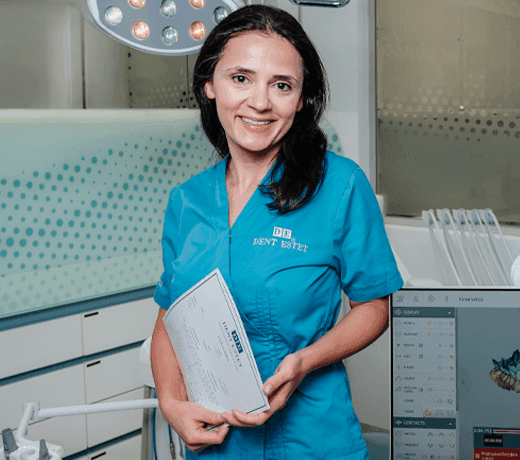
Dr. Alina Pantilie
Dentist – COSMETIC DENTISTRY
CERTIFICATION IN LASER DENTAL TREATMENTS
About
Dr. Alina Pantilie is a dentist specialising in cosmetic dentistry and has been part of the Krondent-DENT ESTET team since 2011. From childhood, she was fascinated by dentists’ white coats and the smell of various medical substances, yet it was her artistic flair and creativity that laid the foundation for her career in dentistry.
For Dr. Alina Pantilie, dentistry presents a constant challenge due to the rapid evolution of technology, but at the same time, it drives her to push her limits and tackle any situation. For many years she practised endodontics with great patience and meticulousness, but eventually turned her attention to the field of cosmetic dentistry, finding satisfaction in seeing her patients’ smiles and their gratitude.
“The surest path to joy is to seek to bring joy to someone else.”
Dr. Alina Pantilie is a mother of three, and her free time is the perfect opportunity to spend quality time with them, taking part in various age-appropriate activities. She also finds relaxation in travelling and cycling, enjoying nature alongside her husband. She expresses her artistic side by playing various pieces on the piano or by reading.
Specialist courses attended by Dr. Alina Pantilie:
2021
- In-house course “Photography in Dentistry” – Miladinov Milos
- Modular course on implant prosthetics – Prof. Dr Bogdan Baldea / Dr Ionut Branzan – Timișoara
2020
- UNAS Congress – Bucharest
2019
- Certificate of further training in the therapeutic and surgical use of lasers in dentistry – Timișoara
- Medical Congress: “New perspectives and aspirations for the dental profession – from complex, high-standard treatments to legislative and managerial aspects in line with current requirements” – Bucharest
2018
- “Laser Therapy in Dentistry” – Module III – “Victor Babes” University of Medicine and Pharmacy – Timișoara
- Medical Congress: “Multidisciplinary Interactions in Dentistry: Targeted Treatments in Endodontics, Prosthodontics and Implantology with Immediate Applications, and Studies on the Pharmacotoxicity of Preparations Used in Dental Practice” – Bucharest
2017
- “Laser Therapy in Dentistry” – Module II – “Victor Babes” University of Medicine and Pharmacy – Timișoara
- Medical Congress: “Multidisciplinary Interactions in Dentistry. Considerations on the selection and application of treatments for resolving complex cases and the use of advanced techniques and technologies in oral prevention and rehabilitation” – Bucharest
2016
- Medical Congress “Interdisciplinary Methods, Techniques and Perspectives in Dentistry. Aesthetic and Functional Considerations in Restorative Therapy, within the Clinical and Paraclinical Framework of a Successful Dental Practice” SDR – Bucharest
- Medical Congress: “Multidisciplinary Interactions in Dentistry. New Trends and Directions in Endodontics” – Bucharest
2015
- “Laser Therapy in Dentistry” – Module I – “Victor Babes” University of Medicine and Pharmacy – Timișoara
- “Dental Club 2015” Congress
2013
- “Endodontic treatment and retreatment – the fundamentals of clinical endodontics” – Dr Camil Ianes, Dr Zeno Florita – Timișoara
- Symposium: “Dentistry in the New Millennium” – SSEM Bucharest
2012
- “Inhalation sedation – conscious sedation with nitrous oxide and oxygen in modern dentistry” – Dr Alida Moise
- “Dental Club 2012” Congress
- Symposium: “Dentistry from A to Z” – Bucharest
2011
- “Skeletal dentures with special retention systems”, Assistant Professor Dr Dragos Smarandescu – Bucharest
- “Preparation techniques for extended bridges” (vector guidance technique), Assistant Professor Dr Dragos Smarandescu, Bucharest
- “Minimally invasive restorations. Glass-fibre-reinforced composite resins”, Assistant Professor Dr Dragos Smarandescu, Bucharest
- "Occlusology and the facial arch", Dr Dragos Smărăndescu, Assistant Professor, Bucharest
- "Endodontics – root canal filling", Professor Bogdan Dumitriu, Bucharest
2010
- "The essentials of prosthodontics", Dr Len Boksman – Bucharest
- “Prosthodontics – Impression-taking and Cementation Techniques”, Assistant Professor Dr Dragos Smarandescu – Bucharest
- "All-ceramic veneers", University Assistant Professor Dr Dragos Smarandescu – Bucharest
- "Direct aesthetic restorations in the anterior region. Direct veneers using light-curing composite resins", Dr Dragos Smarandescu, Assistant Professor – Bucharest
- "Endodontics – Root Canal Instrumentation", Prof. Bogdan Dumitriu, PhD – Bucharest
- "The geometry of core preparation. An introductory course on step preparation", Assistant Professor Dr Dragoș Smarandescu – Bucharest
2004–2010
- Carol Davila University of Medicine and Pharmacy, Bucharest – Faculty of Dentistry
Philosophy
I aim to continue my studies so that I am always up to date with the latest developments and can offer my patients the best possible treatment. I aim to treat every patient with the utmost care and sensitivity, thereby transforming any fear of the dentist into a pleasant experience, from which the patient leaves feeling delighted.
Interview with Dr. Alina Pantilie
Could you tell us about a moment or an experience that inspired you to specialise in cosmetic dentistry?
There wasn’t a single, sudden moment that led me to make this decision; it all came about gradually. Ever since I was a child, I’ve wanted to do something that brings joy to those around me, and it gave me great satisfaction to see the people around me happy. I could say that this is what led me to choose a career in dentistry, as it is here that I can make people happy not only in their hearts, but also physically and tangibly, through a beautiful smile, sometimes achieved through just small adjustments.
What are the steps involved in planning a cosmetic dental treatment?
I’m glad you asked this question, because sometimes patients don’t understand how complex this is. To plan a treatment, a comprehensive assessment of the case is essential. This process involves an initial consultation, analysis of X-rays and facial and occlusal data, taking intraoral and extraoral photographs, digital smile analysis and treatment simulation. Once the treatment plan has been finalised and verified in the practice, we can proceed with the actual implementation of the treatment.
Which procedures are the most demanding?
The most challenging cases are those in which the patient has recently been treated elsewhere and comes to us with problems closing their mouth, pain in the temporomandibular joint, and tears in the articular disc. We propose comprehensive rehabilitation to rectify the mistakes made and to ensure these errors are not repeated in future work, yet the patient is already sceptical, tired of dental treatment and wants, as if by magic, for everything to be resolved in a very short space of time.
Please tell us what technologies and equipment you use, and which of these you consider essential?
In my practice, I use everything currently available on the market in the field of dentistry. We have all the equipment needed to achieve our goals, from the intraoral scanner – without which I could not practise dentistry – Modjaw – the latest technology for real-time dynamic scanning of the dento-maxillary system – to radiography for X-rays and the CT scanner used whenever necessary, the digital software for simulating cases and smiles, and much more.
Could you share with us a story about a patient who had a profound emotional impact on you?
Yes, I remember very clearly my first appointment with a lady who arrived in tears; she wouldn’t even let me touch her teeth at the first appointment – they were very sensitive, and she was very frightened. She gradually plucked up the courage and gained confidence, and at the end of the treatment she cried again, but this time with happiness.
What do you love most about your job?
What fills me with the most joy is the moment when I finish a case and the patient is simply amazed by their new look! This gives me the drive and motivation to carry on.
How do you manage to strike a balance between your work and family life?
To maintain a balance between the two, it is very important to set priorities right from the start and also to ensure that they do not overlap. When I arrive at the practice, I try to get organised, plan my work and focus on that day’s therapy sessions, leaving any ‘problems’ from home to one side. I apply the same principle in reverse too, even if I don’t always manage it, because ideas and solutions to cases are constantly popping into my head. But… when you do something for pleasure and with passion, it gives you energy, and that’s fine by me.
How do you like to spend your free time, and what are your hobbies?
As I have very little free time and it slips away so quickly, I try whenever I can to spend it with my family and children, whether through activities we do together indoors or outdoors. We really enjoy going for walks, pottering about and travelling. I spend my personal free time reading or playing the piano; this helps me relax and re-energise.
Online appointment
Fill out the form and one of our assistants will contact you to schedule a visit to the clinic.