




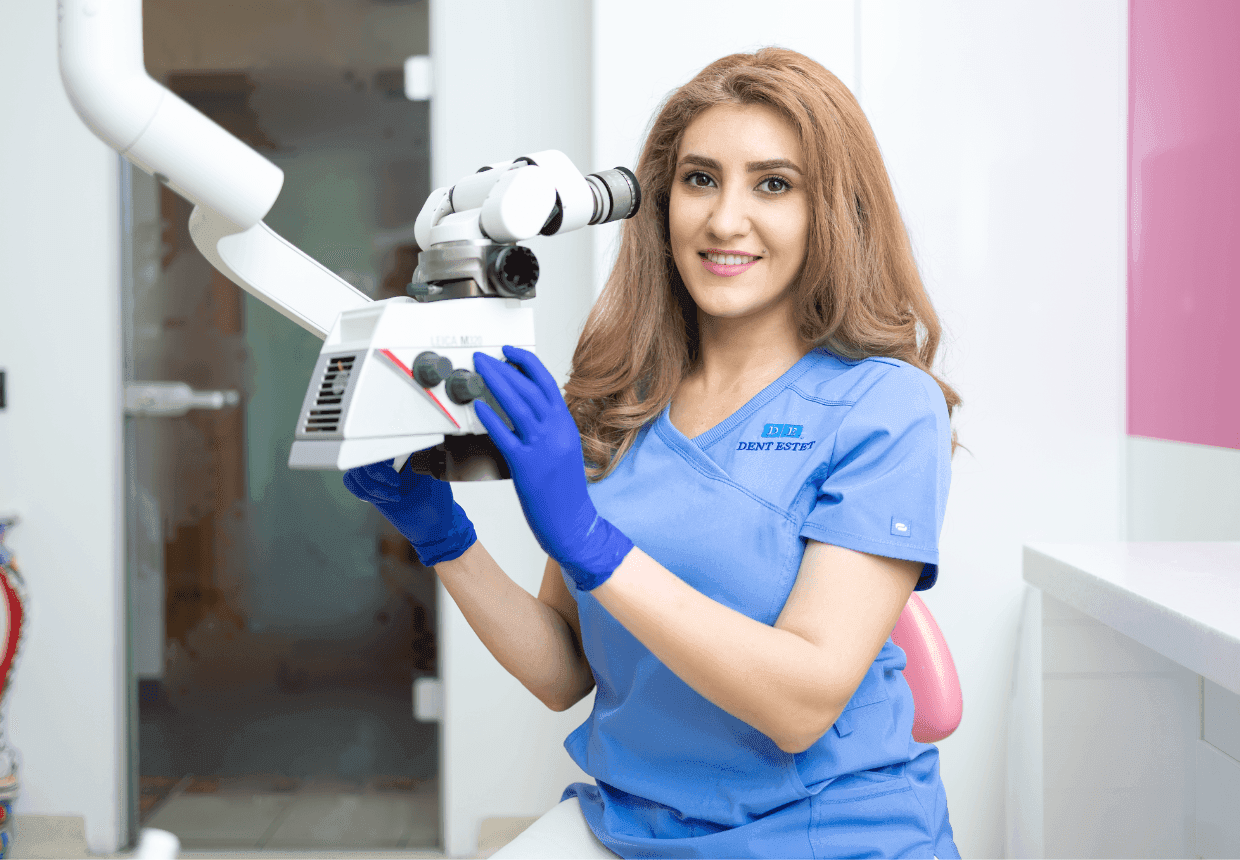
Dr. Bahare Azar
Specialist Dentist – ENDODONTICS – MICROSCOPE
Competence in IMPLANTOLOGY
About
Dr. Bahare Azar is a specialist in Endodontics and has been part of the DENT ESTET team for over 16 years. She graduated from the Faculty of Dental Medicine, Titu Maiorescu University, in 2010, and in 2014 she obtained the title of specialist in Endodontics at the Carol Davila University of Medicine and Pharmacy. Her training was completed with obtaining the competence in Implantology (UMF Carol Davila) in 2012, followed by the Master's program in Oral Rehabilitation with Implant Aggregation, Titu Maiorescu University, Bucharest, 2022, which allows her to analyze complex cases from a multidisciplinary perspective and contribute to choosing the right long-term solution.
In her clinical practice, Dr. Bahare Azar carries out endodontic treatments with the aim of eliminating pain and infection, with a view to preserving the natural tooth wherever possible and medically indicated. Her extensive experience, rigorous protocols and the use of modern dental technology enable her to tackle even complex endodontic cases with precision.
“A dentist’s character is revealed in the decisions they make when the patient’s well-being is the only thing that matters. I want every patient to leave the surgery not only having been treated, but also confident that they have been listened to, understood and cared for responsibly.”
Throughout his time at DENT ESTET, he has worked in a multidisciplinary medical environment, collaborating with doctors from various specialities to plan and carry out integrated treatments. She pays particular attention to patients with dental anxiety, clearly explaining to them the stages of root canal treatment and the recommended options.
Dr. Bahare Azar constantly updates her professional training by attending specialist courses and conferences organised both in Romania and abroad.
Specialist courses and conferences
2026
- ‘Beyond the Smile: Passion, Perfection and Performance’, SSER, Bucharest
2025
- “An Interdisciplinary Approach to Dentistry”, Titu Maiorescu University, Bucharest
- Congress of the “Carol Davila” University of Medicine and Pharmacy, Bucharest
2024
- ROOTS SUMMIT, Athens, Greece
- “Education, Innovation and Progress in Modern Dentistry”, CMSB, Bucharest
- “Aesthetics and Interdisciplinary Complementary Therapies”, SSER, Bucharest
- World Endodontic Summit – Balkans Edition, Plovdiv, Bulgaria
2023
- Congress of the “Carol Davila” University of Medicine and Pharmacy, Bucharest
2022
- “Current Developments in the Dento-Maxillary Field – Update 2022”
- Endodontic Master Series Conference, RCC Endodontics
- OHI-S Endodontic Congress, Vienna, Austria
2021
- “MTA Obturation in Endodontics”, presented by Yoshi Terauchi and Mahmoud Torabinejad
- Dental Days Symposium
2020
- ‘The Final Restoration of Root-Treated Teeth’
2019
- Endopoint International Congress, Moscow, Russia, April 2019
2018
- “Problem Solving Within the Scope and Challenges of Endodontic Procedures”, Milan, Italy, November 2018
- “Pre-Congress Course – Ordinary Member Resident Abroad”, Milan, Italy, November 2018
- ‘Basic Implantology’ course, Bucharest, March 2018
- ‘Intraoral Sutures in Dental Practice’, Bucharest, April 2018
- “Connections in Dental Aesthetics”, Bucharest, May 20182017
- “Multidisciplinary Interactions in Dentistry”, Bucharest – November 2017
- “Complex Aesthetic Treatments Using Botulinum Toxin and Hyaluronic Acid Fillers”, Bucharest – November 2017
- “International Congress of Dental Aesthetics – The Art of Dental Aesthetics”, Bucharest, May 2017
2016
- “Roots Summit”, Dubai, December 2016
- “Smart Endo Days”, Timișul de Jos, October 2016
2015
- “Interdisciplinary methods, techniques and approaches in oral rehabilitation. Ensuring successful aesthetic and functional predictability: improving tissue osseointegration of implants using complex periodontal surgery techniques”, Bucharest, May 2015
- “Romanian Dental Society Congress”, 2015
2014
- “Penn Endo Global Symposium”, Vienna, Austria, 2014
- “The 18th UNAS International Congress”, Bucharest, Romania, 2014
- “9th National Conference on Periodontology”, Bucharest, Romania, 2014
- “The 3rd National Congress of the Romanian Society of Dental and Maxillofacial Prosthetics”, Bucharest, Romania, 2014
- “The 2nd National Conference of the Romanian Endodontics Association”, Bucharest, Romania, 2014
- “First National Conference of the Romanian Paediatric Dentistry Association”, Bucharest, Romania, 2014
2013
- “Current Advances in the Hot Vertical Condensation Technique”, Bucharest, Romania, 2013
- “Course in Endodontic Surgery” – Advanced Course, Bucharest, Romania, 2013
- “Certificate of Further Studies in Implantology”, Bucharest, Romania, 2013
2012
- “Retreatment in Endodontics” – Advanced Course, Bucharest, Romania, 2012
- “Clinical Endodontics”, Bucharest, Romania, 2012
- “Twisted Files – Changing the World of Endodontics”, Bucharest, Romania, 2012
- “Concepts, Methods and Techniques Specific to Adhesive Endodontics”, Bucharest, Romania, 2012
- “International Congress of Dental Aesthetics”, Bucharest, Romania, 2012
2011
- “Biennial Congress of the European Society of Endodontology”, ESE ROME, 2011
- “Modern Endodontics: From Access to 3D Obturation”, Bucharest, Romania, 2011
- “3D Endodontics: New Techniques and Concepts”, Bucharest, Romania, 2011
- “Endodontics Today: AN ART – A SCIENCE – A PLEASURE”, Timișoara, Romania, 2011
2010
- “GC G-aenial, Layering Techniques”, Bucharest, Romania, 2010
Motto
“I will always choose the right course of action for the patient, even when it is not the easiest one.”
Philosophy
“I believe that a dentist should not just treat a tooth, but a person. Every patient comes to the surgery with a different story, with emotions, fears and expectations, and my responsibility is to offer them not only the right treatment, but also the confidence that they are in safe hands.
In my more than 16 years’ experience at DENT ESTET, I have learnt that excellence is not just about medical training and technical precision. It also means truly listening, explaining things clearly, respecting the patient’s pace and building a relationship based on trust. For many people, a few minutes in which they feel understood can be just as important as the treatment itself.
My professional journey has also been shaped by the people who have mentored me. At DENT ESTET, Dr Oana Taban played a key role in my professional development, constantly encouraging me to grow, push my boundaries and strive for excellence.
My philosophy is simple: every treatment must be carried out with the same responsibility and care with which I would treat a member of my own family. I aim to preserve the natural tooth whenever this is possible and medically appropriate, without compromising on safety or the quality of the result.”
A conversation with Dr. Bahare Azar
What drew you to endodontics and what motivates you day in, day out?
I was drawn to the precision of this specialisation and the fact that no two cases are exactly alike. Endodontics requires patience, concentration and the ability to find solutions in situations where every detail can make a difference.
After more than 16 years’ experience, my greatest motivation remains the same: to save teeth that might otherwise be lost and to restore the patient’s comfort, functionality and confidence. One of the most rewarding moments is when a patient walks into the clinic feeling anxious and leaves feeling calm, pain-free and with their own tooth preserved.
Many patients associate root canal treatment with pain. How do you explain to them, at their first consultation, what this procedure involves nowadays?
Modern endodontic treatment is very different from the image many patients still have of it from the past. Carried out under anaesthesia, using a microscope and the latest technology, root canal treatment is a precise, controlled procedure and, in most cases, a comfortable one for the patient. Its aim is to eliminate pain and treat infection, not to cause an unpleasant experience.
I like to explain each stage in a way the patient can understand and answer all their questions before we begin. Fear often stems from the unknown. When the patient knows what to expect, understands why the treatment is necessary and feels that they are being listened to, their anxiety decreases considerably.
In what situations can endodontic treatment carried out under a microscope make a difference compared with conventional methods?
The microscope provides much better visibility and allows the identification of details that might go unnoticed to the naked eye: additional canals, cracks, calcifications, perforations, fractured instruments or the causes of a previous unsuccessful endodontic treatment.
It is particularly valuable in complex cases and in retreatment. The microscope does not replace the dentist’s experience; however, when used in conjunction with clinical training and judgement, it can make the difference between losing a tooth and saving it. For me, using it means greater precision and the ability to provide treatment that is as predictable as possible.
What are the most difficult cases you come across in your practice, and what medical challenges do they present?
The most difficult cases are usually endodontic retreatments and those involving complex root anatomy. Challenges may include calcified canals, fractured instruments, persistent infections, perforations or extensive lesions.
In such situations, the experience gained over more than 16 years at DENT ESTET, patience, careful analysis of diagnostic findings and the use of modern technology are essential. Complex cases do not allow for standard solutions; every decision must be responsibly tailored to the patient’s specific circumstances and the actual prognosis for the tooth.
Is there a particular case that has stuck in your mind and which has confirmed to you the importance of preserving the natural tooth whenever possible?
Over the years I have come across many memorable cases, but the ones that move me the most are those in which patients arrive convinced that extraction is the only solution. When the indication is correct and the biological conditions allow it, endodontic treatment and appropriate restoration can keep the tooth functional for a long time.
For me, the greatest satisfaction is seeing a patient again years later and finding that the treated tooth is still healthy and functional. This is the true success of endodontic treatment: not just the immediate relief from pain, but the long-term stability of the result.
What role do digital technology and modern instruments play in the accuracy of endodontic treatment?
Modern technology has significantly transformed endodontics. The microscope, three-dimensional imaging techniques such as CBCT, apex locators and modern rotary instruments help us to diagnose more accurately, work with greater precision and plan difficult cases more effectively.
However, technology remains a tool. The final outcome depends on the dentist’s experience, training, attention to detail and clinical judgement. For the patient, the combination of experience and technology means a more carefully controlled treatment and a better chance of preserving the natural tooth.
What are the most common mistakes patients make when they experience toothache, and which of these might compromise the chances of saving the tooth?
The most common mistake is to put off seeing a dentist, in the hope that the pain will go away on its own. Sometimes the pain does ease off temporarily, but the infection may continue to spread deeper into the body. Another mistake is self-medication, particularly taking antibiotics without a doctor’s advice, which can mask the symptoms without addressing the cause.
The sooner the patient sees a dentist, the greater the chances that the tooth can be treated and saved. Early diagnosis can mean simpler treatment, a better prognosis and the avoidance of complications.
How do you work with dentists from other specialities to ensure that a tooth that has undergone root canal treatment functions properly and lasts in the long term?
Endodontics is an important stage, but not always the final stage of treatment. Long-term success also depends on the correct restoration of the tooth, periodontal health and its integration into the overall treatment plan.
The fact that I also hold a Master’s degree in Implantology gives me an interdisciplinary perspective and helps me to fully understand both the value of preserving the natural tooth and the situations in which it can no longer be saved under predictable conditions. Collaboration between the endodontist, prosthodontist, periodontist, surgeon and the attending dentist is essential for making the right decision and achieving a stable outcome.
If a patient asks you, ‘How can I avoid a root canal?’, what advice would you give them?
Prevention is always the best solution. I recommend good oral hygiene, regular dental check-ups and treating tooth decay at an early stage. Persistent sensitivity, pain when chewing, spontaneous pain or changes in the colour of a tooth should not be ignored.
A timely consultation can halt the progression of a problem before it reaches the tooth’s nerve. And when endodontic treatment is nevertheless necessary, early intervention increases the chances of a good outcome.
What do you think patients value most in their relationship with you?
I think what patients appreciate most is that I listen to them first and foremost. Many come to see a dentist feeling anxious or following difficult experiences, and before any treatment begins, they need to feel that they are understood and that they are given clear explanations.
I don’t rush this stage, because trust is built before treatment begins. I want the patient to feel that they can ask anything, that decisions are made together, and that every recommendation is centred on their health.
What do your patients most often tell you after they’ve finished their treatment?
One of the nicest things I hear is: ‘I didn’t think it could be so easy.’ Many patients come in convinced that root canal treatment will be painful or very difficult, and afterwards they tell me that the experience was completely different from what they had imagined.
For me, this is an important goal: to change perceptions of endodontic treatment and to offer every patient an experience where medical expertise, calmness and empathy go hand in hand.
How do you like to spend your time outside the clinic?
In my spare time, I like to spend as much time as possible with my family. Travelling, sport and spending time in nature help me to maintain my balance and energy.
One of my less common passions is putting together and collecting jigsaw puzzles. It’s an activity that relaxes me and, in a way, resembles what I enjoy in my profession: patience, attention to detail and the satisfaction of seeing the complete picture. I also enjoy cooking, especially when I can share the time spent in the kitchen with family and friends.
Online appointment
Fill out the form and one of our assistants will contact you to schedule a visit to the clinic.