




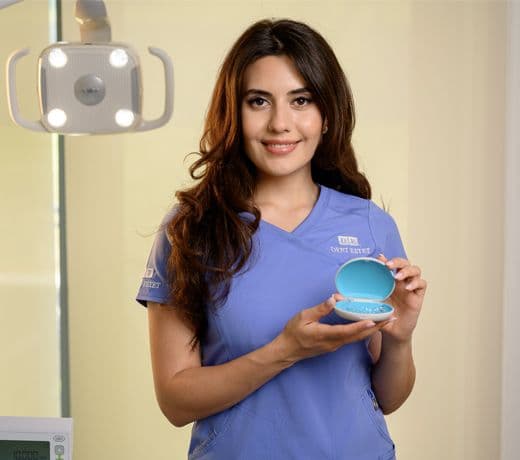
Dr Kimia Azar
Specialist in Orthodontics
About
Dr Kimia Azar is a specialist orthodontist, dedicated to providing empathy, patience and comfort to every patient at DENT ESTET clinics. Having grown up in a family of doctors, she learnt from a young age the importance of compassion towards others. For her, dentistry is not just a profession, but a journey in which human qualities can significantly influence the patient’s experience.
Dr Kimia Azar places particular emphasis on calmness, transparency and a friendly approach. The patient’s smile at the end of orthodontic treatment is her greatest reward, and daily challenges strengthen her determination to continually improve.
To provide high-quality treatments, she uses advanced technologies, such as the intraoral scanner and Dentapen, a minimally invasive digital local anaesthesia system that ensures greater comfort for patients.
In her spare time, Dr Kimia Azar enjoys motorbike rides, Pilates, exploring new cultures through travel, and spending time with family and friends.
Philosophy
“I believe that orthodontics is not just about aligning teeth, but about harmonising function, aesthetics and emotional balance. Every smile tells a story, and my role is to respect that story and guide it with medical responsibility.
I approach each patient as a whole person, not as a standardised case. Dental and jaw structure, age, medical history, lifestyle and emotional state are essential elements in devising the right treatment plan. I do not believe in quick fixes without a biological basis, but in treatments that respect the body’s natural rhythm and ensure stable, long-term results.
My philosophy is based on clarity and trust. I communicate openly, explain each stage and make treatment decisions together with the patient. Successful treatment always begins with understanding and continues through collaboration.
The goal is not artificial perfection, but a result that supports the health of the joints, muscles, bite and overall facial balance.
In my practice, I create a safe, calm and predictable space where the patient feels respected and listened to. I believe that emotional security contributes directly to the success of the treatment.”
Motto
“Attention is the purest form of generosity.” – Simone Weil
Questions
1. What made you decide to pursue a career in dentistry and choose orthodontics?
My interest in dentistry stemmed from a desire to combine the medical field with precision and attention to detail. I was drawn to the opportunity to have a direct and visible impact on patients’ health and confidence.
During my professional training, I discovered that orthodontics is the specialism that best suits me, as it requires a long-term vision, rigorous planning and an ongoing relationship with the patient. For me, orthodontics is not just about aesthetics, but also about functionality, balance and prevention, and the satisfaction of gradually helping to correct dento-maxillary problems was decisive in my choice of this specialism.
2. What is your favourite part of being an orthodontist, the thing that makes you look forward to every day?
What I love most about being an orthodontist is that I get to witness a transformation that happens gradually but has a profound impact on people’s lives. I enjoy accompanying patients throughout this process, building a relationship based on trust, and observing how, as their smile changes, so does the way they see themselves. For me, orthodontics is not just about aligning teeth, but about restoring confidence, balance and the joy of smiling without hesitation.
3. What are the specific features of orthodontic treatment for adults, and what needs to be taken into account to ensure reliable and long-lasting results?
In adults, orthodontic treatment requires more careful planning, as the bone is no longer growing, and there is sometimes already gum recession, bone loss or previous dental work.
Before we begin, we thoroughly assess the health of the gums and the bone supporting the teeth. Movements are more controlled, forces are gentler, and the aim is not just alignment, but the correct and stable positioning of the teeth within the bone.
A well-planned treatment for adults can yield excellent results, provided it respects each patient’s individual biology.
4. For adult patients who already have dental work or implants, how do you adapt the orthodontic treatment to ensure everything comes together in a harmonious final result?
In many cases, orthodontic treatment must be planned in the context of existing crowns, bridges or implants. These elements cannot be ignored; rather, they become key considerations in the planning process.
For example, an implant cannot be moved orthodontically, and its position influences the movement strategy for the neighbouring teeth. In other cases, dental alignment is necessary to create the correct space and position prior to new prosthetic work.
Good coordination between specialities ensures a balanced, functional and stable final result over time.
5. How do new technologies help you achieve a harmonious smile, and which tools are essential to your treatments?
New technologies help me give patients a harmonious smile through extremely precise and personalised treatment planning. Intraoral scanning and digital planning allow me to analyse the position of the teeth and occlusal relationships in detail, and to anticipate the final result right from the initial stage. 3D simulations boost patients’ confidence and facilitate collaboration throughout the entire treatment. I couldn’t imagine orthodontics without digital technology: intraoral scanning and modern appliance systems ensure efficiency, comfort and stable, long-term results.
6. Tell us about a smile makeover that has stayed with you. What made it special?
One of the cases that has stayed with me most vividly was that of a very shy child who, at the first consultation, avoided smiling, struggled to speak and had an anterior crossbite. The treatment was not just about straightening his teeth, but about patience, trust and taking small steps together. Throughout the treatment, I noticed how, as his teeth changed, so did his attitude – he became more open and self-assured. The moment the braces were removed and the child looked at himself in the mirror for the first time, smiling broadly, was incredibly moving. That’s when I was reminded that orthodontics doesn’t just change smiles, but also the way people see themselves.
7. Which doctor from the DENT ESTET team has been your mentor and a source of inspiration in your professional development?
Throughout my career, I have been fortunate enough to be part of a team where colleagues are always open-minded, committed and willing to discuss every case, which has helped me to develop constantly. However, my mentors and main sources of inspiration have been, and remain, Dr Maria Hajnal-Taban and Dr Diana Mansour. From them, I have learnt not only professional rigour and attention to detail, but also the importance of empathy, communication with the patient and the constant desire for self-improvement.
8. How do you work with your colleagues to successfully complete a complex treatment plan involving orthodontic treatment?
Interdisciplinary collaboration is essential to the success of a complex treatment plan. I maintain constant communication with the other colleagues involved – whether in prosthetics, periodontology or surgery – right from the diagnosis and planning stage. Together, we discuss our shared objectives, establish the correct stages of treatment and use digital planning to ensure a unified vision of the final result. Through this close collaboration, each procedure is seamlessly integrated, and the patient benefits from a coherent, predictable and stable long-term treatment plan.
9. What hobbies help you reconnect with yourself outside of work?
Outside of work, I reconnect with myself through activities that bring me peace and balance. I enjoy spending time in nature, taking leisurely walks and allowing myself moments of reflection. Reading and writing also help me to disconnect from the hectic pace of my working days and to clarify my thoughts. These moments give me the space I need to recharge emotionally and return to work with more energy, clarity and empathy.
Dental Health, Explained by Dr. Dr Kimia Azar
Online appointment
Fill out the form and one of our assistants will contact you to schedule a visit to the clinic.