




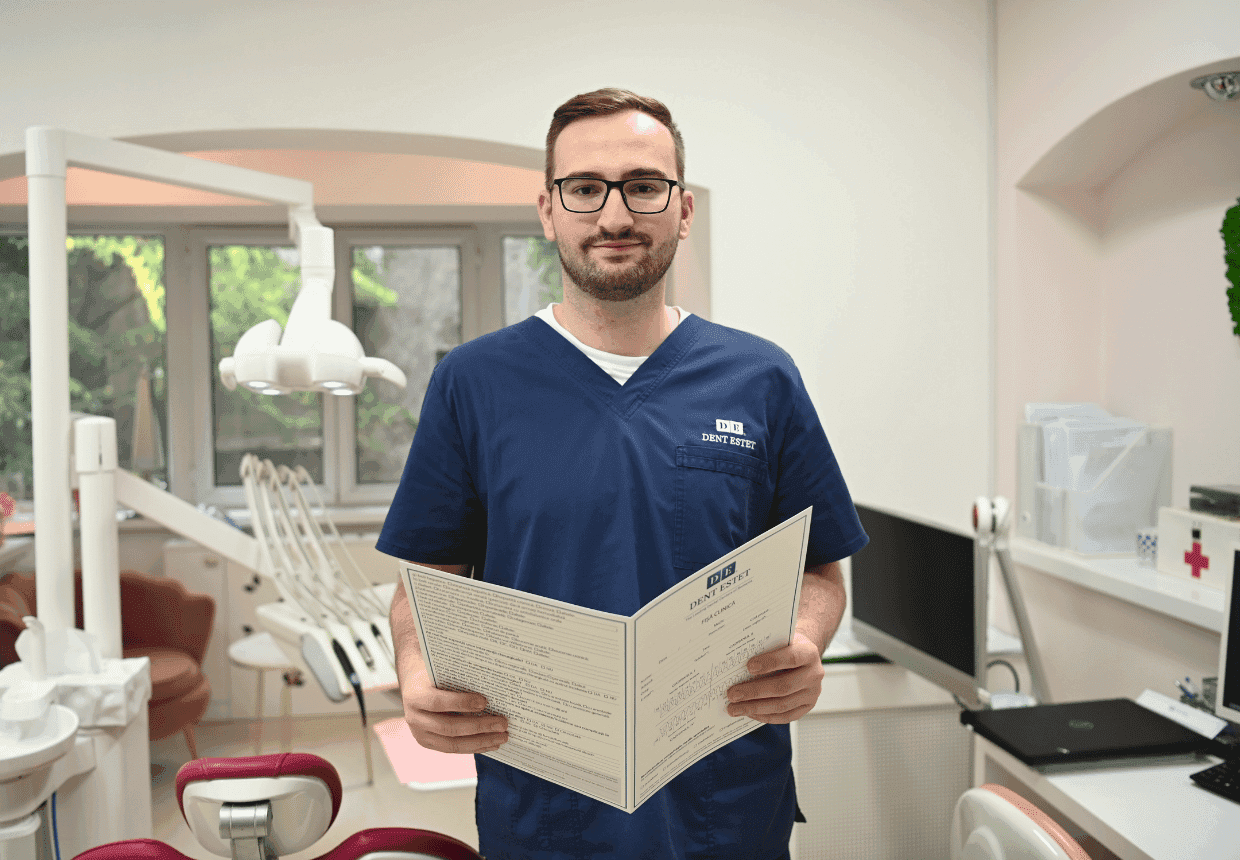
Dr. Rareș Nica
Specialist Dentist - DENTAL PROSTHETICS
About
Dr. Rareș Nica is a specialist in dental prosthetics at the DENT ESTET Ploiești clinic. He graduated from the Faculty of Dental Medicine of the “Titu Maiorescu” University, and later completed his specialized training in dental prosthetics at the “Carol Davila” University of Medicine and Pharmacy in Bucharest.
In his work, he focuses on restoring the functionality and aesthetics of the teeth through prosthetic treatments tailored to the needs of each patient. He pays attention to both medical precision and the natural integration of dental work, aiming for balanced results from a functional and aesthetic point of view.
He chose dentistry out of the desire to help patients regain their oral health and confidence in their own smile. He believes that a correct treatment plan must take into account the clinical situation, the function of the teeth and the patient's expectations.
In his relationship with patients, he emphasizes attention to detail, responsibility and clear communication. The greatest professional satisfaction is seeing that, at the end of the treatment, the patient can smile with confidence again.
In his free time, he enjoys spending time in nature, discovering new places, and traveling with family and friends.
Philosophy
Details make perfection, and perfection is not a detail. – Michelangelo
"I believe that medicine is not just about treating a disease. Its purpose is to improve people's lives—to restore the comfort of eating, speaking, and smiling without having to give it a second thought. In dental prosthetics, this concept takes a very tangible form: every restoration I create must function flawlessly in the patient's daily life for years to come, not merely look good on the day it is cemented.
That is why, for me, a successful treatment is one that restores functionality to a level as close to natural as possible, without neglecting aesthetics. I do not view them as separate goals requiring a compromise. In nature, a tooth's form is the result of its function; a restoration that truly respects anatomy, proportions, and how the teeth harmonize with facial features will almost invariably be aesthetically pleasing as well. Conversely, I am convinced that something unsightly cannot be truly functional: a smile the patient is unhappy with fails to fulfill its purpose, no matter how technically precise the execution.
The patient is a partner in every major treatment decision. I consider it my duty to clearly explain the diagnosis, the available options—along with their respective advantages and limitations—and exactly what each choice entails in terms of stages, duration, and expected outcomes. Only in this way does the decision truly belong to the patient: it is not a recommendation accepted out of blind trust, but a choice they understand and fully embrace.
The principle I never deviate from is minimal invasiveness. I preserve as much natural tooth structure as possible and intervene only to the extent necessary to achieve a predictable, long-lasting result. A proper treatment is not the most extensive one, but rather the one that resolves the issue while sacrificing the least amount of healthy tissue—because the ultimate goal is not the restoration itself, but the person living with it.”
In conversation with Dr. Rareș Nica
What drew you to dental prosthetics?
I was drawn to prosthodontics because it is the specialty that views the oral cavity as a whole and undertakes its complete rehabilitation. You do not treat a single tooth in isolation; instead, you consider function, occlusion, aesthetics, and long-term stability as an integrated system, often acting as the one who synthesizes the work of other specialties into a cohesive final result. Moreover, the outcomes are tangible—both for me and, above all, for the patient. The ability to follow a case from the planning stage through to the final restoration, and to actually see the difference it makes, was and remains the primary reason I chose this path.
What does a well-executed prosthetic restoration mean to you?
A truly well-executed prosthetic restoration is one that restores function to a level as close as possible to the natural state while remaining invisible. The patient should be able to eat, speak, and smile without feeling the presence of a foreign object, and others should not be able to tell that a restoration is there. For me, the greatest compliment is not "what a beautiful restoration," but rather the fact that no one notices anything—the teeth simply look and behave like natural teeth. To achieve this, the restoration must be correct in every aspect simultaneously: precise fit, balanced occlusion, integration with surrounding tissues, and a shape, color, and texture that blend seamlessly with the natural teeth.
How do you strike a balance between function, aesthetics, and patient expectations?
This balance is not found at the end; rather, it is built from the very beginning, prior to any irreversible intervention. Function is the foundation—a restoration must first work correctly—and aesthetics are built upon that foundation, not in opposition to it. I incorporate the patient's expectations into the process as early as possible through a consultation where we present concrete options for their specific case, outlining the advantages and limitations of each. We then move from words to visuals: a digital preview of the result, a wax-up on the model, and a mock-up directly in the mouth, allowing the patient to see and feel what the final restoration will look like before it is even created. In this way, expectations cease to be an unknown factor discovered only at the end; instead, they become a starting point that we refine together until the patient's desires and medically sound practice align.
What details allow a dental restoration to blend in naturally?
The natural look of a dental restoration lies in a combination of details that no one consciously notices, yet everyone immediately senses when they are missing. A natural tooth is not uniformly white; it features shifting shades from base to tip, slight translucency at the edge, and subtle variations that give it a lifelike quality. A successful restoration replicates precisely this, rather than imposing a perfect white—which is usually the first sign that something looks unnatural. Shape and texture also matter: real teeth are neither perfectly smooth nor identical, and the way their surfaces reflect light makes the difference between a smile that looks "too perfect" and one that looks simply like your own. It is equally important for the restoration to blend harmoniously with the gum line, creating the impression that the tooth is emerging from the gum rather than merely sitting on top of it. Other key factors include how the teeth relate to the lips when you smile or speak, the preservation—rather than elimination—of the slight asymmetries found in any natural smile, and, of course, the choice of the right material for each specific situation.
How do you involve the patient in important treatment decisions?
Patient involvement begins with a simple question I ask right at the start: what does the patient want, and what are their expectations regarding the treatment? I don’t base my approach on what I think they *should* want, but rather on what they tell me; only then do we build the plan together. Whenever possible, I propose multiple treatment options—outlining what each entails, along with its advantages and limitations—so that the decision becomes a genuine choice rather than simply accepting the only option presented. Communication doesn’t stop after the initial consultation; we discuss every stage, I explain the next steps and the reasons behind them, and I ensure the patient knows exactly where we stand and where we are headed at all times. A patient who understands what is happening is a patient who feels at ease, trusts the process, and stays engaged—and ultimately, that is reflected in the results.
What is the most complex part of rebuilding a smile?
The most complex aspect is usually not any specific procedure, but rather what happens before and between the procedures: planning and coordination. Rebuilding a smile is rarely a single intervention; more often, it involves a long-term treatment with multiple stages and the involvement of various specialists—such as surgeons, implantologists, and periodontists, and sometimes orthodontists or endodontists. Everything must be conceived from the start with the final result in mind and then built in reverse: determining what needs to be in place at each stage to make the next one possible. The sequence of steps matters—each depends on the preceding one—and over the course of several months, everyone involved must work according to the same plan and toward the same goal. My role is to maintain this big-picture perspective from the initial consultation to the final restoration, ensuring the patient feels they are following a coherent journey rather than undergoing a series of disjointed procedures.
What role does collaboration with other members of the medical team play?
Collaboration plays an essential role—perhaps more so in prosthodontics than in any other specialty—because the outcome never depends on just one person. The first partnership is with the laboratory: the dental technician is, in effect, the co-author of every restoration. I provide the clinical data, the treatment plan, photographs, digital files, and the shade selected with the patient; the technician transforms all of this into an object that must both look and function like a natural tooth. Without constant, precise communication between us, the final restoration cannot meet expectations, regardless of how excellent the clinical preparation may be.
The second partnership involves the interdisciplinary team: the surgeon who prepares the site and places the implants, the periodontist who manages gum and bone health, and the orthodontist who aligns the teeth correctly prior to rehabilitation. Each specialist contributes a vital component; without it, the prosthetic restoration would lack the necessary foundation. For the patient, the advantage is not having to coordinate between specialists: we communicate with one another and work according to a unified plan, while the patient sees a single, cohesive result.
What is your favorite moment in the course of a case?
The moment we complete the case and the patient sees the result. After weeks or months of planning, various stages, and fittings, everything culminates in just a few seconds: the restoration is in place, the patient looks in the mirror, and their reaction says it all. That burst of enthusiasm—sometimes vocal, other times just a broad, irrepressible smile—marks the moment when what we discussed during the initial consultation becomes reality. For me, this is the point where all the hard work finds its meaning. It is not just because the work turned out well, but because standing before me is no longer just a "case," but a person who eats, speaks, and smiles differently than when they first walked through the door. It is the reason I do this job, and what makes me look forward to the next case with the same energy.
What does time spent in nature offer you, and what do you then bring back with you to the consulting room?
First of all, energy. Time spent in nature allows me to disconnect from the pace of the dental practice and return with a clear mind. Then, nature is the best teacher of aesthetics I have: nothing in it is perfectly symmetrical, uniform, or "too clean," yet everything seems to be exactly where it belongs. It is precisely this kind of beauty—with the small imperfections that make things feel alive—that I strive to recreate in my prosthetic work. And, last but not least, I bring with me a certain sense of tranquility: the patience to let each stage take its natural course, and the calm that the patient feels the moment they step into the practice.
Dental Health, Explained by Dr. Rareș Nica
Online appointment
Fill out the form and one of our assistants will contact you to schedule a visit to the clinic.