



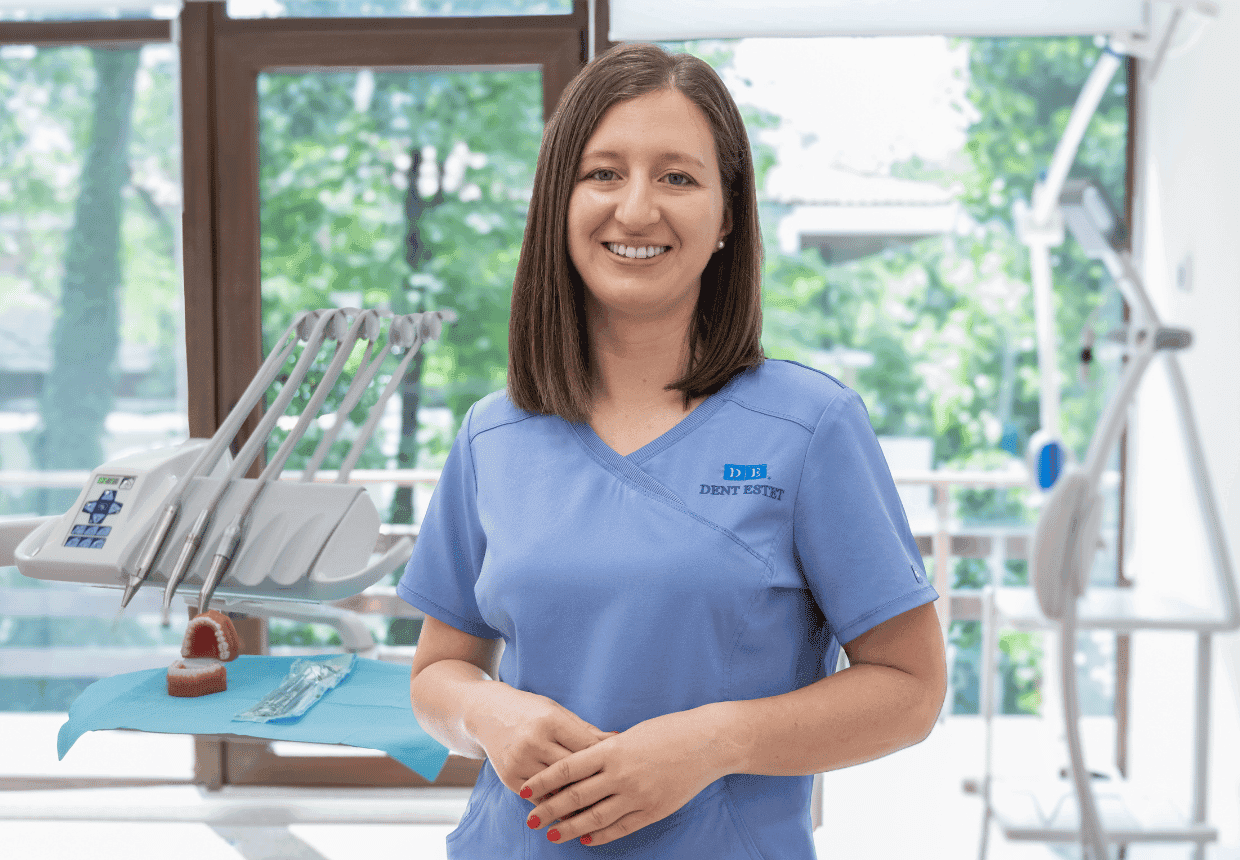
Dr. Valeria Nechita
Specialist Dentist – ORTHODONTICS AND DENTO-FACIAL ORTHOPAEDICS
FAS (Face Aligner System) certification
About
Dr. Valeria Nechita is a specialist in Orthodontics and Dentofacial Orthopaedics at the DENT ESTET Aviatorilor 98 and DENT ESTET 4 TEENS clinics in Bucharest, with experience in treating both adult and adolescent patients.
She graduated from the Faculty of Dental Medicine at the ‘Carol Davila’ University of Medicine and Pharmacy in Bucharest in 2016 and subsequently completed her residency in Orthodontics and Dentofacial Orthopaedics at the same university, between 2016 and 2019.
During the orthodontic assessment, she analyses the position of the teeth, the way they align when the mouth is closed, and the function of the temporomandibular joint (TMJ). In the case of adolescents, she also takes their stage of growth into account when determining the timing and stages of treatment.
Dr Valeria Nechita uses digital tools to document the initial situation and plan tooth movements, including in treatments involving dental aligners. Depending on the case, the assessment may include intraoral and extraoral photographs, 3D scans and 4D dynamic recordings using MODJAW®, which enable analysis of mandibular movements.
In complex cases, she establishes the treatment stages in collaboration with doctors from the other relevant specialities. When the plan includes orthognathic surgery, Dr Nechita plans and monitors the orthodontic stages in collaboration with the surgical team.
Dr Valeria Nechita has furthered her training in functional and digital orthodontics through the advanced FACE programmes and courses dedicated to aligner treatment.
Courses and conferences
2026
- Aligners Course – April 2026, Valencia, Spain
2025
- FACE XP Continuing Education – HANDS-ON COURSE 2023–2025 (7 modules) Parma, Italy
2024
- FAS Aligners meeting – April 2024, Barcelona, Spain
- In-practice training with Dr Alberto Canabez – April 2024, Barcelona, Spain
- DSD aligners, 6 online modules, 5–21 November 2024, Bucharest, Romania
2023
- FACE International Meeting – June 2023, Bucharest, Romania
- In-office training with Dr Alberto Canabez – May 2023, Barcelona, Spain
- FACE Aligner System – certification course – May 2023, Bucharest, Romania
- BENEFIT System Course – March 2023, Bucharest, Romania
2022
- FACE 2-Year Advanced Orthodontics International Course – 2020–2022, Cluj, Romania; Parma, Italy
2019
- FACE 10-Year Conference, Goal-Directed Predictability – November 2019, Cluj, Romania
- 11th World Implant Orthodontic Conference – October 2019, Bucharest, Romania
2018
- Dental Focus Conference: Modern Orthodontic Concepts: Non-surgical and surgical treatment options – November 2018, Bucharest, Romania
2017
- The International Orthodontic Learning Programme – 2017–2018 (5 modules), Bucharest & Vilnius, Romania & Lithuania
- ‘Ortho Analyzer 3Shape Level 2’ training, November 2017, Copenhagen, Denmark
- Principles of the Tweed Technique, pre-Tucson course – June 2017, Bucharest, Romania
2015
- Workshop: ‘Direct Restorations: Correct, Natural and Aesthetic Solutions’, Prof. Simone Grandini – June 2015, Bucharest, Romania
Philosophy
When it comes to orthodontics, I believe in a conservative approach and, much like an artist, I have an overall vision of what will look aesthetically pleasing in terms of the shape and position of the teeth. What I love most about my profession is that I have the opportunity to improve someone’s life by giving them a healthy, carefree smile, and to help them feel good about themselves and more confident.
Interview with Dr. Valeria Nechita
Why did you choose to study dentistry?
I could say that she chose me, or, rather, that she was chosen for me. With several options in mind, my French teacher, with whom I’d been having private tuition since Year 3, told me at one point that dentistry would certainly suit me. That’s when I started to toy with the idea. I’d been seeing the same dentist for many years; I gradually became more interested and observant during my check-ups, and I realised that I liked the atmosphere in the surgery and the results the dentist achieved for patients. That’s where it all began.
But what about specialising in Orthodontics and Dentofacial Orthopaedics?
It was much simpler here. At university, I explored all the specialisms, and Orthodontics was by far the one that sparked my interest the most, as it is a specialism that involves a great deal of planning and organisation. Furthermore, the spectacular results you can achieve have both aesthetic and social implications. When you see a patient whose self-esteem soars when they smile, who seems to take flight and feel they can achieve anything in life, that’s when you feel a real sense of satisfaction as a doctor.
What is the most important thing when it comes to a healthy smile?
Let it be the smile you no longer want to hide, the one you want to show to everyone.
When did your journey with DENT ESTET begin?
Eight and a half years ago, shortly after I finished university.
Is there a particular course or moment that has had a significant impact on your professional development?
Yes, it’s the FACE course, a modular programme spanning nearly two years, which has made me see orthodontics as a much more complex specialism. The course begins with a detailed analysis of the patient’s dental and facial aesthetics and places just as much emphasis on occlusion – the patient’s bite – as this is what ensures dental health. It really is a course which, I can say, has completely changed my outlook on the diagnosis of patients and, by extension, on treatment options.
What would you say to adult patients who, for various reasons, put off seeking orthodontic treatment?
I believe there are two very important things that patients need to know: there is no age limit for orthodontic treatment, and regardless of the age at which it is carried out, it can extend the lifespan of the teeth in the dental arch.
Why should every child have an orthodontic check-up?
Because, during the growth phase, with an accurate diagnosis, the development of abnormalities can be prevented. So our aim is preventative. Furthermore, when it comes to treatment, treating children has the great advantage of the patient’s growth, which helps us to guide both tooth growth and bone growth in a favourable direction.
Orthodontic treatment between the ages of seven and ten can completely correct certain abnormalities and can also make treatment during adolescence easier and shorter.
What does the future of dentistry look like in the field of orthodontics?
In orthodontics, as in other specialisms, the future is digital: from taking impressions, through diagnosis and treatment planning, to the fabrication of dental appliances.
Do you have a mentor or someone who inspires you? Why?
My mentors at the moment are the lecturers on the FACE course: Dr Renato Cocconi, Dr Domingo Martin and Dr Alberto Canabez. They are the ones who have broadened my horizons.
But do you have a favourite MOTTO?
“A healthy smile enables a person to reach their full potential in life.”
What do you love most about your job?
That every patient is different and, in practice, presents a new challenge.
Choose three words that best describe you.
Organised, persevering, reliable.
How would your patients describe you?
Let’s ask them. I can describe how I see myself in relation to my patients: patient and keen to help them understand their diagnosis, the aims of their treatment and the purpose of each piece of equipment.
What gives you the greatest satisfaction in your job?
Patient satisfaction at the end of treatment, when we compare the initial situation with the final one, and the fact that they know we have made some positive changes, both in terms of appearance and function.
What is your promise to patients?
During the treatment planning session – the one in which the patient and I set our shared goals – we discuss both the process and the outcome, and what I always tell my patients is that I will take all their wishes into account, provided that fulfilling them is within my power. My patients also know that, although the journey can sometimes seem difficult and lengthy, the results will be well worth it.
Who is Valeria Nechita when she isn’t busy straightening smiles?
Mum to a five-and-a-half-year-old boy, who loves the mountains, reading and spending time with friends.
Dental Health, Explained by Dr. Valeria Nechita
Online appointment
Fill out the form and one of our assistants will contact you to schedule a visit to the clinic.