



Does activated charcoal whiten teeth or damage tooth enamel?
 Author: Dr. Andreea Florea
 November 23, 2026
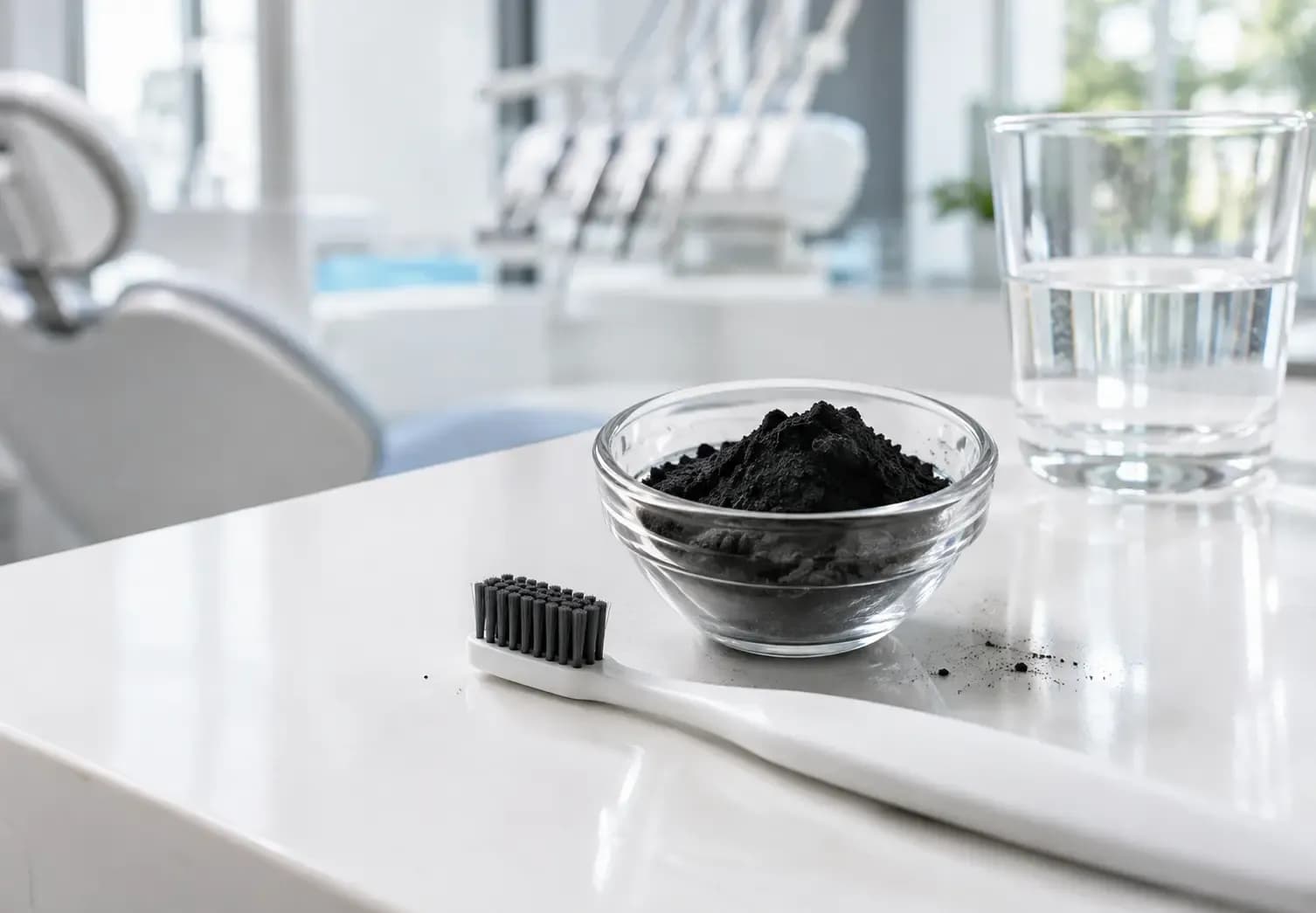
Activated charcoal does not whiten teeth in the same way as professional teeth whitening treatments. Some products may help remove surface stains, but they do not change the natural shade of the teeth. Furthermore, repeated use of abrasive formulations may contribute to tooth enamel wear.
Marketed as toothpaste, powder or capsules, activated charcoal has become popular as a ‘natural’ alternative to teeth whitening. However, the visual effect of teeth appearing cleaner should not be confused with actual whitening.
Its popularity is also underpinned by the fact that:
- it is perceived as a ‘natural’ product;
- it is readily available;
- the visual effect of the black powder is striking;
- it is heavily promoted on social media;
- it can quickly give the impression of cleaner teeth.
However, the fact that a product is natural or popular does not automatically mean that it is the most suitable method for the tooth surface.
Can activated charcoal whiten teeth?
Not in the sense of teeth whitening as such.
Teeth whitening involves lightening the shade of the teeth through the action of agents that affect the pigments in the tooth structure. Activated charcoal does not work in this way.
The benefits of an in-clinic teeth-whitening treatment
How does activated charcoal work on stains?
Its effect is primarily mechanical.
The particles can scrub the tooth’s surface and help remove extrinsic stains, such as those caused by coffee, tea or other pigmented products.
After use, your teeth may appear cleaner or brighter.
Why does surface cleaning not mean whitening?
Extrinsic stains are located on the surface of the tooth and can be reduced by cleaning.
"The natural colour of a tooth is influenced by its internal structures, including the dentine. Activated charcoal does not alter this colour at a deeper level. Therefore, removing a stain is not the same as lightening the tooth’s natural shade.” – Dr Andreea Florea, Dentist, Cosmetic Dentistry at the DENT ESTET clinic in Sibiu
How can activated charcoal affect tooth enamel?
The main issue relates to abrasion. If the tooth surface is repeatedly rubbed with an abrasive product, there is a risk that the enamel will gradually wear away.
The impact varies depending on the product, particle size, frequency of use and the pressure applied whilst brushing.
The abrasiveness of products can vary
Not all activated charcoal products have the same formula.
In the case of powders or capsules used as makeshift remedies, it is difficult to assess how abrasive the particles are and how much pressure is being exerted on the tooth.
Lost enamel does not regenerate
If enamel thins due to wear, the lost structure does not grow back.
Furthermore, the underlying dentine has a naturally more yellowish hue. As the enamel becomes thinner, this can become more visible.
Paradoxically, repeated use of a chosen ‘whitening’ method can make teeth appear yellower.
It may increase tooth sensitivity
Thinning or wear of the tooth surface can contribute to the development of sensitivity.
The patient may experience discomfort when:
- cold;
- hot;
- acidic foods or drinks;
- certain sweet foods.
Not all charcoal-based products are equivalent to ordinary toothpaste
Some activated charcoal products may have different formulations to toothpastes intended for daily use, including in terms of fluoride content.
For this reason, a product chosen solely for its ‘whitening’ effect should not automatically replace the toothpaste used for regular oral hygiene. Find out what rules you need to follow to ensure a proper routine and a white, healthy smile
What other drawbacks might products containing activated charcoal have?
As well as possible abrasion, the use of activated charcoal can also cause practical problems.
Black particles can become lodged between the teeth, near the gums or around the edges of dental restorations. These can sometimes be difficult to remove and may produce exactly the opposite aesthetic effect to that intended.
Other problems may include:
- irritation of the gums due to excessive rubbing;
- accumulation of particles in the interdental spaces;
- short-lived results;
- overuse in the hope of achieving a more noticeable effect;
- a false sense that the discolouration problem has been resolved.
How can you tell if your enamel might be affected?
Enamel wear does not always cause obvious changes straight away. As it progresses, however, certain signs may appear that are worth looking out for.
These include:
- sensitivity to cold or heat;
- sensitivity to acidic foods;
- more translucent tooth edges;
- changes in surface texture;
- changes in tooth shape;
- a more yellowish appearance;
- visible areas of wear.
If you have been using activated charcoal or other abrasive methods frequently and notice such changes, it is advisable to stop using them and book an assessment.
Activated charcoal or professional teeth whitening: what’s the difference?
The two methods work through different mechanisms.
Activated charcoal is primarily designed to mechanically remove surface stains. Teeth whitening acts on the pigments in natural teeth by using whitening agents.
| Criterion | Activated charcoal | Professional in-clinic whitening |
| Mode of action | Surface abrasion | Action on tooth pigments |
| Can it alter the natural shade? | No | Yes, depending on the case |
| Assessment before use | Usually not | Yes |
| Soft tissue protection | Not medically supervised | Performed as part of the procedure |
| Tailored to the patient | No | Yes |
| Monitoring | No | Yes |
| Result | Variable, mainly on superficial lesions | Adapted to the type of staining and the clinical situation |
Why does professional teeth whitening offer greater control?
In-clinic teeth whitening is preceded by an assessment of the teeth and gums. This enables the dentist to determine whether the procedure is suitable and whether there are any issues that need to be treated first.
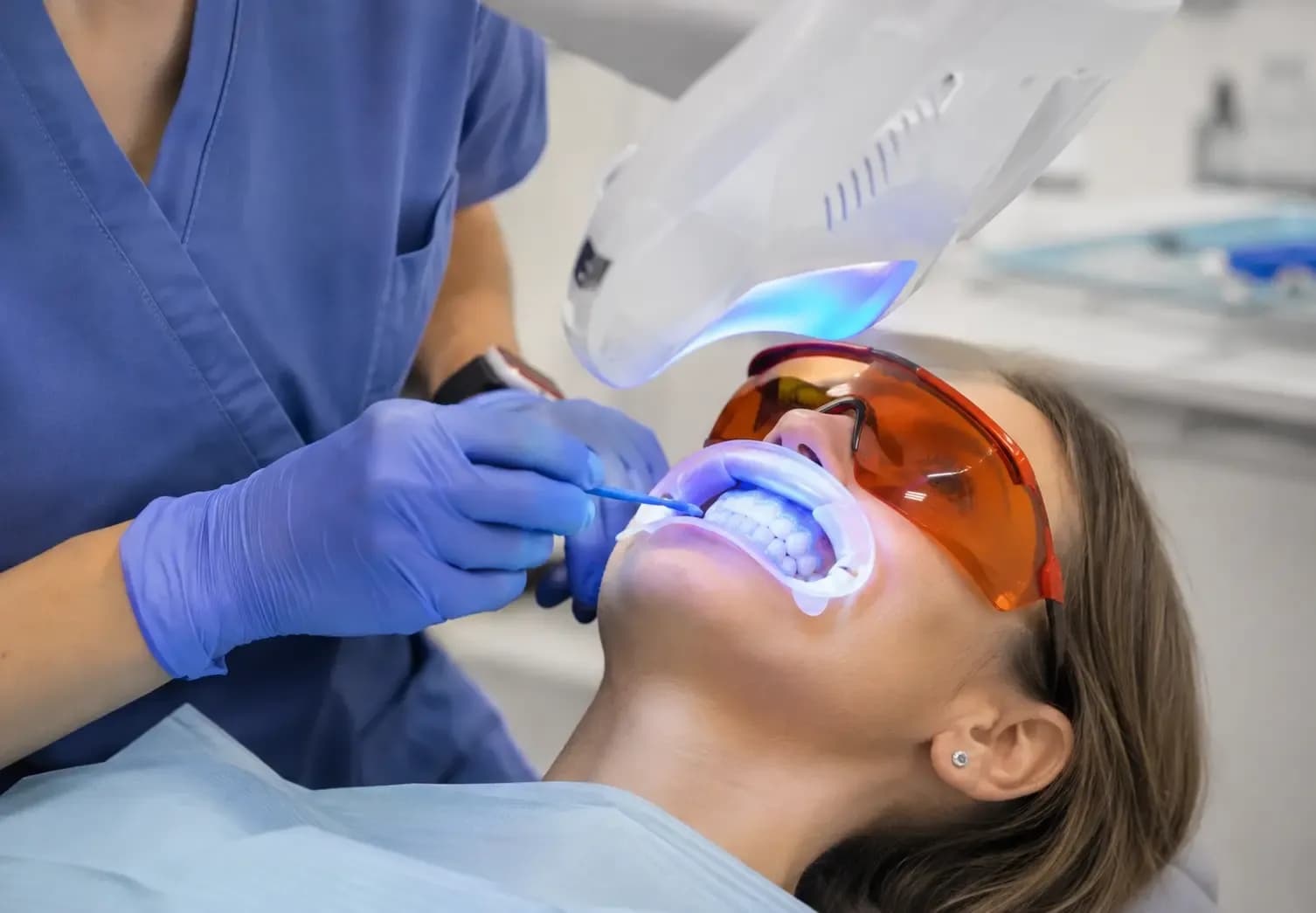
At the dentist’s:
- the health of your teeth and gums is assessed;
- the type of staining is identified;
- the soft tissues are protected;
- the treatment is tailored to the patient;
- sensitivity can be monitored;
- the result can be monitored throughout the procedure.
The key difference is not just the aesthetic result, but the fact that the procedure takes place in a controlled environment.
Why is professional cleaning important before bleaching?
Not every tooth that appears darker in colour necessarily needs whitening.
Bacterial plaque, tartar and superficial stains can alter the appearance of teeth. Professional cleaning removes these and allows the true natural shade to be assessed.
Sometimes, once surface stains have been removed, the patient finds that their teeth are already bright enough.
In short:
- cleaning removes stains, whilst whitening reveals the natural shade of the teeth.
- For superficial stains, professional cleaning may be a more suitable option than repeated use of an abrasive product at home.
When should you see a doctor before trying a teeth-whitening method?
Changes in tooth colour can have various causes, and some of these cannot be resolved by whitening.
An assessment is recommended before using whitening products if:
- you have severe tooth sensitivity;
- you have untreated tooth decay;
- you have damaged fillings;
- your gums are inflamed or bleeding;
- you notice areas of wear;
- the edges of your teeth appear more translucent;
- a single tooth has changed colour;
- your teeth have gradually become more yellow and you do not know the cause.
A tooth that has changed colour on its own should be assessed before any cosmetic procedure.
Frequently asked questions about activated charcoal and teeth whitening
Are charcoal toothpastes safer than charcoal powder?
Products formulated for dental use are easier to control than a makeshift powder, but their composition and abrasiveness vary from product to product.
Can I use activated charcoal if I have sensitive teeth?
It is wiser to speak to your doctor first. There is a cause for the sensitivity that needs to be identified, and rubbing the area with an abrasive product may make it worse.
Does activated charcoal whiten crowns and fillings?
No. Activated carbon does not alter the colour of the restorations, and black particles may sometimes accumulate at their edges.
How often can activated charcoal be used?
There is no single frequency that is suitable for everyone and every product. It is advisable to consult your doctor before using it repeatedly.
A superficial result is not worth achieving at the expense of one’s dignity
Activated charcoal can help remove certain superficial stains, but this effect should not be confused with teeth whitening.
Frequent use of abrasive products can damage the enamel, and tooth structure lost through wear does not regenerate spontaneously.
If you want brighter teeth, the first step is to identify the cause of the discolouration. Depending on the situation, a professional cleaning may be sufficient, or a whitening procedure carried out under controlled conditions may be recommended.
Book a consultation and a whitening assessment at DENT ESTET to find out which option is right for your teeth.