




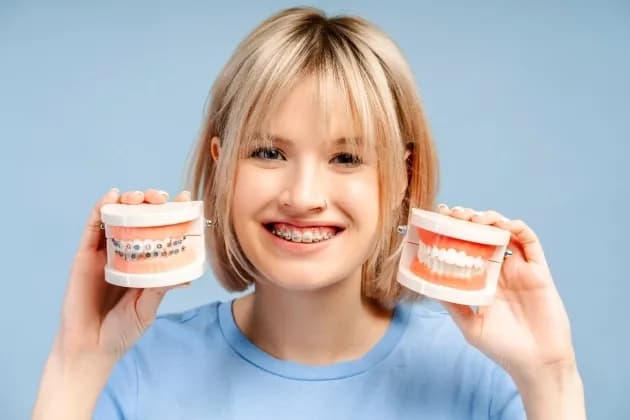
Teeth straightening or braces – differences, advantages and disadvantages
 Author: Dr. Dr Ana Marinescu
 February 24, 2026
Orthodontic treatment aims to correct the bite and achieve optimal dental alignment for facial aesthetics. There are many indications for orthodontic treatment, ranging from simple crowding to serious dento-skeletal problems.
To achieve these objectives, two types of orthodontic appliances can be used:
- fixed braces – these involve attaching brackets to the surfaces of the teeth;
- clear aligners – orthodontic appliances that use custom-made aligners.
If you’re wondering which option is right for you, we invite you to read this article to find out the differences between the two categories of orthodontic appliances, as well as the advantages and disadvantages of each system.
What are dental aligners?
Aligners, or dental splints, are orthodontic appliances that work by gradually adjusting the position of the teeth. Each set of aligners consists of two trays, one upper and one lower, which work simultaneously, coordinating the movements of both dental arches.
“Treatment with aligners can be recommended for adults as well as children and teenagers, even during periods of growth. There are aligner systems that allow children to be treated in two stages: an initial stage and a final stage, once growth has ceased,” explains Dr. Ana Marinescu, Specialist in Orthodontics and Dentofacial Orthopaedics.
Dental aligners are made from a flexible, transparent plastic material that is biocompatible with intraoral tissues. Thanks to their transparency, they offer improved aesthetics, as the aligners are almost invisible in the mouth.
The aligners, custom-made based on data entered into specialised software, guide the teeth into the correct position. Each set of aligners can be worn, depending on the stage of treatment, for a period of 7, 10 or 14 days.
The benefits of orthodontic treatment:
• High-quality cosmetic dentistry
Aligners can go unnoticed by those around you, making them ideal for anyone who wants to straighten their teeth discreetly.
• Enhanced comfort
The mouthguards can be removed whilst eating or whenever you wish, although they must be worn for 22 hours a day.
• Maintaining optimal oral hygiene
The mouthguards can be removed for tooth brushing whenever necessary.
What are braces?
Braces are a fixed orthodontic appliance used to align the teeth and restore the functionality of the dento-maxillary complex.
During orthodontic treatment, the specialist guides the desired tooth movements by fitting brackets to the teeth and threading metal wires through the brackets using elastic bands.
Each bracket contains information relating to the future position of the tooth; they are, in effect, the tools through which the orthodontist corrects malocclusion and improves the aesthetics of the smile.
Orthodontic brackets come in several forms:
- metal
- self-ligating metal
- ceramic
Brackets can be fitted to the outer or inner surfaces of the teeth (lingual).
Traditional brackets use coloured or plain elastics to secure the archwire inside them, whereas self-ligating brackets do not require these, as they feature a flap that helps to secure the archwire within the brackets.
Main benefits of braces:
Greater efficiency in treating complex orthodontic cases.
Superior control during orthodontic treatment.
Affordable compared to dental aligners.
Key differences between teeth straightening and braces
Dental alignment
1. Aesthetics
The aesthetic advantage lies with dental aligners, which are almost invisible. Pressure points made from a composite material matched precisely to the colour of the patient’s teeth are applied to the tooth surfaces, but these are barely visible.
These pressure points may become discoloured following excessive consumption of food and drink containing food colourings, but any discolouration can be quickly removed during a professional dental hygiene appointment.
2. Duration and effectiveness of treatment
New innovations in modern orthodontics have made the use of aligners effective in increasingly complex cases.
However, there are cases (impacted teeth, severe jaw compression) where a hybrid system must be used, involving the use of fixed orthodontic appliances (disimpaction devices, segmental braces), with the final stage completed using aligners.
There are also certain types of tooth movement that aligners can achieve more easily and precisely than orthodontic brackets.
3. Comfort
As they are made from a flexible plastic material using innovative technologies, aligners are much more comfortable and are also easy to remove.
The initial discomfort caused by the tooth movements themselves occurs with both treatment options. In the first few days, the patient may feel slight pressure on their teeth caused by the force exerted by the aligner, which gradually subsides over the first 3–5 days after activation.
4. Oral hygiene
Dental aligners are removed for every meal, allowing for thorough and comprehensive brushing;
Furthermore, aligners are easier to clean once removed from the mouth. This reduces the risk of tooth decay, which helps to maintain good dental and periodontal health.
5. Durability
As dental aligners are made from a flexible material, they cannot break whilst in the mouth; however, they may break if not stored carefully in their case.
6. Diet
There are no dietary restrictions when undergoing treatment with dental aligners. You can follow your usual diet, but remember that the aligners must be removed before meals.
It is not recommended to consume hot or coloured liquids whilst wearing aligners, as the material they are made from may alter its properties.
7. Costs
Although dental aligners have a higher initial cost, they do not require such frequent check-ups, and maintenance costs are usually covered by the initial cost.
Braces
1. Aesthetics
Ceramic or composite brackets are much more aesthetically pleasing than metal ones, as they are close to the natural colour of the teeth, and using them in combination with clear elastics significantly improves the appearance of the mouth.
These contact points may become stained due to excessive consumption of foods and drinks containing food colourings, but the stains can be quickly removed during a professional cleaning appointment.
2. Duration and effectiveness of treatment
The biomechanics of fixed braces are far more precise, offering superior control compared to clear aligners.
In complex cases of impacted teeth or severe skeletal abnormalities, orthodontic treatment with brackets may be more effective than treatment with aligners.
There are also certain types of tooth movement that aligners can achieve more easily and precisely than orthodontic braces.
3. Comfort
Braces cause greater initial discomfort than aligners. Due to the components of the braces, sores may develop on the inside of the cheeks or on the tongue, or mouth ulcers may occur.
4. Oral hygiene
During orthodontic treatment with braces, teeth must be brushed with greater care, particularly in hard-to-reach areas. The area between the braces and the gums is prone to dental demineralisation or gum inflammation.
Additional cleaning aids are required to remove bacterial plaque from these areas.
5. Durability
Metal brackets are the most resistant to microtrauma, followed by aesthetic brackets – ceramic or composite. These can become detached from the tooth surfaces; however, unlike aesthetic brackets, they cannot break.
6. Diet
When undergoing treatment with braces, there are several dietary restrictions:
- Hard foods (nuts, hazelnuts, etc.) should be avoided or eaten with care;
- Sticky foods (chewing gum, toffees, etc.) should be avoided;
- Extra care is needed with fruit and vegetables containing stones.
It is not recommended to consume hot or coloured liquids whilst wearing aligners, as the material they are made from may change its properties.
7. Costs
Orthodontic treatment with braces involves monthly costs for maintenance and adjustment of the braces, as well as additional costs in the event of breakage or detachment of any components. Metal braces have the advantage of lower initial costs than aesthetic braces.
How to choose between aligners and braces
The choice of orthodontic appliance depends primarily on the type of dento-maxillary abnormality.
“A consultation with a specialist orthodontist is essential for understanding the advantages and disadvantages of both options, in line with the diagnosis and the complexity of the case. Costs, aesthetic preferences and patient compliance are factors that influence the choice of orthodontic appliance,” explains Dr Ana Marinescu, Specialist in Orthodontics and Dentofacial Orthopaedics.
Frequently asked questions about braces and aligners
What are aligners and how do they work?
Aligners are modern, almost invisible orthodontic appliances that work by programming the desired tooth movements into each set of aligners.
Are braces more effective than aligners?
Both types of orthodontic appliances are effective when the choice is based on objective criteria, following an accurate and comprehensive diagnosis.
Which option is more comfortable?
Dental aligners are more comfortable than orthodontic braces, do not cause intraoral lesions and allow for excellent oral hygiene.
Which solution is easier to clean up?
Dental aligners are easier to keep clean than braces, as they can be removed from the mouth and regularly checked for bacterial plaque build-up.
Are aligners more expensive than braces?
The initial cost of aligner treatment is higher, but the costs of treatment with braces, together with the monthly costs of adjusting the braces, are similar.
Bibliography
- Clear Aligner Therapy: An up-to-date review article, Journal of Orthodontic Science, 2023
- Clear Aligner Treatment: Indications, Advantages, and Adverse Effects—A Systematic Review, Dentistry Journal, 2025
- Metal vs. Ceramic Braces: A Comprehensive Comparison, article published on www.bracestoday.com, 2023
- Clear Aligners vs. Braces: Which is Right for You?, American Association of Orthodontists, 2019