




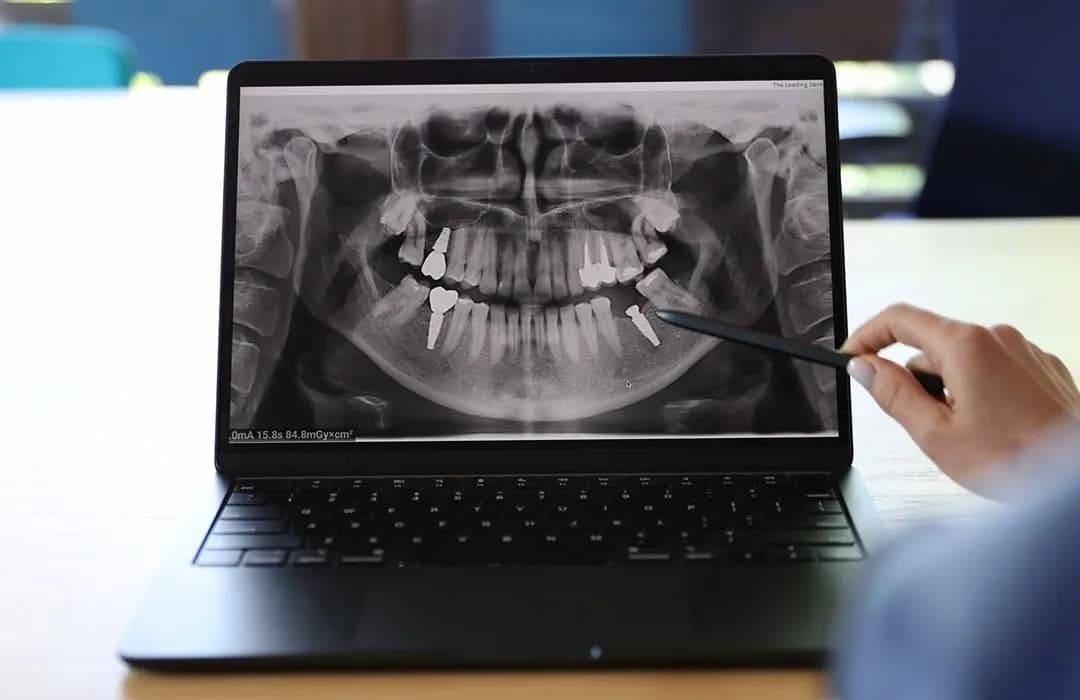
Bone resorption after tooth extraction: Why It occurs and how it can be limited
 Author: Dr. Ionela Dumitru
 September 9, 2026
After a tooth is extracted, the alveolar bone naturally begins to resorb, with the loss of bone volume being more pronounced during the first few months. This biological process, during which the alveolar ridge gradually loses some of its original dimensions, can be limited through treatments performed at the appropriate time.
The alveolar bone is the part of the maxillary and mandibular bone that supports the roots of the teeth. It is constantly undergoing remodelling in response to local mechanical and biological stimuli. The health and volume of the alveolar bone are important not only for supporting the teeth and enabling proper chewing, but also for facial appearance.
In addition, when replacing the missing tooth with a dental implant is being considered, the amount and shape of the available bone are important factors for correct implant positioning and for achieving a functional and aesthetic result.
What is bone resorption after tooth extraction?
After a tooth is extracted, the bone that previously surrounded its root no longer receives the same biological and mechanical stimuli. As a result, bone resorption occurs, a process in which bone tissue is broken down and remodelled.
“Healing of the extraction socket begins immediately after the tooth is removed. A blood clot forms, followed by controlled inflammation, proliferation of granulation tissue, formation of new bone and its progressive remodelling. This process is normal and necessary for wound healing, but it does not completely restore the shape and bone volume that existed before the extraction.” - Dr Ionela Dumitru, Dentist – Aesthetic Dentistry, certified in Implantology
Why does the body start to lose bone after tooth extraction?
One important explanation is the loss of tooth function and of the stimulation transmitted to the bone through the supporting structures. The periodontal ligament, which connects the tooth root to the alveolar bone, is vascularised and contains cells and receptors involved in tissue maintenance and remodelling. Once the tooth is removed, the periodontal ligament disappears from the socket and the stimulation associated with the tooth is lost.
It is important to emphasize that resorption does not mean that the bone suddenly “disappears” after extraction. It is a gradual process influenced by:
- local anatomy;
- the thickness of the bone walls;
- the reason for the extraction;
- the presence of infection;
- the way in which the alveolus heals.
For this reason, assessing the area and planning treatment in advance can play an important role when there is an intention to replace the tooth with an implant.
How much bone is lost and how long does it take?
Bone loss after tooth extraction occurs in stages. However, it begins within the first few weeks following extraction and continues at a slower rate over the years if the tooth is not replaced with a dental implant.
- The first changes occur in the first few weeks;
- Most of the resorption takes place within the first 3–6 months;
- The process continues slowly over the following years.
Bone resorption begins within the first few weeks after extraction
The first changes to the alveolar ridge occur in the first few weeks after extraction. During this period, the following take place:
- the blood clot formed after extraction develops and becomes organized;
- the clot is replaced by granulation tissue;
- new bone begins to form.
At the same time, the walls of the extraction socket undergo remodeling and the dimensions of the alveolar ridge begin to decrease.
How much bone is lost in the first 3–6 months after extraction?
The most significant changes in dimensions generally occur in the first 3–6 months.
According to some studies, this period may involve:
- horizontal bone loss of approximately 29–63%;
- vertical bone loss of approximately 11–22%.
These percentages should be interpreted as values reported in the scientific literature, not as an exact prediction for each patient.
The process continues if the tooth is not replaced with an implant
After the first 6 months following extraction, alveolar bone remodelling continues, but at a slower rate.
Dental implant treatment is the solution for stopping this process. If implant treatment is planned, the dentist may consider preserving the extraction socket from the time the tooth is removed. Recent studies suggest that, in certain situations, this approach may reduce the need for subsequent bone augmentation procedures.
What factors accelerate bone resorption?
Several factors can negatively influence tissue healing after tooth extraction:
- Tooth extraction is the main event that triggers bone resorption, but the rate and extent of these changes vary from patient to patient;
- Dental infections and periodontitis can compromise the tissues surrounding the tooth and lead to bone loss even before the extraction takes place;
- Poor oral hygiene can have a negative impact on healing;
- Dental trauma can affect the healing period;
- Smoking may be associated with greater bone loss, according to studies;
- Long-term use of removable dentures;
- Certain diseases or treatments that affect bone metabolism or healing. A specific example is medication-related osteonecrosis of the jaw (MRONJ), which is particularly associated with certain antiresorptive and antiangiogenic drugs (e.g. medication for osteoporosis). This is a complication distinct from normal physiological resorption and should be discussed separately when the patient is undergoing such treatments.
Why is preserving bone important for a future dental implant?
A dental implant requires adequate bone volume and good bone quality so that it can be positioned correctly and integrate successfully. It is not enough for there to be simply “some bone”; the shape of the alveolar ridge must allow the implant to be positioned appropriately in relation to the future dental crown and the surrounding tissues.
“When there has been significant bone resorption, implant placement can become more difficult. Sometimes the implant can be inserted without further intervention; at other times, bone augmentation is required either before or at the same time as implantation. The aim of alveolar socket preservation is precisely to limit volume loss and to make future treatment more predictable and, in certain cases, less complex.” – Dr Ionela Dumitru
However, alveolar socket preservation does not guarantee that the implant can subsequently be placed without any further procedures, such as bone augmentation.
Alveolar ridge preservation: the most effective method for preventing bone loss
Alveolar ridge preservation (maintaining bone volume following tooth extraction), known in the specialist literature as alveolar ridge preservation (ARP), refers to a group of procedures carried out immediately after extraction to limit bone resorption and to preserve the volume and shape of the alveolar ridge as effectively as possible.
Depending on the situation, the dentist may place a grafting material into the socket and may use a membrane or a socket-sealing material.
The aim of the procedure is not simply to ‘fill’ the space left after extraction, nor is it to completely halt bone loss. However, alveolar socket preservation can limit this loss and help to maintain the best possible bone volume for a future dental implant.
Studies confirm this benefit. A meta-analysis published in 2025 showed that, compared with natural healing following extraction, preservation procedures can reduce bone loss by approximately 2 mm in width and 1–2 mm in height.
Materials used for alveolar ridge preservation
- xenografts – materials of animal origin;
- allografts – bone materials derived from human donors, processed under specific conditions;
- synthetic (alloplastic) materials – bone substitutes made from biocompatible materials;
- collagen membranes or other methods of sealing/protecting the alveolar socket, used depending on the chosen technique.
Who is it recommended for?
Alveolar socket preservation may be considered particularly when:
- an implant is planned following extraction;
- there is a risk of significant bone volume loss;
- maintaining the contour of the alveolar ridge is important from an aesthetic point of view.
What options are available if the bone loss has already occurred?
Where bone resorption has already occurred, there are several methods by which bone volume can be restored:
Bone augmentation
- Bone augmentation can be used when the volume of bone in a particular area needs to be increased.
- Depending on the case, materials of human, animal or synthetic origin may be used.
- In some situations, bone augmentation can be performed at the same time as dental implant placement. In others, a healing period is required before the implant can be placed.
Guided bone regeneration (GBR)
- Guided bone regeneration involves the use of grafting material together with a membrane that helps maintain the space required for new bone formation.
- It is frequently used for horizontal defects or for certain vertical defects.
- It can be carried out prior to, or at the same time as, implant placement.
Sinus lift
- A sinus lift is a surgical procedure that creates the space required to place grafting material beneath the sinus membrane.
- It is indicated when, following tooth loss, there is a reduction in bone height in the posterior region of the maxilla, accompanied by pneumatisation of the maxillary sinus.
Bone blocks
- It is a surgical procedure indicated for extensive bone defects, when the available bone volume is insufficient for implant placement.
- Bone blocks are generally used in situations where less complex augmentation methods cannot provide the necessary bone volume.
How can bone loss be prevented?
Ideally, the prevention of bone loss begins before extraction becomes necessary. Timely treatment of tooth decay, infections and periodontal disease can help to preserve the tooth and the alveolar bone. When extraction is unavoidable, ensuring the procedure is as minimally invasive as possible, whilst protecting the alveolar walls, can contribute to a more favourable healing process.
Proper oral hygiene, regular dental check-ups and treatment of periodontal disease are important for maintaining the supporting tissues. Giving up smoking is also recommended to promote healing and reduce the risks associated with implant treatments.
“If the tooth is to be replaced with an implant, it is advisable to carry out an assessment as soon as possible after extraction, or even before it, where circumstances permit. In this way, it can be determined whether spontaneous healing, alveolar socket preservation, immediate implantation or another strategy is preferable. The central idea supported by current literature is that treatment should be planned according to the desired end result, not merely on the basis of the tooth extraction.” – Dr Ionela Dumitru
Frequently Asked Questions
How much bone is lost following a tooth extraction?
The amount of bone lost varies from patient to patient. The most significant changes generally occur within the first 3–6 months. Studies have reported horizontal losses of approximately 29–63 per cent and vertical losses of approximately 11–22 per cent at six months; however, these figures cannot be automatically applied to every patient.
What is alveolar ridge preservation and when is it recommended?
Alveolar ridge preservation is a procedure carried out following extraction to limit bone resorption and to maintain bone volume and tissue contours as effectively as possible. It is recommended when a dental implant is planned or when preserving the bone and gingival contours is important.
Can a dental implant be fitted if bone has already been lost?
Yes. Bone loss does not automatically mean that a dental implant is no longer possible. Depending on the amount and location of the available bone, the implant can be placed directly, at the same time as a bone regeneration procedure, or following a bone reconstruction phase.
In cases where there is insufficient bone volume, procedures such as guided bone regeneration, bone grafting or a sinus lift may be carried out.
How can bone resorption be prevented following a tooth extraction?
Resorption cannot be completely prevented, as bone remodelling is part of the normal healing process. However, it can be limited in certain situations by preserving the socket immediately after extraction.
In conclusion, the loss of a tooth is naturally followed by alveolar bone remodelling. The process begins immediately after extraction and is most intense during the first few months, whilst the shape and volume of the alveolar ridge may change over time.
Preserving the alveolar ridge is one of the ways in which these changes can be limited. The available evidence shows benefits in maintaining the dimensions of the ridge and, in certain situations, in reducing the need for augmentation procedures at the time of implantation.
For the patient, the most important decision is not to choose a procedure ‘at any cost’, but to draw up the right plan from the moment it is established that the tooth can no longer be saved.
Bibliography
- Araujo MG. – Alveolar Ridge Preservation: The Past, the Present, the Future, Journal of Periodontal Research, 2026; PubMed – Araujo, 2026
- Avila-Ortiz G, Couso-Queiruga E, Stuhr S, Chambrone L – Long-term outcomes of post-extraction alveolar ridge preservation and alveolar ridge reconstruction followed by delayed implant placement: A systematic review, Periodontology 2000, 2025
- Wei YP, Han ZY, Hu WJ, et al – Alveolar Ridge Preservation at Molar Extraction Sites: A Systematic Review and Meta-Analysis, Journal of Evidence-Based Dental Practice, 2025
- Mardas N, Macbeth N, Donos N, Jung RE, Zuercher AN – Is alveolar ridge preservation an overtreatment?, Periodontology 2000, 2023
- Couso-Queiruga E, Stuhr S, Tattan M, Chambrone L, Avila-Ortiz G. – Post-extraction dimensional changes: A systematic review and meta-analysis, Journal of Clinical Periodontology, 2021