





Braces and veneers: when and how these dental treatments are carried out
 Author: Dr. Raluca Bădulescu
 June 12, 2026
Yes, braces and dental veneers can be part of the same treatment plan. In most cases, orthodontic treatment is carried out first to align the teeth and correct the bite, and dental veneers are then applied to optimise the shape, size and colour of the teeth.
The two treatments do not serve the same purpose and are not interchangeable. Braces create the functional foundation of the smile by correcting the position of the teeth and the bite, whilst veneers refine the aesthetic appearance of the smile. When integrated into a treatment plan devised by a multidisciplinary team, the result can be more natural, more conservative and more stable in the long term.
What you need to know about braces and dental veneers
- Braces correct the position of the teeth and the bite.
- Dental veneers improve the shape, colour and proportions of the teeth.
- In most cases, orthodontic treatment is carried out before veneers are fitted.
- Correct alignment of the teeth can reduce the need for tooth grinding.
- Veneers cannot correct actual problems with tooth position or bite.
- Combined treatment aims to improve both the function and the aesthetics of the smile.
The difference between braces and dental veneers
Braces and dental veneers serve different purposes. Braces alter the position of the teeth and correct the bite, whilst dental veneers alter the shape, colour and proportions of the teeth without changing their position.
Braces are an orthodontic treatment used to correct the position of the teeth and achieve a healthy, stable bite.
According to the American Association of Orthodontists (AAO), orthodontic treatments aim not only to align the teeth, but also to achieve a functional and stable bite, which has an impact on chewing, speech and long-term oral health.
It can correct:
- crowded teeth;
- gaps between teeth;
- rotated teeth;
- alignment problems;
- certain types of malocclusion.
By moving the teeth in a controlled manner, orthodontic treatment not only helps to improve the appearance of your smile, but also optimises chewing, speech and oral hygiene.
Dental veneers are thin ceramic restorations applied to the visible surface of the teeth.
They are recommended for:
- discolouration that does not respond to whitening;
- unsightly tooth shapes;
- worn tooth edges;
- minor fractures or cracks;
- dental disproportions.
Veneers can transform the appearance of your smile, but they cannot move teeth or correct bite problems.
The key difference is simple: braces correct the position of the teeth, whilst veneers improve their appearance. That is why, when there are orthodontic problems, orthodontic treatment is usually the first step.
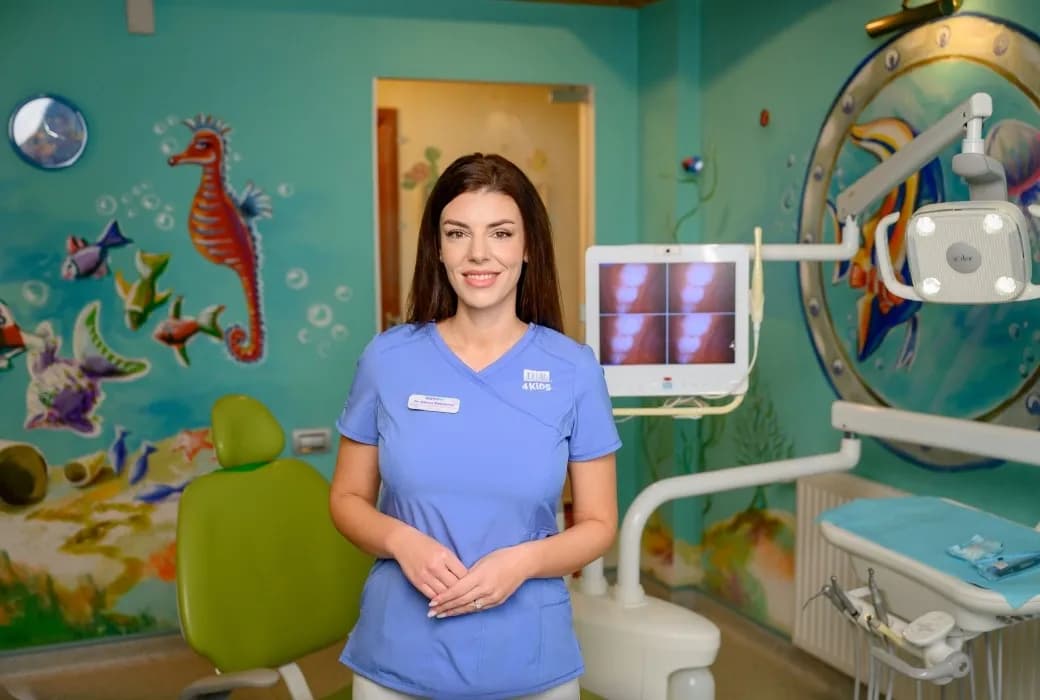
“In many cases, orthodontic treatment allows us to achieve a superior aesthetic result with minimal tooth preparation. This is one of the reasons why an orthodontic assessment is important before planning dental veneers.” – Dr Raluca Bădulescu, Specialist in Orthodontics and Dentofacial Orthopaedics
When is it recommended to have braces and veneers fitted at the same time?
Combined treatment is recommended when the patient has both dental alignment or occlusion problems and aesthetic imperfections that cannot be resolved by orthodontics alone.
- Crowded teeth and discolouration
One of the most common scenarios is that of patients who have crowded teeth and, at the same time, wish to improve the colour of their smile.
Braces align the teeth and correct their position, whilst veneers can subsequently optimise their colour and shape, particularly when teeth whitening cannot achieve the desired result.
- Gaps between teeth and unsightly shapes
In certain cases, braces are used to redistribute the spaces between the teeth correctly.
This stage allows veneers to be fitted subsequently in a balanced and proportionate manner, helping to achieve a more natural-looking result.
- Malocclusion and aesthetic imperfections
Combined treatment may also be recommended when there is an incorrect bite associated with aesthetic imperfections.
If veneers were fitted before the bite was corrected, they could be subjected to incorrect forces, which may increase the risk of:
- fracture;
- chipping;
- detachment;
- accelerated wear;
- unstable results.
Veneers can improve the appearance of slightly misaligned teeth, but they are not a substitute for orthodontic treatment when there are genuine problems with alignment or bite.
Current orthodontic literature emphasises that aesthetic restorations must be integrated into a functional and stable occlusion to reduce the risk of wear, fracture or long-term prosthetic failure.
- Complete smile rehabilitation
In complex smile makeovers, collaboration between the orthodontist and the dentist specialising in cosmetic dentistry is essential.
The aim is not merely to achieve a beautiful smile in photographs, but to achieve a functional, stable and harmonious result, tailored to the patient’s facial features.
“Dental veneers and orthodontic treatment are not competing treatments, but complementary ones. When planned correctly, orthodontics creates the functional foundation, whilst veneers allow for the aesthetic refinement of the smile with minimal loss of tooth structure.” – Dr Raluca Bădulescu, Specialist in Orthodontics and Dentofacial Orthopaedics
Stages of combination therapy
The success of a combination treatment depends on proper planning and following the steps recommended by your doctor.
Consultation and planning
The first stage is the multidisciplinary consultation.
The dentist assesses:
- the position of the teeth;
- the bite;
- gum health;
- the shape and proportions of the teeth;
- the patient’s aesthetic goals.
Planning may include X-rays, clinical photographs, digital scanning and occlusal analysis.
At this stage, it is determined whether the patient requires orthodontic treatment prior to veneers and what the optimal sequence of procedures is.
Orthodontic treatment (braces)
During the orthodontic phase, the main aim is to align the teeth and correct the bite.
The teeth are gradually moved until they reach a position that is more correct from both a functional and aesthetic point of view.
A major advantage of orthodontics is that it can reduce the need to prepare teeth for future veneers. In other words, the cosmetic dentist no longer needs to compensate for incorrect tooth positions by grinding them down.
In many cases, pre-aligning the teeth allows for a more conservative approach during the cosmetic stage, reducing the need to prepare healthy tooth structure.
The stabilisation period
Once the braces have been removed, the result must be maintained.
Teeth have a natural tendency to shift after treatment, which is why the retention phase is essential.
The dentist may recommend:
- a retainer splint;
- a fixed retainer;
- regular check-ups.
This stage is very important before veneers are fitted. If the teeth are not fully stabilised, their position may change later on and affect the aesthetic result.
Final aesthetic assessment
Once the orthodontic result has stabilised, a final aesthetic assessment is carried out.
The dentist assesses:
- the shape of the teeth;
- the proportions of the smile;
- the gum line;
- the desired colour;
- how well they harmonise with the facial features.
At this stage, the number of veneers required is also determined.
It is not always necessary to fit veneers to all visible teeth. In some cases, the best result can be achieved through a combination of teeth whitening, minimal reshaping and veneers fitted only to certain teeth.
Fitting dental veneers
Veneers are custom-made to suit each patient’s individual characteristics.
Depending on the case, the treatment may include:
- digital scanning;
- aesthetic simulation;
- minimally invasive preparation;
- temporary restorations;
- cementing of the permanent veneers.
Veneers are not always a reversible procedure, particularly when they involve enamel preparation. For this reason, the indication must be correctly established and integrated into a well-founded treatment plan.
Duration of the full course of treatment
The duration of the combined treatment varies depending on the complexity of the case.
| Stage | Estimated duration |
| Orthodontic treatment | 6–24 months |
| Stabilisation period | 1–6 months |
| Dental veneers | 1–3 sessions |
| Full treatment | approximately 8 months – 3 years |
Generally speaking, orthodontic treatment is the longest stage. The application of veneers is relatively quick once the orthodontic treatment has been completed and the results have stabilised.
The benefits of combination therapy
The main benefit of combined treatment is achieving a balance between function and aesthetics.
Braces create the correct foundation by aligning the teeth and improving the bite, whilst veneers perfect the appearance of the smile by optimising its shape, colour and proportions.
The benefits include:
- correct alignment and harmonious aesthetics;
- stable, long-term results;
- optimal functionality;
- correct distribution of masticatory forces;
- reduced need for tooth preparation;
- natural integration of aesthetic restorations.
The current trend in modern aesthetic dentistry is to combine orthodontics and minimally invasive restorations to achieve aesthetic results whilst preserving as much healthy tooth structure as possible.
Risks if treatments are not combined correctly
Fitting veneers without correcting significant orthodontic problems may compromise both the aesthetics and the functionality of the result.
The following may occur:
- visible disproportions;
- excessively large teeth;
- an artificial-looking smile;
- occlusal problems;
- fractures or chips in the veneers;
- accelerated wear;
- difficulties with oral hygiene;
- results that are unstable over time.
From a functional point of view, an incorrect bite can place excessive strain on restorations and reduce the long-term predictability of treatment.
Cost of treatment with braces and premium veneers
The cost of combined treatment involving braces and premium veneers depends on the complexity of the case, the type of braces, the number of veneers required and any recommended complementary treatments.
To provide an accurate estimate, a consultation and a personalised treatment plan are required.
You can view the up-to-date prices on the DENT ESTET pages dedicated to orthodontic treatments and cosmetic dentistry.