



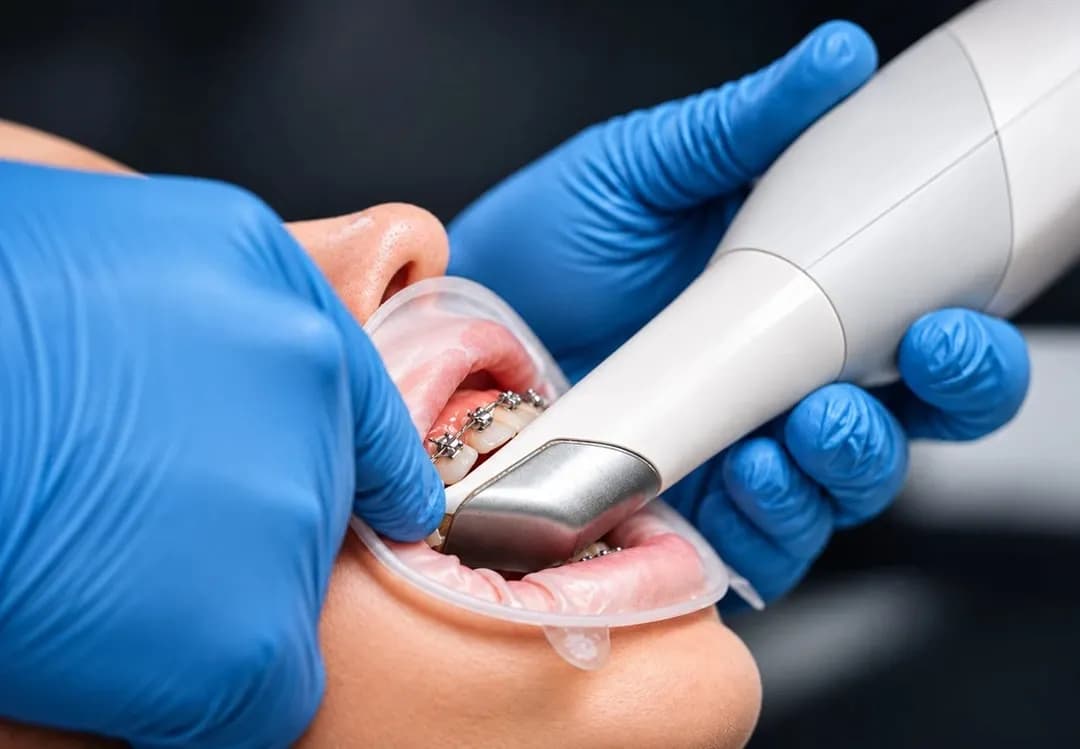
Can you wear braces if you have crowns, bridges or dental implants?
 Author: Dr. Marius Ion
 November 13, 2026
Yes, you can wear braces even if you have crowns, bridges or implants, depending on your clinical situation. Natural teeth covered with crowns can be moved orthodontically; bridges may restrict certain tooth movements; and osseointegrated implants remain fixed in the bone.
However, treatment planning varies from case to case. Crowns, bridges and implants each have their own specific characteristics, and the specialist in Orthodontics and Dentofacial Orthopaedics must assess the condition of the teeth, the health of the gums and bone, the position of the roots and the treatment objectives.
In complex cases, collaboration between the orthodontist, prosthodontist and implant surgeon may be necessary to establish a safe and predictable treatment plan.
Can you have orthodontic treatment if you’ve had dental work done?
Yes. The presence of prosthetic restorations is not, in itself, a contraindication for orthodontic treatment.
However, before treatment begins, the following must be assessed:
- the stability and fit of existing crowns and bridges;
- the health of the gums and periodontal tissues;
- the position and integration of implants;
- any carious lesions or infectious processes;
- the functional and aesthetic objectives of the treatment.
Natural teeth covered with crowns retain their periodontal ligament and can be moved orthodontically. Implants, on the other hand, are integrated directly into the bone and do not respond in the same way to applied forces.
| Type of dental treatment | Is orthodontic treatment possible? | Special features |
| Dental crown | Yes, in many cases | The natural tooth can be moved, but fitting the brackets may require special techniques |
| Dental bridge | Yes, in certain situations | The bridge may restrict the independent movement of the abutment teeth and may require adjustments |
| Dental implant | Yes, for the surrounding natural teeth | A bridge may restrict the independent movement of the abutment teeth and may require adjustments |
“When a patient already has crowns, bridges or implants, the question is not simply whether we can carry out orthodontic treatment, but which teeth we can move, which restorations we can preserve, and how we can structure the treatment stages so that the final result is stable and functional.” - Dr Marius Ion, specialist in Orthodontics and Dentofacial Orthopaedics at the DENT ESTET clinic in Sibiu
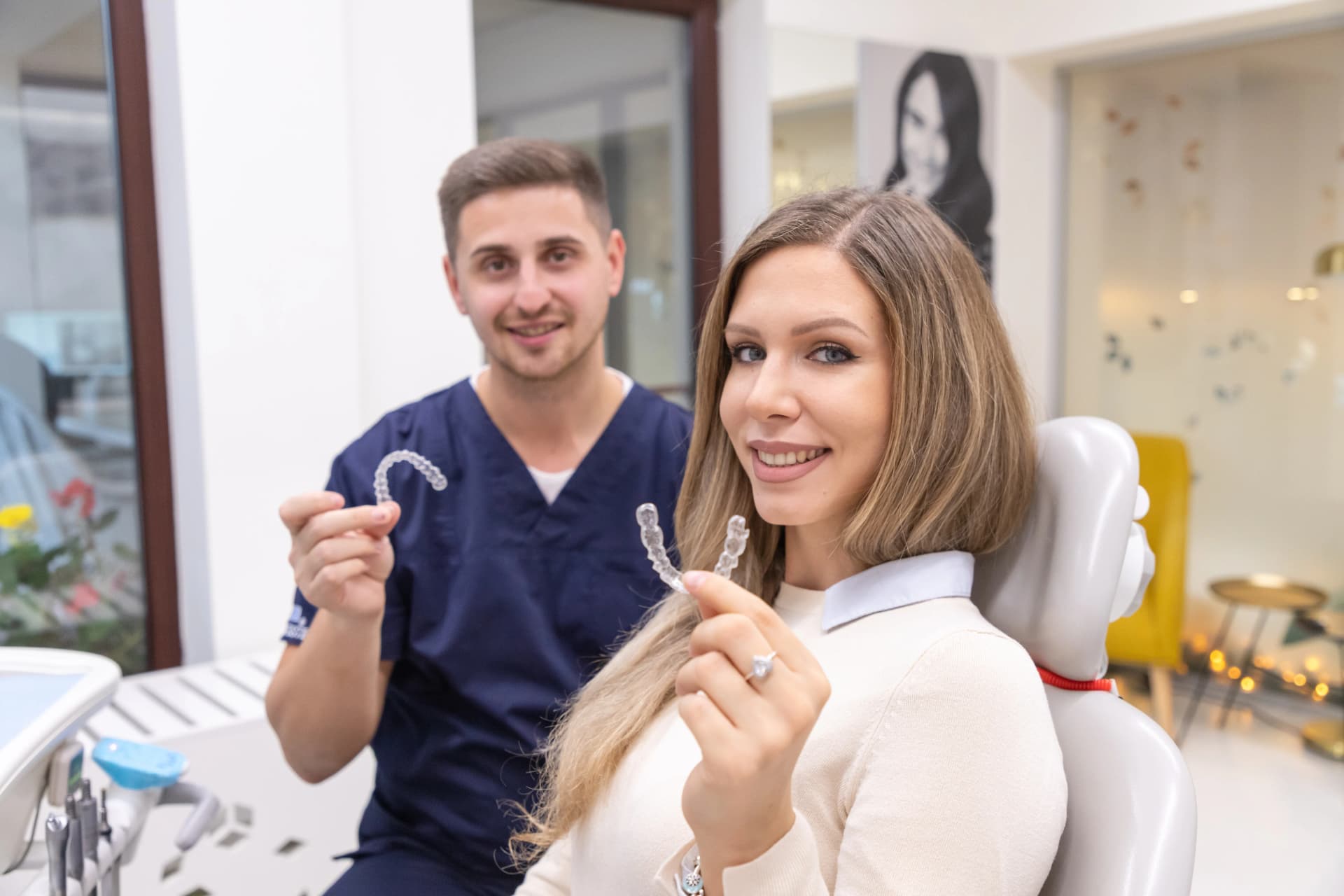
Braces on teeth with crowns: can these teeth shift?
Yes. A tooth covered by a dental crown can be moved orthodontically, as the movement takes place at the level of the root and the supporting tissues, not at the level of the prosthetic crown.
Specific considerations arise particularly with regard to the attachment of orthodontic appliances and the condition of the existing restoration.
Braces on teeth with crowns: can these teeth shift?
Yes. A tooth covered by a dental crown can be moved orthodontically, as the movement takes place at the level of the root and the supporting tissues, not at the level of the prosthetic crown.
There are specific considerations, particularly regarding the attachment of orthodontic appliances and the condition of the existing restoration.
Can brackets be fitted to dental crowns?
Yes, but the technique differs from that used for bonding to natural enamel.
Depending on the crown material – ceramic, zirconia, metal-ceramic or other materials – specific preparation and bonding protocols may be required to achieve a secure bond.
The risk of the bracket coming loose may be higher than on natural enamel, and at the end of treatment, the orthodontic appliances must be removed carefully to protect the restoration.
What needs to be checked before treatment?
The dentist must assess:
- the condition of the tooth beneath the crown;
- the fit and stability of the crown;
- the health of the gums;
- the presence of tooth decay or other dental problems.
This information helps ensure the success of the treatment.
What happens if you have a dental bridge and need braces?
The situation is more complex than with a single crown. A bridge replaces one or more missing teeth and is supported by abutment teeth or implants.
Can the bridge be kept in place during treatment?
In some cases, yes.
The decision depends on:
- the position and size of the bridge;
- the stability of the restoration;
- existing gaps;
- the objectives of orthodontic treatment.
The bridge may be retained if it allows the planned movements to take place. In other situations, it may be necessary to temporarily modify, remove or replace it with temporary restorations or individual crowns, so that the abutment teeth can be moved separately.
Why do the orthodontic and prosthetic stages need to be planned together?
Orthodontic treatment can be used to:
- redistributing space;
- correcting the position of the teeth;
- aligning the abutment teeth;
- preparing for future restorations;
- achieving a more favourable position for the final prosthetic restoration.
Therefore, when significant changes to tooth position are required, the orthodontist and prosthodontist must jointly determine the sequence of stages.
Can you wear braces if you have dental implants?
Yes, but there is a fundamental biological principle that must be understood: an osseointegrated implant cannot be moved orthodontically.
The implant is fixed directly into the bone and has no periodontal ligament. The natural teeth surrounding it can be moved, but the implant remains in the position in which it was inserted.
Can a dental implant be moved with braces?
No. An osseointegrated dental implant cannot be moved by conventional orthodontic treatment, as it has no periodontal ligament. However, the dentist can plan the movement of the natural teeth surrounding the implant, depending on its position and the treatment objectives.
How does the implant affect the orthodontic treatment plan?
The position of the implant can be both a limitation and an advantage.
In certain situations:
- the implant can act as a relatively stable anchor point;
- the natural teeth surrounding it can be moved;
- an implant placed in an unfavourable position may restrict certain movements;
- orthodontic mechanics must be adapted to its position.
Is it better to have orthodontic treatment before having an implant?
In many cases, yes. If a patient is missing a tooth and is due to have an implant fitted, orthodontic treatment may be carried out beforehand to ensure the space and position of the roots are correctly prepared.
Orthodontics can help to:
- creating the necessary space for the prosthesis;
- correcting the position of neighbouring teeth;
- improving occlusal relationships;
- preparing the position for the future crown.
It is not enough for the visible space between the crowns of the teeth to be adequate. The position of the roots must also be checked so that the implant can be inserted in the correct position.
“When the implant has not yet been inserted, orthodontics allows us to prepare the space and the position of the roots for the future restoration. Once osseointegrated, the implant becomes a fixed point, and orthodontic treatment must adapt to its position.” – Dr Marius Ion
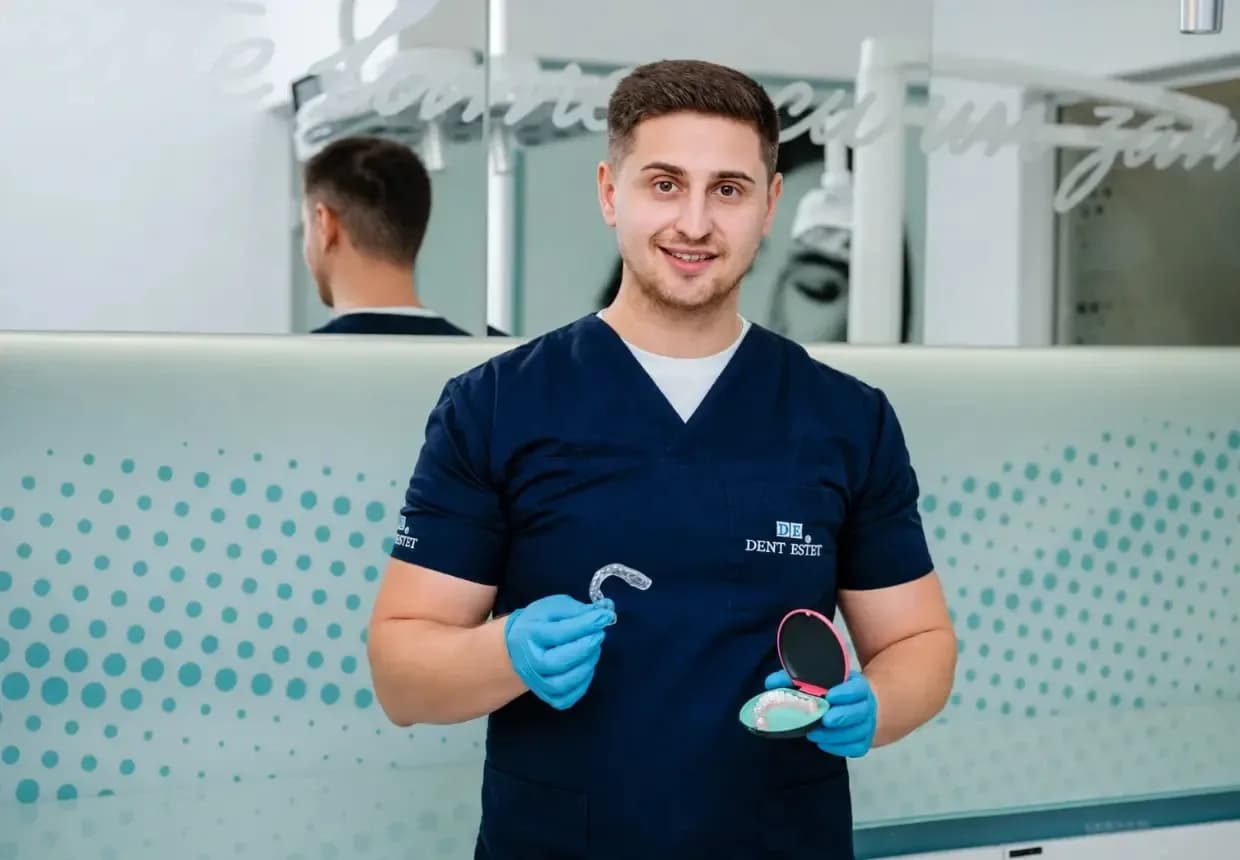
What type of dental appliance can be used if you have crowns, bridges or implants?
The presence of prosthetic restorations does not automatically dictate the choice of a single orthodontic system. Both fixed braces and clear aligners may be options, depending on the complexity of the case and the required tooth movements.
Fixed braces
Fixed appliances allow direct control of tooth movement, but in the case of crowns, special protocols may be required for fixing the brackets.
Bridges may require adjustments to the orthodontic mechanics, whilst existing implants will remain fixed throughout the treatment.
Clear aligners
Aligners can also be used in cases where crowns or implants are present, provided the clinical situation allows it.
Planning must take into account existing restorations, the need for any attachments, and the biological and prosthetic limitations of the case.
The choice of device is based on clinical assessment and the treatment objectives, not merely on aesthetic preferences.
| Criterion | Fixed braces | Clear aligners |
| Dental crowns | May require special techniques for fixing the brackets | May require attachments and adjustments to the treatment plan |
| Dental bridges | The bonding of teeth may restrict certain movements | The same biological and prosthetic limitations must be taken into account |
| Implants | Existing implants remain fixed | Existing implants remain fixed |
| Control of movements | Allows for direct biomechanical control | Depends on the design of the aligners and attachments |
| Limitations | Higher risk of detachment on certain restorations | Some complex movements may require additional mechanics |
How is orthodontic treatment planned if you have dental work?
Planning is essential for patients who already have crowns, bridges or implants. The dentist must consider both the desired tooth movements and how the existing restorations will affect each stage.
The assessment may include:
- an examination of the teeth, gums and supporting tissues;
- an analysis of tooth position and occlusion;
- intraoral and extraoral photographs;
- intraoral scanning and panoramic X-rays;
- CBCT, where clinically indicated;
- assessment of existing crowns, bridges and implants;
- assessment of potential orthodontic movements;
- planning of any prosthetic modifications;
- selection of the appliance and determination of the treatment stages.
In complex cases, the treatment plan is drawn up in consultation with the prosthodontist and the implant surgeon.
Do crowns or bridges need to be replaced after braces?
Sometimes they can be retained, whilst at other times they may need to be refitted following orthodontic treatment.
Treatment alters the position of the teeth and the occlusal relationships. A restoration made to fit the teeth’s original position may no longer be compatible with the situation following orthodontic treatment.
Crowns or bridges can be retained if they are:
- stable;
- properly fitted;
- sound;
- compatible with the new tooth position and the new occlusion.
In the case of bridges, the movement of the abutment teeth may necessitate the restoration being redone.
Where the patient is due to receive new prosthetic restorations anyway, it may be advisable for these to be fitted after the completion of orthodontic treatment, if the clinical situation permits.
Frequently asked questions about braces on teeth with crowns, bridges or implants
Does the bridge need to be removed before treatment?
Not always. Some bridges can be retained, whilst others need to be modified or temporarily replaced to allow the teeth to move independently.
Can the teeth surrounding an implant be moved?
Yes, provided that the patient’s biological condition and the orthodontic treatment plan allow for this.
Can I wear aligners if I have crowns or implants?
Yes, provided the clinical situation allows it. The treatment plan must be adapted to the existing restorations.
Do I need to have my crowns replaced after orthodontic treatment?
Not necessarily. If the restorations are stable, well-fitted and compatible with the new occlusion, they can be retained.
Orthodontic treatment must be adapted to existing dental work
Crowns, bridges and implants each have a different impact on orthodontic treatment.
Individual crowns may allow the natural tooth to move, bridges may restrict the independent movement of teeth, whilst implants remain fixed and must be incorporated into the treatment plan.
There is no one-size-fits-all solution for every patient. An orthodontic assessment and, where necessary, collaboration between the orthodontist, prosthodontist and implant surgeon enable the correct sequence of treatments to be established.
If you have crowns, bridges or implants and are considering orthodontic treatment, book an orthodontic consultation at DENT ESTET to assess your situation and draw up a personalised plan.