




 Author:
  April 13, 2026
Dental implants have become one of the most reliable solutions for replacing missing teeth, and technological advances have significantly transformed the way they are performed. Whereas in the past implantology relied mainly on the dentist’s experience and limited diagnostic tools, today the process is supported by advanced digital technologies and artificial intelligence (AI).
The integration of AI into dental implantology enables precise, personalised and safe treatment planning. Through the use of digital diagnostics and specialised software, every stage – from diagnosis to implant placement and crown fabrication – is optimised and simulated prior to the procedure.
Thus, dental implants created with the help of AI are no longer merely an innovation, but a modern standard in contemporary dentistry.
Computed tomography (CBCT) in dental implant planning
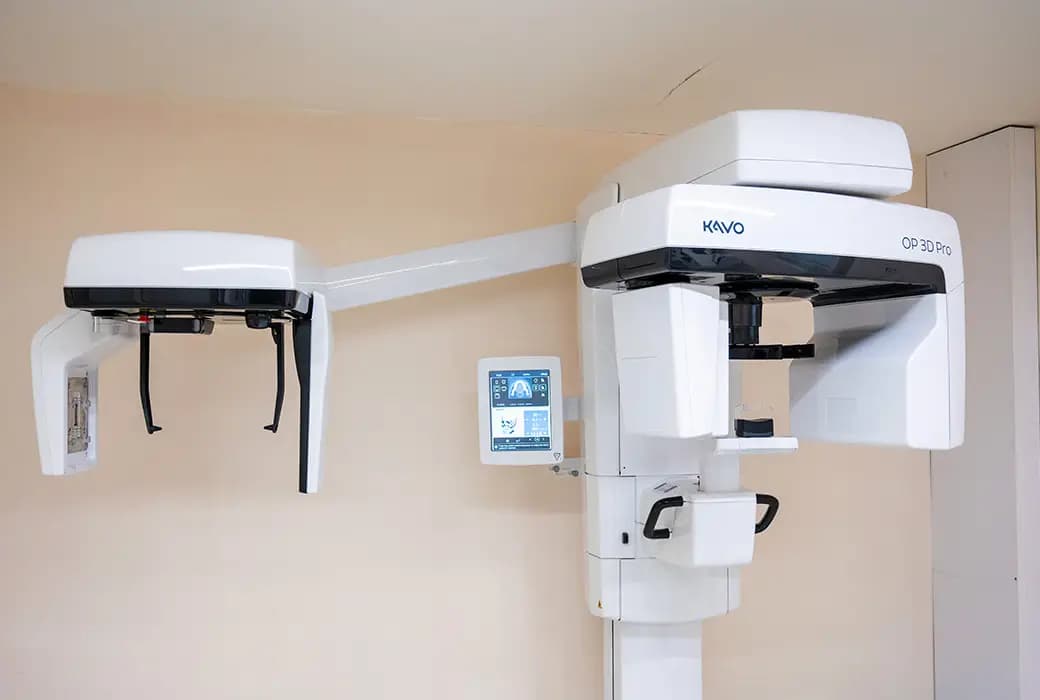
CBCT (Cone Beam Computed Tomography) is currently the gold standard in dental implant diagnostics, providing a detailed three-dimensional view of oral structures.
Through this examination, the dentist can accurately assess:
- bone volume and density
- the position of sensitive anatomical structures (the inferior alveolar nerve, the maxillary sinuses)
- any anatomical variations or lesions
Compared to conventional X-rays, CBCT eliminates distortions and allows for much more reliable planning of the procedure.
Digital intraoral scanning for dental implants (without traditional impressions)
Digital intraoral scanning complements the diagnosis by providing accurate information about the teeth and soft tissues. Using 3Shape® Trios Real Color technology, a highly accurate digital model of the oral cavity is created.
The benefits of this stage include:
- increased patient comfort, with no need for traditional impressions
- high data accuracy
- rapid integration into the digital workflow
This combination of CBCT and intraoral scanning forms the basis of a comprehensive and accurate diagnosis in modern implantology.

Stage 2: The patient’s 3D digital model in dental implant planning
Once the initial examinations have been carried out, all the data is integrated into a 3D digital model. This stage is essential, as it provides a comprehensive view of the oral cavity and forms the basis for all subsequent treatment decisions.
Integration of CBCT and intraoral scan data
In digital implantology, data obtained from CBCT and intraoral scanning are integrated into a three-dimensional digital model of the patient.
This model allows:
- correlation of bone structure with dental and gingival anatomy
- assessment of the available prosthetic space
- a comprehensive visualisation of the case prior to treatment
The result is an accurate overview, essential for the correct planning of the dental implant.
The role of artificial intelligence in patient data analysis
Artificial intelligence brings an additional level of accuracy to the analysis of digital data.
Using advanced algorithms, AI can:
- identify relevant anatomical patterns
- automatically segment structures (bone, teeth, nerves)
- support clinical decision-making
This stage contributes to the standardisation of planning and the reduction of variability between cases.
Stage 3: Planning dental implants using artificial intelligence
Planning is the stage at which the treatment takes shape. Using a digital model and artificial intelligence, the dentist can simulate the implant’s positioning in detail prior to the procedure. This reduces risks and increases the predictability of the final result.
Simulation of the ideal position of the dental implant
Implant planning is carried out in a digital environment, where the implant’s position is simulated prior to the procedure.
The following criteria are considered simultaneously:
- biological (bone density and volume)
- functional (distribution of occlusal forces)
- aesthetic (integration into the dental arch)
This simulation allows for optimal implant positioning and reduces the risk of complications. Indirectly, proper planning also helps to reduce the risk of implant failure.
Digital planning software: 3Shape Implant Studio®
Software such as 3Shape Implant Studio® transforms patient data into an interactive virtual environment.
The dentist can:
- adjust the size and position of the implant
- check the angle and insertion depth
- simulate the final prosthetic restoration
This level of customisation allows for a treatment plan tailored to each patient.
Stage 4: Surgical guide for dental implants
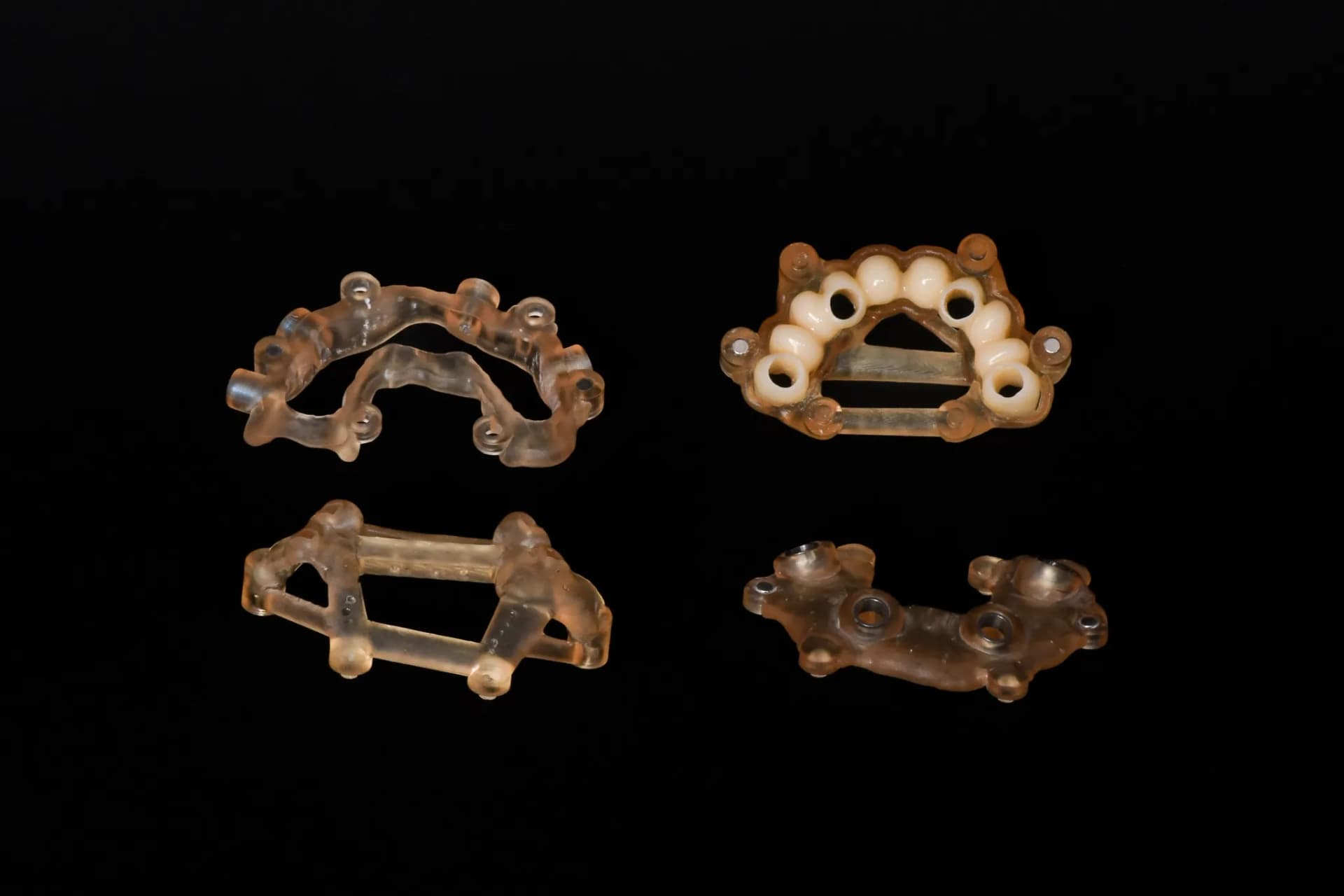
To ensure that the digital plan is followed during the procedure, a bridge is needed between the virtual and clinical environments. This is the surgical guide, which is custom-made for each patient.
Digital design of the surgical guide
Once the treatment plan has been established, the customised surgical guide is produced.
This enables:
- the accurate transfer of the digital plan during the procedure
- a reduction in human error
- increased precision in implant placement
3D printing of the guide for guided implantology
The surgical guide is produced using 3D printing, employing biocompatible materials.
During the procedure, it is used to guide the instruments and the implant along the pre-determined path, ensuring predictability and safety.
Stage 5: Placement of the dental implant using digitally guided surgery
The procedure itself is much more controlled in digital implantology. Thanks to the surgical guide and detailed planning, the implant is placed with precision, causing minimal impact on the surrounding tissues.
The difference between a conventional implant and a digitally guided implant
| Conventional dental implant | Digitally guided dental implant | |
| Planning | Based on clinical assessment and X-rays | Detailed digital planning, in 3D model |
| Implant placement | Determined during the procedure | Determined in advance using digital simulation |
| Accuracy | Largely depends on the dentist’s experience | Digitally controlled, using a surgical guide |
| Procedure | Usually more invasive (gum flap) | Minimally invasive, sometimes without a large incision |
| Safety | Higher risk of variations | Reduced risk due to precise planning |
| Duration of the procedure | May be longer | Usually shorter |
| Predictability of results | Variable | High and easy to anticipate |
| Planning | Limited | Detailed, 3D |
| Accuracy | Depends on experience | Digitally controlled |
| Procedure | More invasive | Minimally invasive |
| Predictability | Variable | High |
The benefits of guided implantology for the patient
Guided implantology offers multiple benefits for the patient:
- Minimally invasive procedure
- reduced surgical time
- increased safety
- faster recovery
Stage 6: Implant-supported prosthesis fabricated using CAD/CAM technology
Once the implant has integrated into the bone, the next step is to fit the dental crown. This stage is just as important, as it affects both the functionality and the final appearance of your smile.
How the dental crown is made on the implant
Once the implant has integrated, the dental crown is created using a digital scan.
This allows for:
- precise fitting onto the implant
- faithful reproduction of the tooth’s morphology
- optimal functionality
Digital dental aesthetics and natural integration of the implant
Digital technologies enable the crown to blend naturally into the patient’s smile.
The following are taken into account:
- the shape and size of the teeth
- facial proportions
- tooth colour and texture
The result is a restoration that closely mimics the natural tooth.
Stage 7: Long-term monitoring and maintenance of the dental implant
The success of a dental implant does not end with the procedure. Long-term monitoring is essential for maintaining the results and preventing complications.
The role of digital technology in implant monitoring
Implant monitoring is carried out through regular check-ups and digital assessments.
These allow for:
- assessment of implant stability
- the identification of bone changes
- preventing complications
How AI extends the lifespan of dental implants
Artificial intelligence can analyse patient data in real time and detect subtle changes.
This makes it possible to:
- identify potential problems at an early stage
- adapt the maintenance plan
- extend the lifespan of the dental implant
The benefits of dental implants created using artificial intelligence
The integration of artificial intelligence into implantology brings real benefits for patients, both from a medical perspective and in terms of the overall experience. Treatment becomes more precise, safer and more predictable.
- high precision
- personalised treatment
- rapid recovery
- predictable aesthetic results
Frequently asked questions about dental implants created using artificial intelligence
How long does digitally designed dental implant treatment take?
The duration of treatment depends on the complexity of the case, but digital planning can reduce the duration of the procedure and optimise the treatment stages.
Is digitally guided dental implant surgery painful?
The procedure is performed under anaesthesia, and the use of minimally invasive techniques helps to minimise post-operative discomfort.
What is the difference between a traditional dental implant and a digitally designed one?
The main difference lies in the detailed preoperative planning and the use of a surgical guide, which offers greater precision.
Can I have a dental implant if I don’t have enough bone?
In certain situations, additional procedures, such as bone grafting, may be required. An accurate assessment is made following imaging investigations.
How long does a dental implant made using digital technology last?
With proper oral hygiene and regular check-ups, a dental implant can last for a long time – over 10–15 years or even longer.
Bibliography
- Revilla-León M, Gómez-Polo M, Vyas S, Barmak BA, Galluci GO, Att W, Krishnamurthy VR. Artificial intelligence applications in implant dentistry: A systematic review. J Prosthet Dent. 2023 Feb;129(2):293-300. doi: 10.1016/j.prosdent.2021.05.008. Epub 16 June 2021. PMID: 34144789.
- Rahim A, Khatoon R, Khan TA, Syed K, Khan I, Khalid T, Khalid B. Artificial intelligence-powered dentistry: Probing the potential, challenges, and ethicality of artificial intelligence in dentistry. Digit Health. 11 Nov 2024;10:20552076241291345. doi: 10.1177/20552076241291345. PMID: 39539720; PMCID: PMC11558748.
- Wang J, Wang B, Liu YY, Luo YL, Wu YY, Xiang L, Yang XM, Qu YL, Tian TR, Man Y. Recent Advances in Digital Technology in Implant Dentistry. J Dent Res. July 2024;103(8):787-799. doi: 10.1177/00220345241253794. Epub 31 May 2024. PMID: 38822563.
- Macrì M, D'Albis V, D'Albis G, Forte M, Capodiferro S, Favia G, Alrashadah AO, García VD, Festa F. The Role and Applications of Artificial Intelligence in Dental Implant Planning: A Systematic Review. Bioengineering (Basel). 31 July 2024;11(8):778. doi: 10.3390/bioengineering11080778. PMID: 39199736; PMCID: PMC11351972.
- Kurt Bayrakdar S, Orhan K, Bayrakdar IS, Bilgir E, Ezhov M, Gusarev M, Shumilov E. A deep learning approach for dental implant planning in cone-beam computed tomography images. BMC Med Imaging. 19 May 2021;21(1):86. doi: 10.1186/s12880-021-00618-z. PMID: 34011314; PMCID: PMC8132372.
- Elgarba BM, Fontenele RC, Tarce M, Jacobs R. Artificial intelligence serving pre-surgical digital implant planning: A scoping review. J Dent. 2024 Apr;143:104862. doi: 10.1016/j.jdent.2024.104862. Epub 8 Feb 2024. PMID: 38336018.
- Tabatabaian F, Vora SR, Mirabbasi S. Applications, functions, and accuracy of artificial intelligence in restorative dentistry: A literature review. J Esthet Restor Dent. 2023 Sep;35(6):842-859. doi: 10.1111/jerd.13079. Epub 31 July 2023. PMID: 37522291.