



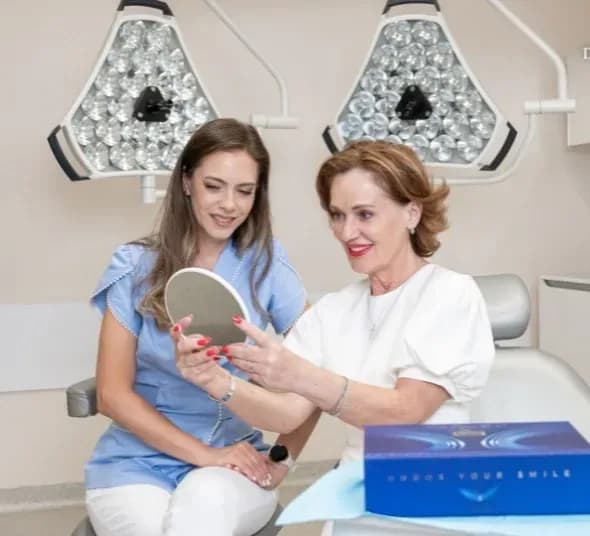
Esthetic smile rehabilitation with dental veneers and crowns in Bucharest – Dr. Oana Taban’s Case
 Author:
 October 12, 2026
A successful esthetic dental rehabilitation is not about creating a standardized smile, but about harmonizing the teeth with the patient's facial features and natural expressions. In the case of Dr. Oana Taban, Founder of DENT ESTET, the objective was to replace existing dental restorations to redefine her smile while ensuring long-term oral health.
The treatment plan, coordinated by Dr. Alice Gavrilescu, a specialist in Oral and Maxillofacial Surgery with expertise in Esthetic Dentistry, at the DENT ESTET dental clinic in Bucharest, included Premium ASPEN all-ceramic veneers, zirconia crowns, and a Straumann® BLX SLActive® dental implant. Digital planning and functional analysis enabled a cohesive design of the restorations, ensuring harmony in their shape, proportions, and color.
The clinical case, in brief:
| Initial situation | Old, unaesthetic and biologically ill-fitting restorations; tooth shape, dimensions, axes and spaces requiring harmonisation |
| Objective | A natural, balanced and functional smile, integrated into the patient’s facial features and expressiveness |
| Treatments | All-ceramic veneers, zirconia crowns and a dental implant |
| Materials and systems | ASPEN Premium restorations and Straumann® BLX SLActive® implants |
| Planning | Smile analysis, Smile Cloud, 3Shape TRIOS intraoral scanning and MODJAW® 4D |
| Team | Dr Alice Gavrilescu, Lead Clinician; Th. Pavel Ciulin, MDT – design and customisation at the ASPEN laboratory |
What was the patient’s initial dental condition?
The dental team found that the existing restorations no longer met aesthetic and biological requirements and that it was necessary to replace them and harmonise the shape and size of the teeth, the dental axes, the spaces, the contact lines and the incisal plane.
The assessment included:
- the relationship between the teeth, gums and lips;
- dentofacial proportions;
- contacts between the dental arches;
- the dynamics of the smile during speech and natural facial expressions.
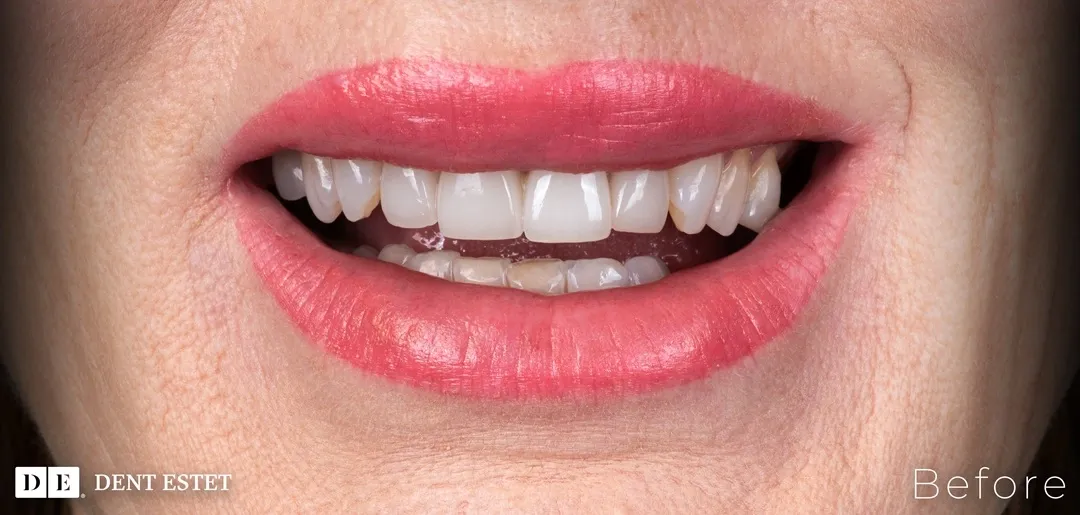
The initial situation prior to aesthetic restoration with veneers and dental crowns.
What investigations and analyses were required?
Planning of the treatment plan began with:
- intraoral and extraoral photographs;
- intraoral scanning;
- bite analysis using MODJAW® 4D technology.
The intraoral scan recorded three-dimensional images of the tooth and gum surfaces, whilst MODJAW® 4D tracked the movements of the mandible and dynamic tooth contacts, ensuring that the shape of the future teeth would take both aesthetics and function into account.
The data was integrated into Smile Cloud, and the 3Shape TRIOS scanner provided the digital models for the design of the restorations.
Why were veneers, crowns and a dental implant combined?
The three solutions were combined because not all teeth were in the same condition or required the same type of restoration. In a personalised treatment plan, the choice is made for each area individually, and then all the elements are brought together to form a cohesive result.
Dental veneers for the aesthetic zone
The ASPEN Premium all-ceramic veneers discreetly corrected the shape, size and alignment of the teeth, closed the gaps and harmonised the proportions. The minimally invasive preparation aimed to preserve as much healthy tooth structure as possible, within the limits of the clinical situation.
Dental crowns for posterior teeth
The zirconia crowns restored the teeth requiring full coverage and were integrated with the veneers. They restore the shape and strength of the teeth and ensure correct occlusal contacts during chewing. The choice between a veneer and a dental crown depends on the tooth’s structure and the clinical indication.
Dental implant to complete the restoration
The treatment plan also included a Straumann® BLX SLActive® dental implant to complete the restoration with a fixed solution. The implant-supported restoration was coordinated with the veneers and crowns as part of the same aesthetic and functional outcome.
What were the stages of the treatment?
1. Smile analysis and digital planning
The shape and length of the teeth, their relationship with the lips and gums, and the overall symmetry were assessed. Photographs, scans and an analysis of the proportions helped to shape the future smile.
2. Removal of old restorations
Old, unsightly and biologically unsuitable restorations were carefully removed to assess the tissues and prepare the tooth structure in a controlled manner for the new veneers and crowns.
3. Minimally invasive dental treatment
The teeth were prepared in accordance with the planned restoration. For veneers, the approach aimed to preserve as much of the healthy tooth structure as possible, without compromising the fit of the ceramic restoration.
4. Fitting dental veneers and crowns
The veneers and crowns were individually designed by the ASPEN laboratory. Th. Pavel Ciulin, MDT – Expert Designer, customised the colour, translucency and texture of the restorations.
5. Aesthetic and functional inspection
The proportions, contact lines, incisal plane and symmetry were checked. MODJAW® 4D analysed the movements of the mandible and the contacts between the dental arches, in order to adapt the restorations.
What technologies and materials were used, and why?
- Digital Smile Design and Smile Cloud – for analysing the smile in relation to the face and for planning the shape of future restorations.
- 3Shape TRIOS intraoral scanner – for digital dental impressions.
- MODJAW® 4D – for recording mandibular movements and functional analysis of occlusion.
- ASPEN Premium Ceramics and zirconia – for the fabrication of premium dental veneers and crowns.
- Straumann® BLX SLActive® – for replacing a missing tooth and integrating the implant into the overall treatment plan.
What was the outcome of the cosmetic restoration?
The result was a natural, balanced and functional smile that preserves Dr Oana Taban’s expressiveness. The shape, size and axes of the teeth have been harmonised, gaps have been closed, and the incisal edge and symmetry of the smile have been optimised. The veneers, crowns and implant-supported restoration form a coherent whole, with no visible differences between the solutions used.
The natural appearance resulted from the relationship between the teeth and facial features, from the variations in translucency and texture achieved in the laboratory, and from the preservation of the smile’s distinctive characteristics. The functional aspect was assessed in parallel to ensure compatibility with mastication and mandibular movements.
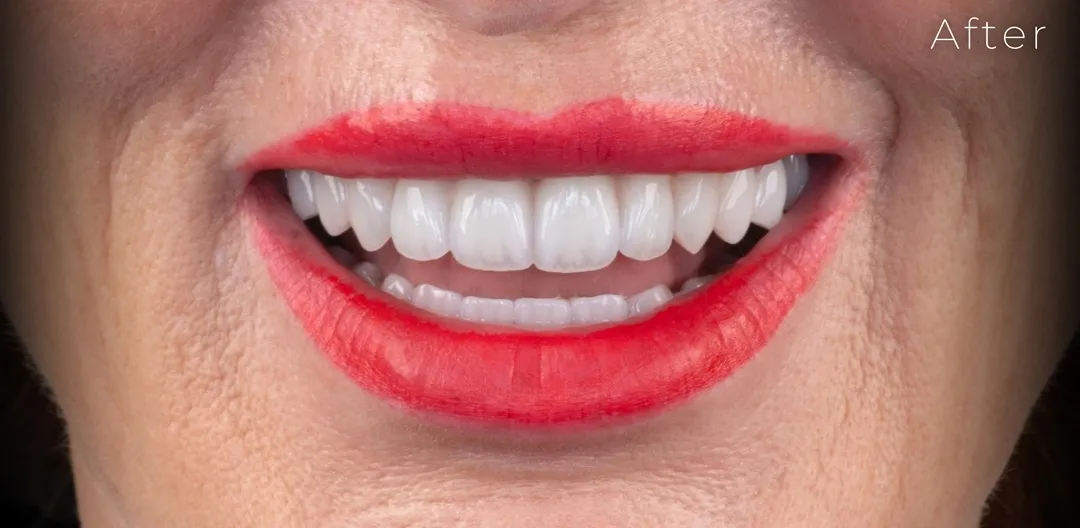
[AFTER IMAGE] The final result following restoration with veneers, crowns and a dental implant.
In what situations might treatment involving veneers and crowns be appropriate?
A treatment plan combining veneers and crowns may be considered when the requirements differ from one tooth to another. This may be relevant for:
- old restorations;
- differences in shape or size;
- gaps between teeth;
- alignment issues affecting the harmony of the smile;
- teeth requiring full coverage.
The suitability of treatment is not determined solely on the basis of photographs and does not necessarily involve treating all visible teeth. The dentist assesses each tooth, the gums, the bite and the patient’s objectives, and then recommends the appropriate solution.
How do you achieve a personalised smile, rather than a standard one?
Customisation is achieved by adjusting features such as>
- the shape of the teeth;
- their length;
- translucency;
- the shade of each individual tooth.
For Dr Oana Taban, the key criterion was to preserve expressiveness.
The medical team
The case was coordinated by Dr Alice Gavrilescu, a specialist in dento-alveolar surgery. The treatment plan incorporated aesthetics, prosthetics, implantology and function. At the ASPEN laboratory, Th. Pavel Ciulin, MDT – Expert Designer, customised the ceramic restorations.
See the Before & After case
For before-and-after images and a visual presentation of the restorations
Do you have a similar dental problem?
Old fillings, gaps between teeth or a desire to improve one’s smile do not automatically mean the same treatment is required. A consultation and the necessary assessments will determine whether veneers, crowns, dental implants or other solutions are recommended.
Frequently asked questions about dental veneers and crowns
Can veneers and crowns be combined in the same treatment?
Yes. They can be incorporated into the same treatment plan, with each tooth receiving a solution tailored to its structure. The design and materials are coordinated to achieve a cohesive result.
What is the difference between a veneer and a dental crown?
A veneer mainly covers the visible surface of the tooth. A crown covers the tooth all round and may be required for restoration and extended protection. The choice is made following a clinical examination.
What are the benefits of digital smile planning?
Digital planning helps with analysing proportions, designing restorations and communicating the treatment plan. It complements the dentist’s diagnosis and expertise, without replacing the clinical assessment.
Is an implant necessary for any cosmetic restoration?
No. An implant can replace a missing tooth or one that cannot be saved, provided the clinical situation allows it. The need for one is assessed on a case-by-case basis.