




 Author:
  June 22, 2026
Bruxism is an involuntary habit characterised by teeth grinding or jaw clenching.
In patients with dental implants, bruxism can significantly increase the risk of complications:
- cracks in dental crowns,
- loosening of prosthetic components,
- inflammation of the tissues surrounding the implants,
- implant loss in severe cases.
For this reason, treatment planning for dental implants in patients with bruxism must be carried out carefully, selecting premium implant systems and ensuring the most balanced occlusion possible from the temporary restoration right through to the final restoration.
What is bruxism and how does it affect dental health?
Bruxism is a repetitive muscular activity of the jaws, which most often occurs unconsciously during sleep or at times of intense stress during the day. This strain affects not only the teeth, but also has an impact on general health.
Factors that contribute to bruxism:
- stress/anxiety
- fatigue
- sleep disorders
- smoking
- excessive consumption of caffeine or alcohol
- certain occlusal imbalances and dento-maxillary abnormalities.
Types of bruxism
Bruxism takes two main forms:
- nocturnal bruxism – this is the most common form and is often associated with sleep disorders and psychological stress;
- daytime bruxism – this manifests as involuntary clenching of the jaws during the day, particularly during periods of tension or intense concentration, and may be partially recognised and controlled by the patient.
Effects on dental health
The effects of bruxism can be significant. Teeth wear down progressively, leading to cracks in the enamel, tooth sensitivity, gum recession and even crown fractures.
The masticatory muscles become overworked, and the temporomandibular joint may develop pain, clicking noises or restricted mouth opening. In some cases, patients notice that they wake up in the morning feeling muscle fatigue or facial tension.
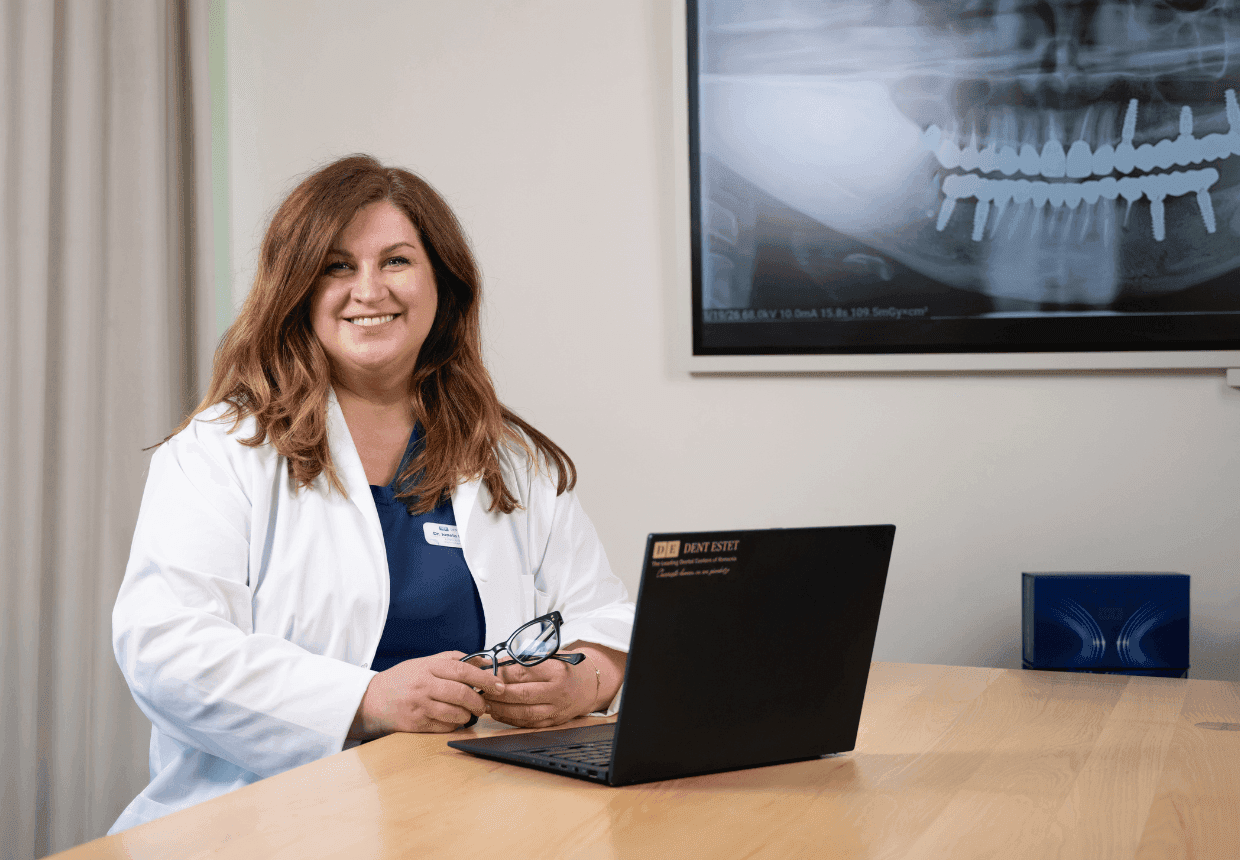
“Many patients come to the clinic complaining of muscle pain in the cheek area, particularly in the masseter muscles, morning headaches, restless sleep or joint noises when opening their mouths. Over time, this bad habit can lead to severe tooth wear, crown cracks, tooth sensitivity and even tooth fractures,” explains Dr Ionela Dumitru, a specialist in dento-alveolar surgery.
Risks for patients with dental implants
For patients with dental implants, the risks are even greater because the implant lacks the periodontal ligament present in natural teeth.
For this reason, the excessive forces generated by teeth grinding are transmitted directly to the bone and the implant components, and risks may arise at the crown level (loosening of internal components, fractures of the dental crown), as well as risks at the bone level, such as overloading of the implants leading to marginal bone loss.
“Early identification of bruxism is essential before commencing implant treatment. In clinical practice, patients who have suffered multiple tooth fractures require a careful occlusal analysis and additional protective measures. At DENT ESTET clinics, occlusal analysis using the 4D MODJAW scanner is recommended as part of the initial investigations. The data provided by this technology helps us to prevent such situations,” explains Dr Ionela Dumitru.
Types of dental implants recommended for patients with bruxism
The choice of implant must always be considered in conjunction with occlusal planning, balanced force distribution and the use of a night guard.
In patients with bruxism, premium implant systems are preferred as they offer greater mechanical strength, good biological stability and a lower risk of prosthetic complications. Screw-retained restorations and fracture-resistant monolithic crowns are also preferred.
Straumann premium dental implants
Straumann BLX and BLC implants are among the most commonly used in cases of bruxism.
Advantages:
- Thanks to their stable internal connection and high mechanical strength, micro-movements and the risk of loosening under repetitive lateral forces are reduced;
- The Roxolid titanium-zirconium alloy offers increased resistance to mechanical fatigue and better withstands high occlusal loads;
- Modern SLActive surfaces promote rapid osseointegration and biological stability;
- Furthermore, Straumann prosthetic components have very precise tolerances, which contribute to a more balanced distribution of forces and a reduction in prosthetic complications;
- In complex cases, such as full-arch restorations in patients with severe abrasion, Straumann systems allow for multiple prosthetic options and advanced treatment protocols.
Nobel Biocare premium dental implants
Nobel Biocare implants, particularly the NobelParallel and NobelActive models, are considered an excellent choice for patients with bruxism, especially in complex restorations and cases involving high occlusal loads.
Advantages:
- Excellent primary stability;
- Highly stable internal conical connection.
- TiUnite and TiUltra surfaces promote predictable osseointegration and reduce the risk of micro-movements;
- The aggressive threaded design provides good anchorage in the bone and is particularly useful when bone density is low or controlled immediate loading is required.
“In patients with severe bruxism, implants with a larger diameter and a greater number of implants are often used to distribute forces evenly, where bone conditions permit. Furthermore, screw-retained restorations and monolithic zirconia crowns are preferred as they better withstand repetitive mechanical stress,” explains Dr Ionela Dumitru.
Neodent dental implant
Neodent implants are increasingly used in the treatment of patients with bruxism, due to the benefits they offer.
Advantages:
- Stable Morsefit internal connection;
- Modern surfaces, created using technologies such as Acqua and NeoPoros, contribute to good bone integration and predictable biological stability;
- The 16-degree Morse tapered internal connection and platform switching reduce the risk of loosening and help to absorb lateral forces more effectively;
- A wide range of prosthetic components and the possibility of use in extensive restorations or full-mouth rehabilitation.
The stages of dental implant treatment for patients with bruxism
- Initial consultation and occlusal analysis
Treatment always begins with identifying and managing the causes that contribute to bruxism, as part of a specialist consultation.
At this initial stage, a digital analysis of the occlusion and joints using the MODJAW 4D scanner is recommended.
- Interim treatments (if necessary)
Depending on the results, orthodontic treatment may be recommended prior to dental implant placement, in order to achieve a balanced occlusion.
Furthermore, the specialist may recommend the removal of old prosthetic work if it is incorrectly fitted and disrupts the occlusal plane, as well as the replacement of missing teeth with implants.
- Implant treatment and the prosthetic stage
Premium implants with special surfaces that accelerate osseointegration and provide increased stability are preferred.
At the prosthetic stage, crowns are designed to reduce the lever arm and excessive contacts.
Durable materials, such as monolithic zirconia, are preferred, and screw-retained restorations allow for proper maintenance and easier management of complications.
- Use of a night-time mouthguard
A custom-made night-time mouthguard is mandatory following implant placement and serves to protect both the implants and the joints and muscles.
The patient must be monitored periodically through regular check-ups and occlusal adjustments where necessary; the final result depends on the prosthetic planning and adherence to post-operative instructions.
Frequently asked questions about dental implant treatment
Can I have implants if I grind my teeth at night?
Yes, provided the treatment is planned correctly, premium implants are chosen, and the patient wears a night-time mouthguard and attends regular check-ups.
Which type of dental implant is most resistant to bruxism?
Premium implants such as Straumann and Nobel Biocare are often preferred due to their increased mechanical strength and prosthetic stability.
Is a dental tray required after a dental implant has been inserted?
Yes, wearing a night-time mouthguard is considered essential for patients with bruxism to protect implants, muscles, joints and dental prostheses.
How long does it take for a dental implant to heal in patients with bruxism?
The timeframe is similar to the standard one: approximately 2–3 months for the lower jaw and 4–6 months for the upper jaw; however, in many cases, the implantologist prefers a longer period of osseointegration before fitting the final prosthesis in patients with bruxism.
Bibliography
1. Häggman-Henrikson B, Ali D, Aljamal M, Chrcanovic B. “Bruxism and Dental Implants: A Systematic Review and Meta-Analysis.” Journal of Oral Rehabilitation, 2024, Vol. 51(3). DOI: 10.1111/joor.13567.
2. Chattrattrai T, Janal MN, Lobbezoo F, Raphael KG. “The Association Between Sleep Bruxism and Awake Bruxism: Polysomnographic and Electromyographic Recordings in Women With and Without Myofascial Pain.” Journal of Oral Rehabilitation, 2023, Vol. 50(9), pp. 822–829. DOI: 10.1111/joor.13468.
3. Chrcanovic BR, Kisch J, Albrektsson T, Wennerberg A. Bruxism and dental implant failures: a multilevel mixed-effects parametric survival analysis approach. J Oral Rehabil. 2016;43(11):813–823.
4. Chrcanovic BR, Kisch J, Albrektsson T, Wennerberg A. Bruxism and dental implant treatment complications: a retrospective comparative study of 98 bruxism patients and a matched group. Clin Oral Implants Res. 2017;28(7):e1–e9
5. D, Poggio CE. “Implant Complications in Patients with Bruxism.” International Journal of Prosthodontics, 2017.
6. Lobbezoo F, Ahlberg J, Raphael KG et al. “International Consensus on the Assessment of Bruxism.” Journal of Oral Rehabilitation, 2018, Vol. 45(11), pp. 837–844.
7. Carlsson GE. “Dental Occlusion: Modern Concepts and Their Application in Implant Prosthodontics.” Odontology, 2009.