




Intraoral scanning versus traditional dental impressions: differences, advantages and when to use them
 Author: Dr. Eric Bumbar
 August 1, 2026
Intraoral scanning is a digital impression-taking method whereby the dentist obtains a 3D image of the teeth and gums, with a view to creating prosthetic work or for other types of dental treatment. Traditional dental impressions use special materials applied inside the mouth to reproduce the shape of the teeth. In Romania, both methods are precise and scientifically validated, each playing a well-established role in modern dentistry.
These two impression-taking methods represent an essential step in treatments aimed at producing prosthetic work (dental crowns, dental veneers) or in dental implant treatments (during the prosthetic phase).
In this article, Dr. Eric Bumbar, a dentist certified in implantology, analyses, based on the latest scientific evidence, the advantages and limitations of each method and explains why the choice of the most suitable technique is always tailored to each patient and each clinical situation.
What is intraoral scanning?
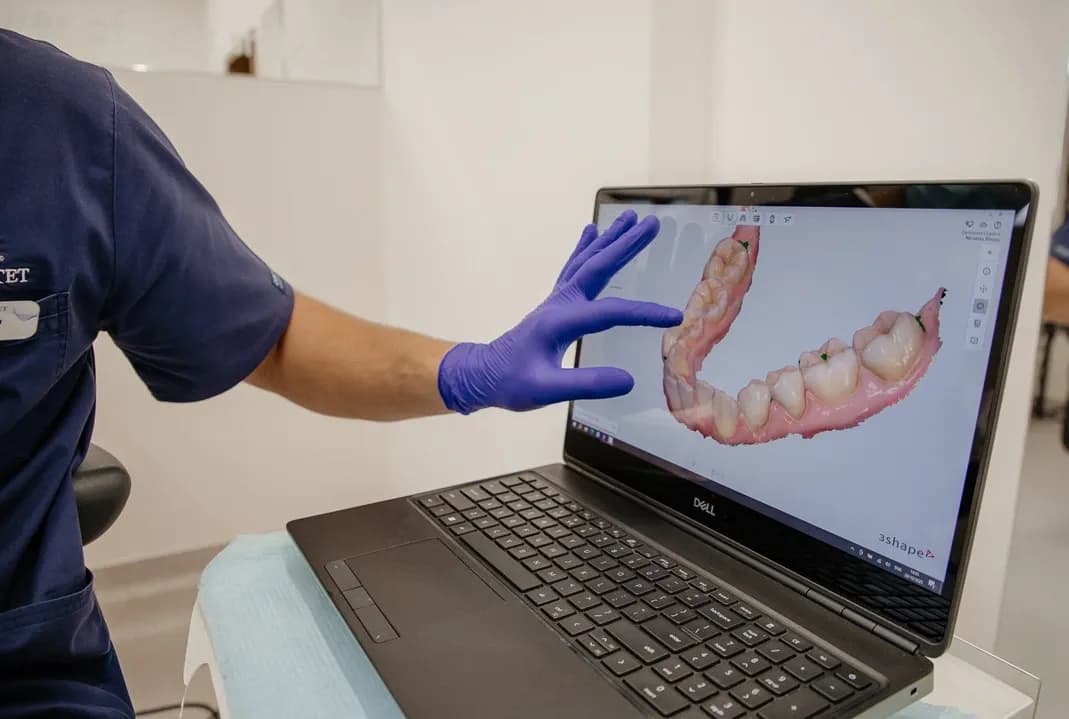
Intraoral scanning is a modern method of digital impression-taking, which allows a three-dimensional (3D) model of the teeth and gums to be created without the use of traditional impression materials.
Using an intraoral scanner, the dentist captures 3D images of the oral cavity, which are then converted into a digital model that can be analysed and sent directly to the dental laboratory.
Intraoral scanning has become an essential component of modern dentistry due to:
- greater patient comfort;
- high precision;
- integration into a fully digital workflow.
“Recent studies show that, for many types of prosthetic restorations, this offers results comparable to those obtained using conventional impressions, whilst also providing the advantage of a more comfortable experience for the patient.” – Dr. Eric Bumbar
What is a conventional dental impression?
A traditional dental impression is the conventional method by which a dentist obtains an accurate reproduction of the teeth and gums for the purpose of fabricating prosthetic work.
For a traditional impression, elastic materials are placed into a special impression tray. Once the material has set, the impression is sent to the laboratory, where a model is made, which is then used to fabricate the prosthetic restorations.
Although digital technologies have advanced considerably in recent years, the conventional impression remains a reliable and accurate method, successfully used in numerous clinical situations. The choice between a conventional impression and an intraoral scan is always made according to the specific details of each case and the treatment objectives.
Intraoral scanning versus traditional dental impressions – key differences
Both intraoral scanning and traditional dental impressions serve the same purpose: to produce as accurate a reproduction as possible of the teeth and gums in order to create precise and durable restorations.
The differences lie in how this information is obtained and processed, as well as in aspects relating to patient comfort and the time taken to complete the procedure.
Patient comfort
| Traditional impression | Intraoral scanning |
| As impression materials are placed in the oral cavity, there may be some slight discomfort or a feeling of nausea and pressure. | It is more comfortable, reduces the feeling of nausea caused by impression materials and allows, if necessary, only a specific area to be rescanned. |
Time taken
| Traditional impression | Intraoral scanning |
| The information is recorded using an elastic material, which is then sent to the laboratory to create the working model. | The images captured are converted into a three-dimensional digital model, which can be analysed and sent instantly to the laboratory. |
Accuracy and clinical use
| Traditional impression | Intraoral scanning |
| The accuracy of this method depends on the dentist’s experience and adherence to the working protocol. | Intraoral scanning offers superior accuracy and is effective in many modern digital treatments. |
“Recent studies show, however, that for most single-tooth prosthetic restorations and short-span bridges, the two methods offer comparable results when performed correctly. Intraoral scanning does not completely replace the conventional impression. In certain complex clinical situations, such as some cases of total edentulism or extensive implant-supported restorations, the dentist may still recommend a conventional impression to achieve the desired results.” – Dr. Eric Bumbar, dentist specialising in implantology.
The benefits of intraoral scanning
The development of digital technologies has brought greater comfort and efficiency to the process of taking dental impressions; however, both conventional and digital impressions can deliver excellent results when used in the appropriate clinical situations.
Here, however, are the advantages of intraoral scanning:
- a more comfortable experience for the patient;
- reduced nausea;
- digital visualisation of the teeth;
- integration with digital planning;
- rapid transmission to the dental laboratory;
- useful in cosmetic, prosthetic, orthodontic and implant treatments.
When is intraoral scanning used?
Intraoral scanning is used in a wide range of clinical situations:
- for dental crowns, veneers and prosthetic restorations;
- in planning orthodontic treatments and for making dental splints;
- for implant work, where the specific circumstances of the case allow;
- to monitor treatment progress by comparing scans taken at different stages;
- for aesthetic planning and clearer communication of the desired outcome.
When is a conventional dental impression used?
- in situations where digital scanning cannot capture all the necessary details clearly enough, due to the position of the treatment area or difficult access;
- for certain complex prosthetic cases, where the dentist and dental technician consider that the conventional method provides the information required to produce the restoration;
- when specific reproduction of soft tissues is required, including the way in which they move or adapt during function;
- in cases where the margins of the preparation are difficult to capture digitally, particularly if they are situated below the gum line;
- as an alternative to or in addition to a digital impression, when combining the two methods helps to obtain the information required for planning and carrying out the treatment.
Which method is best for the patient?
The choice of the appropriate method is not based on the technology itself, but on the specific characteristics of each clinical case, the type of restoration and the treatment objectives.
The dentist’s role is to select the solution that offers the greatest precision and predictability for each individual patient.
In conclusion, the success of a restoration is not determined solely by how the impression is taken, but by the entire process of planning and carrying out the treatment. When used correctly and for the appropriate indications, both intraoral scanning and conventional dental impressions can lead to functional, aesthetic and durable results.
Frequently Asked Questions
Does intraoral scanning hurt?
No, intraoral scanning is a painless procedure that does not require anaesthesia.
Is intraoral scanning more comfortable than a traditional dental impression?
Yes, for many patients it is more comfortable, as it does not involve the use of impression materials in the mouth.
Can intraoral scanning be used for implants?
Yes, intraoral scanning can be used in many dental implant treatments, depending on the complexity of the case and the dentist’s recommendation.
When is a traditional dental impression required?
A conventional dental impression may be required in certain complex cases or when the dentist considers that it provides the appropriate clinical information for the restoration.