



 Author:
 October 30, 2026
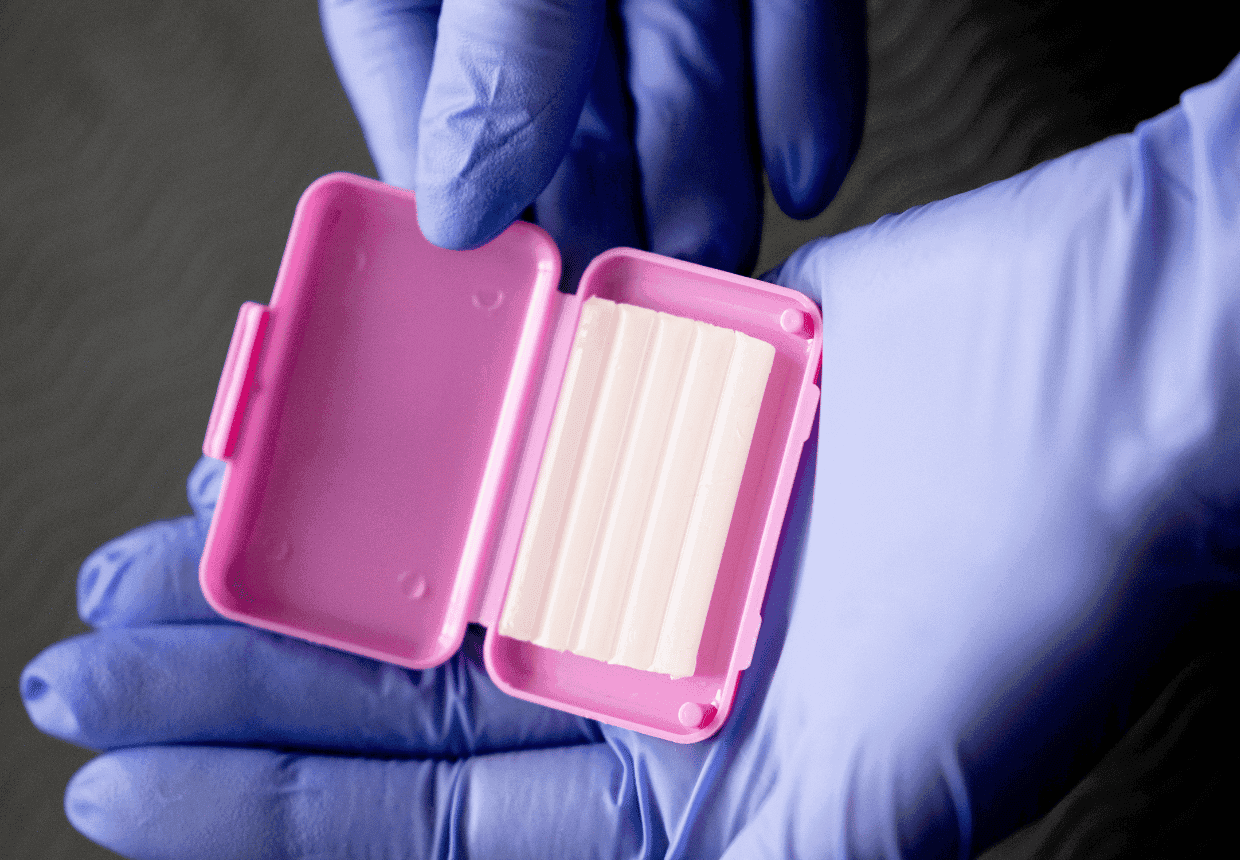
Orthodontic wax is a soft material that is applied to brackets or other components of fixed braces to reduce friction against the lips and cheeks. It is useful when irritation or superficial sores occur, particularly in the first few days after the braces are fitted or following certain orthodontic adjustments.
It is applied to a clean, dry surface and provides temporary protection, without replacing the adjustments made by the orthodontist.
What is orthodontic wax and what is it used for?
Orthodontic wax is a soft, biocompatible material intended for use in the oral cavity, which forms a protective barrier between the braces and the oral mucosa. It reduces friction and prevents irritation of the lips, cheeks and tongue caused by brackets or the orthodontic archwire.
The wax is used in particular by patients wearing fixed braces to minimise the discomfort caused by repeated contact between the braces’ components and the soft tissues.
How does orthodontic wax protect the lips and cheeks?
Orthodontic wax protects the lips and cheeks by forming a physical barrier between the braces and the oral mucosa.
Brackets, hooks and the ends of the orthodontic archwire may have surfaces or edges which, during speech, chewing and movements of the lips and cheeks, cause repeated friction. This friction can cause irritation, minor traumatic lesions or ulcers on the oral mucosa.
By applying orthodontic wax to the part causing discomfort:
- It reduces mechanical friction between the appliance and the soft tissues.
- It covers protruding surfaces, creating a smoother surface over which the lips and cheeks can glide more easily.
- It limits repeated trauma to the mucosa, allowing time for irritated tissues to heal.
- It alleviates local discomfort and sensitivity, making it easier to speak, chew and get used to the braces.
Orthodontic wax does not contribute to the movement of teeth and does not relieve the pressure felt on them during orthodontic treatment.
What is orthodontic wax made of?
Depending on the manufacturer, orthodontic wax may contain:
- Microcrystalline wax or paraffin – mineral-based ingredients that provide consistency and allow the product to be easily moulded.
- Beeswax – found in certain formulations to provide elasticity and adhesion.
- Carnauba wax or other vegetable waxes – used in some products to adjust the consistency.
- Flavourings and flavouring agents – optional ingredients to enhance the taste.
The exact composition varies from product to product, and some formulations are completely flavourless. It is advisable to check the ingredients and the manufacturer’s instructions, especially if you have any known allergies.
When should orthodontic wax be used?
Orthodontic wax is used when fixed braces cause irritation or discomfort to the lips, cheeks or tongue. Its purpose is to reduce friction between the braces and the oral mucosa, thereby protecting the soft tissues.
Orthodontic wax is not required as a preventative measure for all patients. Its use is recommended when discomfort arises, particularly in the following situations.
In the first few days after the braces are fitted
In the first few days after fixed braces are fitted, the oral mucosa needs time to adjust to the brackets and the orthodontic archwire.
Repeated contact between these components and the inside of the cheeks or lips can cause redness, sensitivity or minor sores.
Orthodontic wax can be applied to the parts causing irritation to reduce friction and help you get used to the braces.
It is important to distinguish between irritation of the mucous membrane and the pressure felt on the teeth after the braces have been fitted. Orthodontic wax is useful for protecting soft tissues, but it does not treat the discomfort caused by the orthodontic forces exerted on the teeth.
After braces have been adjusted
Following certain orthodontic adjustments, new points of contact may arise between the braces’ components and the oral mucosa.
In these situations, orthodontic wax can be used temporarily to protect irritated areas, particularly when a bracket or other component of the braces rubs against the inside of the cheek or lip.
If the discomfort persists or a component of the braces repeatedly causes irritation, it is advisable to have it checked by your orthodontist.
When a bracket or orthodontic wire causes irritation
Brackets, hooks or the ends of orthodontic wires can sometimes cause irritation or traumatic ulcers through repeated contact with the oral mucosa.
Orthodontic wax can be applied to the component causing the discomfort to limit direct contact with the affected area.
If the end of an orthodontic wire is pricking your cheek, the wax can provide temporary protection until the orthodontist has assessed and corrected the problem.
Orthodontic wax does not repair the components of the dental appliance. If a bracket has come loose or the archwire continues to irritate the mucosa, you should contact your orthodontist.
How do you apply orthodontic wax to braces correctly?
For effective use, orthodontic wax should be moulded and applied directly to the part of the braces causing the irritation. It is important that the surface in question is clean and dry, so that the wax adheres properly and forms a protective barrier.
How to apply orthodontic wax in 7 steps
- Wash your hands before handling the wax.
- Identify the area of the braces causing irritation.
- Clean and dry the area around the bracket or wire for better adhesion.
- Break off a small piece of wax and mould it between your fingers until it becomes pliable.
- Apply the wax to the bracket, pressing gently until it covers the area that is rubbing against the gum.
- Check that the area is protected and replace the wax when it comes away or as and when necessary.
- Do not reuse wax that has been removed, and do not neglect brushing your teeth or cleaning the spaces around the brackets.
Wax is not a substitute for oral hygiene and should not encourage the build-up of food debris and bacterial plaque.
How much orthodontic wax should you apply?
It is recommended to use a small amount of orthodontic wax, enough to form a small ball that completely covers the part of the braces causing irritation.
The amount may vary depending on the area requiring protection:
- For a single bracket: a small ball, enough to cover its surface.
- For an irritating wire end: enough to cover the part causing discomfort, without using too much material.
- For several irritating areas: apply a small piece separately to each problematic part.
The wax should be moulded between your fingers and gently pressed onto the bracket so that it adheres well and forms a smooth surface.
How long does orthodontic wax last, and when should it be replaced?
Orthodontic wax can be left on the braces for as long as necessary to protect the oral mucosa from friction and irritation, in accordance with the product instructions.
There is no fixed duration for wearing it; this depends on how well the wax adheres and the patient’s level of comfort.
Orthodontic wax should be replaced:
- When it comes away from the bracket or the orthodontic archwire.
- When it becomes soiled or food debris accumulates on it.
- Before oral hygiene, to allow for proper cleaning of the teeth and braces.
- After meals, if necessary, especially if it has moved or no longer adheres properly.
Wax provides only a temporary solution. If the pain persists, the irritation worsens, the archwire constantly pricks the gums or a bracket comes loose, an assessment by the orthodontist is required.
Can you eat or drink whilst wearing orthodontic wax?
Generally, it is recommended to remove orthodontic wax before eating, as it may come away whilst chewing or trap food particles.
After eating and brushing your teeth, you can apply a new piece if the area continues to cause discomfort.
Drinking water does not necessarily require the wax to be removed, provided it remains securely in place and the product instructions allow this.
Can you sleep with orthodontic wax?
Yes, you can sleep with orthodontic wax applied to your braces, provided it is intended for intraoral use and is used in accordance with the manufacturer’s and orthodontist’s instructions.
The wax can be useful at night as it reduces friction between the brackets and the orthodontic archwire and your lips and cheeks, preventing irritation caused by repeated contact with the oral mucosa.
Recommendations for use at night:
- Brush your teeth and clean your braces before going to bed.
- Wash your hands and apply a small amount of wax to the area causing discomfort.
- Make sure the wax adheres firmly to the braces.
- In the morning, remove the wax before brushing and replace it with a new piece if necessary.
What should you do if orthodontic wax doesn’t relieve the discomfort?
Orthodontic wax provides temporary protection against friction between the braces and the inside of the mouth. However, if discomfort persists despite correct application, it is important to identify the cause and, if necessary, seek an assessment from your orthodontist.
Firstly, check how the wax has been applied. Ensure that the area causing irritation is completely covered and that the wax adheres properly to the surface of the braces.
A protruding wire end, a loose bracket or a component that is causing trauma to the mucosa may require intervention by your orthodontist. Wax cannot correct these mechanical problems.
How do you treat irritation caused by braces?
To protect the irritated area and reduce discomfort:
- Maintain good oral hygiene to prevent the build-up of plaque around the braces.
- Temporarily avoid hard, crunchy or very spicy foods, which can aggravate the irritation.
- You can gently rinse your mouth with lukewarm salt water, if appropriate for your situation. Do not swallow the solution.
- Follow your orthodontist’s advice on caring for your oral mucosa and using products to relieve discomfort.
These measures may help to relieve symptoms, but they are no substitute for having the braces adjusted if there is a component causing repeated injury.
When should you contact your orthodontist?
It is recommended that you contact your orthodontist if:
- An orthodontic wire repeatedly pokes your cheek or lip.
- A bracket has come loose.
- The pain is severe, persistent or getting worse.
- Sores on the mucous membrane do not heal or there are signs of infection.
- You need to keep reapplying wax to the same area to make the braces more comfortable.
If severe symptoms occur, such as significant swelling or a fever, seek prompt medical assessment. Difficulty breathing or swallowing requires emergency medical assistance.
Not all lesions that appear in the mouth are caused by braces. If persistent or recurrent sores occur, your dentist can assess the cause and distinguish traumatic lesions from other conditions, such as those described in the article on the differences between mouth ulcers and cold sores.
Orthodontic wax provides temporary protection for the tissues, but it is no substitute for having your braces checked and adjusted.
“A bracket that repeatedly irritates the oral mucosa should not be ignored. Constant rubbing can cause damage to the mucosa, ulcers and local inflammation, affecting the patient’s comfort and oral hygiene.
If the irritation persists for several days in a row or recurs in the same place, an orthodontic check-up is recommended. The bracket may be positioned incorrectly, may have come partially loose, or there may be a wire end traumatising the soft tissues. “During treatment, as the forces applied alter the position of the teeth, the orthodontic archwire may also end up rubbing against the oral mucosa.” – Dr. Kimia Azar

How do you maintain good oral hygiene when using orthodontic wax?
The use of orthodontic wax is not a substitute for oral hygiene and should not make it more difficult to clean your braces.
Before brushing, remove the wax so that you can clean the surfaces of your teeth and the areas around the brackets properly.
Use a toothbrush suitable for fixed braces and supplement your oral hygiene routine with interdental brushes or other tools recommended by your orthodontist.
After cleaning your teeth, if the irritation persists, you can apply a new piece of wax to the part of the braces causing the discomfort.
Do not reuse wax that has been removed, as it can accumulate food debris and bacterial plaque.
Frequently asked questions about orthodontic wax
What happens if you accidentally swallow orthodontic wax?
Accidental swallowing of a small amount of orthodontic wax intended for intraoral use does not usually cause any health problems. It is not necessary to induce vomiting. If persistent symptoms occur or a large amount has been swallowed, seek medical advice. Difficulty breathing or signs of choking constitute a medical emergency.
How many times a day can you apply orthodontic wax?
Orthodontic wax can be reapplied as often as necessary, depending on any discomfort and how well it adheres to the braces. There is no set number of applications per day.
It is important to use a clean piece each time and to follow the product instructions.
If you need to apply wax very frequently to the same area, speak to your orthodontist to check whether your braces need adjusting.
Is orthodontic wax applied directly to the sore?
No. Orthodontic wax is applied to the part of the braces that is causing friction, not directly onto the sore patch on the mouth lining.
By covering the irritating bracket or wire, the wax limits repeated contact with the affected area and can help to reduce discomfort.
Can orthodontic wax also be used by children?
Yes, orthodontic wax can also be used by children wearing fixed braces when certain components cause irritation to the oral mucosa.
It should be applied in accordance with the orthodontist’s recommendations and the product instructions. For younger children, adult supervision is recommended to ensure correct application.
Where can you buy orthodontic wax?
Orthodontic wax can be requested from your orthodontist or purchased from pharmacies, depending on availability.
Your orthodontist can recommend a product that is suitable for your type of braces and your needs.
What can you use instead of orthodontic wax if you don’t have any to hand?
If you don’t have any orthodontic wax to hand, there are a few temporary solutions to reduce the irritation caused by braces or the orthodontic archwire. However, not all materials commonly used at home are safe for use in the mouth.
Orthodontic silicone: if you have a product specifically designed for intraoral use, this can be an alternative to orthodontic wax. Use it according to the manufacturer’s instructions. Orthodontic silicone can be purchased from pharmacies, subject to availability.
Rinsing with lukewarm salt water: this can temporarily soothe irritated mucous membranes. Dissolve about half a teaspoon of salt in a glass of lukewarm water, rinse your mouth and spit out the solution.
Soft and cold foods: cold yoghurt or other soft foods may temporarily relieve discomfort, though they do not replace the mechanical protection provided by wax.
Oral gels: in certain situations, your dentist may recommend products for the care of irritated mucosa, including oral gels containing ingredients such as sage or propolis, depending on their composition and the patient’s specific needs. These do not replace the protective barrier provided by wax or orthodontic silicone.
Do not use chewing gum, adhesives or other improvised materials to cover the components of the dental appliance.
Orthodontic wax – a temporary solution for protecting the oral mucosa
Orthodontic wax is a useful product for reducing irritation caused by fixed braces. By forming a protective barrier between the brackets, the orthodontic archwire and the oral mucosa, it can alleviate discomfort and make it easier to get used to the braces.
However, if the irritation persists, worsens or is caused by a loose or damaged component, it is important to contact your orthodontist to identify and rectify the cause.
Are your braces causing irritation or discomfort?
If a component of your braces continues to irritate your lips or cheeks, your orthodontist can check and adjust them. Book an appointment at DENT ESTET to have the situation assessed.