




 Author:
  March 9, 2026
Dental X-rays and dental computed tomography (dental CT) are fundamental imaging investigations in modern dentistry. Every successful treatment plan must begin with a high-quality investigation, as a clinical examination alone is not sufficient.
The role of panoramic X-rays and dental CT scans is to provide information on the quantity and quality of bone structure, or details regarding other anatomical structures, such as nerves or maxillary sinuses. Although both investigations use X-rays, the technology behind them and the level of detail they provide are completely different.
In this article, Dr. Rareș Nica, a resident in dental prosthetics and coordinator of the DENT ESTET Radiology Centre, explains exactly what the role of each examination is, how they assist in the treatment process and, most importantly, when it is appropriate to use them.
What is a panoramic dental X-ray?
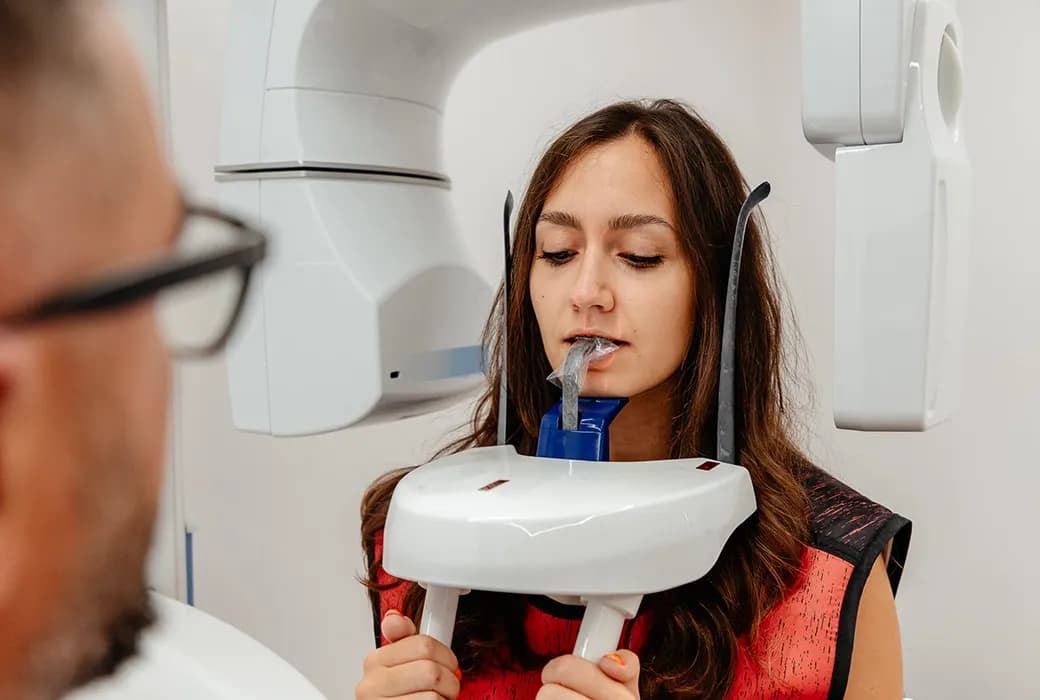
A panoramic dental X-ray is, by definition, a two-dimensional (2D) imaging examination that captures the entire dento-maxillary anatomy on a single film.
A panoramic dental X-ray can show:
- the teeth on both arches;
- the jawbones;
- the temporomandibular joints;
- the maxillary sinuses.
The purpose of a panoramic X-ray is to provide the dentist with an overview, a sort of ‘map’ of the oral cavity, quickly and without discomfort.
“A dental X-ray is the first-line investigation we recommend to any adult patient on their first visit to the clinic, to ensure there are no hidden problems. Because it provides a wealth of information from a single exposure, with a low radiation dose, dental X-rays are even recommended for children, particularly to monitor the replacement of milk teeth with permanent ones,” explains Dr. Rareș Nica.
Interpretation of a panoramic dental X-ray
Accurate interpretation of dental X-rays enables the dentist to glean a wealth of vital information for the treatment plan.
During the analysis, the dentist first checks for the presence of all teeth, their position in the dental arch, the presence of impacted teeth (such as wisdom teeth) and the general condition of the alveolar bone supporting the teeth.
“In my daily practice, I frequently encounter situations where the patient feels no pain, but on the X-ray I discover a chronic infection at the base of a root, which has developed silently beneath an old prosthetic restoration,” says Dr. Rareș Nica.
However, panoramic X-rays have their limitations. If, following analysis, a complex cystic formation or a wisdom tooth situated extremely close to the mandibular canal (through which the nerve passes) is observed, a simple panoramic X-ray will not be sufficient to operate in complete safety, and a three-dimensional approach will be necessary.
Advantages and limitations
Like any medical procedure, this investigation offers a clear set of benefits, but also comes with certain limitations that we must take into account depending on the complexity of the clinical case.
The benefits of dental X-rays
- It is very quick, non-invasive and comfortable;
- It is less expensive than 3D scans;
- The radiation dose involved is minimal (similar to a flight of a few hours).
The limitations of dental X-rays
- It provides limited detail, as the image is two-dimensional;
- Distortions of anatomical structures may occur;
- It does not allow for accurate measurements of bone volume, which are necessary for complex procedures.
"It is important to note that the benefits far outweigh the risks during the initial diagnostic phase. The fact that radiation exposure is extremely low makes it ideal for regular monitoring of oral health, allowing for a quick assessment of overall health." – Dr. Rareș Nica.
Indications for panoramic X-rays
- Detection of extensive dental caries and infections that develop at the root level or within the jawbone, which are invisible to the naked eye.
- Assessment of bone structure for dental implant treatments. A panoramic X-ray provides information on bone volume, but allows the exact thickness of the bone to be determined, which is why it remains only a preliminary step before proceeding to more detailed investigations.
- Planning orthodontic treatments, as it helps the dentist determine the position of the teeth and the available space on both arches.
- In paediatric dentistry, dental X-rays are frequently used to assess tooth eruption in children. In this way, the dentist ensures that the permanent teeth are developing correctly within the bone and that there are no anatomical obstacles to their normal eruption.
What is a dental CT scan?
Cone-beam computed tomography, also known as CBCT or dental CT, represents the pinnacle of imaging in modern dentistry and oral and maxillofacial surgery.
Unlike panoramic radiography, which provides a flat image, CT technology creates an extremely accurate 3D reconstruction of all bone, dental and nerve structures.
The major difference between panoramic radiography and dental CT lies in the ability to ‘navigate’ digitally through the patient’s bone, slice by slice, in all three spatial planes.
This investigation plays a vital role in performing complex surgical procedures with millimetre precision, thereby eliminating risks.
At DENT ESTET clinics, the price of a CT scan can range from 180 lei, when the scan is for a single tooth, up to 580 lei for a full (bimaxillary) scan.
Advantages and disadvantages
The decision to recommend a dental CT scan is never made on a whim. Surgical precision is of the utmost importance, but the scan must be justified by a specific treatment plan.
Advantages of dental CT scans
- It provides a detailed 3D view of facial anatomy.
- It ensures high precision, allowing for accurate (1:1) volume measurements.
- It is absolutely essential in implantology for safe surgery.
Disadvantages of dental CT scans
- It is more expensive than an X-ray;
- It involves greater radiation exposure than panoramic X-rays;
- It is not recommended as a routine investigation for straightforward cases.
Indications for dental CT scans
Dental CT has become the gold standard and an absolute necessity in the assessment for dental implants. This scan allows for the precise measurement of the density, height and thickness of the jawbone and enables the virtual simulation of implant placement prior to the actual surgery, thereby protecting vital structures such as the sinuses or nerves.
This 3D scan is recommended for complex dental trauma. For example, in cases of accidents where fine fractures of the tooth roots or jawbone are suspected.
The examination is crucial in endodontics, for complex root canal retreatment, or in surgery, for the assessment of teeth deeply embedded in the bone, whose position risks compromising neighbouring teeth or adjacent nerve structures.
Differences between panoramic X-rays and dental CT scans
| Comparative criterion | Panoramic X-ray | Dental CT (CBCT) |
|---|---|---|
| Level of detail | Medium, provides a general 2D image. | Very high, precise 3D reconstruction. |
| Cost | Lower, affordable. | Higher. |
| Duration | Very short (2–5 minutes). | Short (5–10 minutes). |
| Recommendations (Children/Adults) | Safe for children, excellent as routine screening for all patients. | Recommended for adults for planning complex cases (e.g. implants). |
Frequently asked questions about panoramic X-rays and dental CT scans
How much does a panoramic dental X-ray cost?
The cost of a panoramic X-ray at DENT ESTET clinics is 140 RON. The costs of radiological examinations can be found on the pricing page.
What is the difference between an X-ray and a dental CT scan?
A panoramic X-ray provides a flat, 2D image, making it ideal for a general check-up. A dental CT scan, on the other hand, creates an extremely accurate 3D reconstruction of the bone, tooth and nerve structures.
Is an X-ray safe for children?
Yes. When correctly prescribed by a doctor to assess growth, the radiation dose is minimal, and the diagnostic benefit far outweighs any minor risk.
Bibliography
- Cone Beam CT for Dental and Maxillofacial Radiology (Evidence-Based Guidelines), European Commission Radiation Protection No. 172
- Dental Radiographic Examinations: Recommendations for Patient Selection and Limiting Radiation Exposure, American Dental Association
- Scarfe WC, Farman AG. - What is Cone-Beam CT and How Does it Work?, Dental Clinics of North America
- Bornstein MM et al. - Cone Beam Computed Tomography in Implant Dentistry, International Journal of Oral Maxillofacial Implants