




Pain after root canal treatment: how long does it last and when should you see a dentist?
 Author: Dr. Erika Vasilescu
 September 15, 2026
Root canal treatment removes the infected tissue from inside the tooth and helps to preserve it in the dental arch. Mild sensitivity may occur after the procedure, but severe, worsening pain or pain accompanied by swelling should be assessed by a dentist.
In this article, Dr Erika Vasilescu, a specialist in endodontics at DENT ESTET clinics, explains how pain may manifest after root canal treatment, what the causes of the pain might be, and what the solutions are in such cases.
Is it normal to experience pain after root canal treatment?
Yes, mild or moderate sensitivity is normal in the first few days following root canal treatment. Even though the dental pulp – often referred to as the ‘nerve’ – has been removed, the tissues surrounding the root remain alive and may be temporarily inflamed.
The discomfort may be more noticeable if the tooth was painful or infected before the procedure. Normally, the sensation gradually subsides.
“Following endodontic treatment, we are particularly interested in how the symptoms develop. Sensitivity that gradually subsides is usually part of the healing process. Pain that worsens or the appearance of swelling are reasons for a follow-up assessment” – Dr Erika Vasilescu.
How might pain manifest itself following endodontic treatment?
The pain can range from mild discomfort to persistent pain. What matters most is its intensity, duration and progression.
Mild discomfort around the treated tooth
Localised discomfort when touched or whilst chewing may occur after root canal treatment. It is usually mild and does not affect normal activities.
Sensitivity or pain when biting
Sensitivity when biting is common in the first few days, as the tissues surrounding the root may remain inflamed. A follow-up appointment with the endodontist who carried out the root canal treatment is necessary if the patient is unable to bite normally on that tooth.
Severe, throbbing or persistent pain
Severe, throbbing pain that does not subside or becomes more intense is a symptom that should not be ignored.
“An assessment is required, especially if this pain is accompanied by pressure, swelling, discharge or a general feeling of being unwell.” – Dr Erika Vasilescu.
How long does the pain last after a root canal treatment?
You may experience some discomfort following root canal treatment, but this usually subsides within three to five days. Recovery depends on the initial infection, the anatomy of the tooth and the complexity of the treatment.
| The period | What is normal | What requires attention |
| The first 24–48 hours | sensitivity to touch or biting | very severe pain, swelling or difficulty swallowing |
| Days 3–5 | decreasing discomfort | pain that remains severe or worsens |
| After 5–7 days | minimal or no symptoms | persistent pain, recurrence of symptoms or uneven bite |
Why might pain occur after root canal treatment?
Pain is most often caused by temporary inflammation around the root, but it can also have underlying causes that need to be addressed.
Inflammation of the tissues surrounding the root
- These tissues may remain irritated after the root canals have been cleaned and filled.
- This reaction is common if the discomfort gradually subsides.
The filling or dental crown is too high
- If the restoration is too high, the treated tooth will bear additional pressure with every bite.
- The dentist can check the bite and adjust the restoration.
The infection has not cleared up completely
- A widespread infection may take some time to heal.
- Persistent pain, swelling or a small lesion on the gum requires a check-up.
Complex anatomy / Difficult-to-locate root canal
- Some teeth have narrow, curved or extra root canals.
- A microscope and, where indicated, a CBCT scan can provide further information.
A crack or fracture in a tooth
- A crack can cause pain when biting, even if the root canal treatment has been carried out correctly.
- The solution depends on its location and extent.
Less common causes
- Less commonly, symptoms may be linked to incomplete obturation, material protrusion, perforation or tissue irritation.
- The cause cannot be determined solely on the basis of the type of pain.
When should you contact an endodontist?
You should see an endodontist if:
- swelling occurs in the gums or face;
- the discomfort does not subside after a few days;
- the pain is severe and getting worse;
- your bite feels uneven;
- you develop a fever or an unpleasant taste in your mouth;
- your general condition is affected;
- you experience difficulty swallowing or breathing.
What can you do if your tooth hurts after root canal treatment?
If you experience pain following root canal treatment, until your next appointment:
- follow the instructions regarding medication;
- avoid chewing on the treated tooth;
- you should eat light meals and avoid hard or sticky foods;
- continue with your usual oral hygiene routine.
What happens if the pain persists?
If the pain persists, the dentist will re-examine the tooth before recommending a course of treatment. An X-ray may be required or, in selected cases, a CBCT scan.
Clinical and radiological assessment
The dentist checks the bite, the gums, the restoration and any available images. Sometimes, the source of the pain may be an adjacent tooth.
Adjustment of the filling or crown
If the tooth is under excessive stress when biting, adjusting the restoration can reduce the pressure and allow the tissues to settle down.
Endodontic retreatment
Retreatment may be recommended when there is an untreated root canal, a reinfection or a root filling that no longer properly seals the inside of the tooth.
Apical resection
Apical resection is a surgical procedure that treats the area around the root tip when the problem cannot be resolved by working inside the root canal alone.
Extraction
Extraction remains a last-resort solution, recommended when the tooth is severely fractured or can no longer be restored and safely retained.
What role do microscopes and imaging play in endodontic treatment?
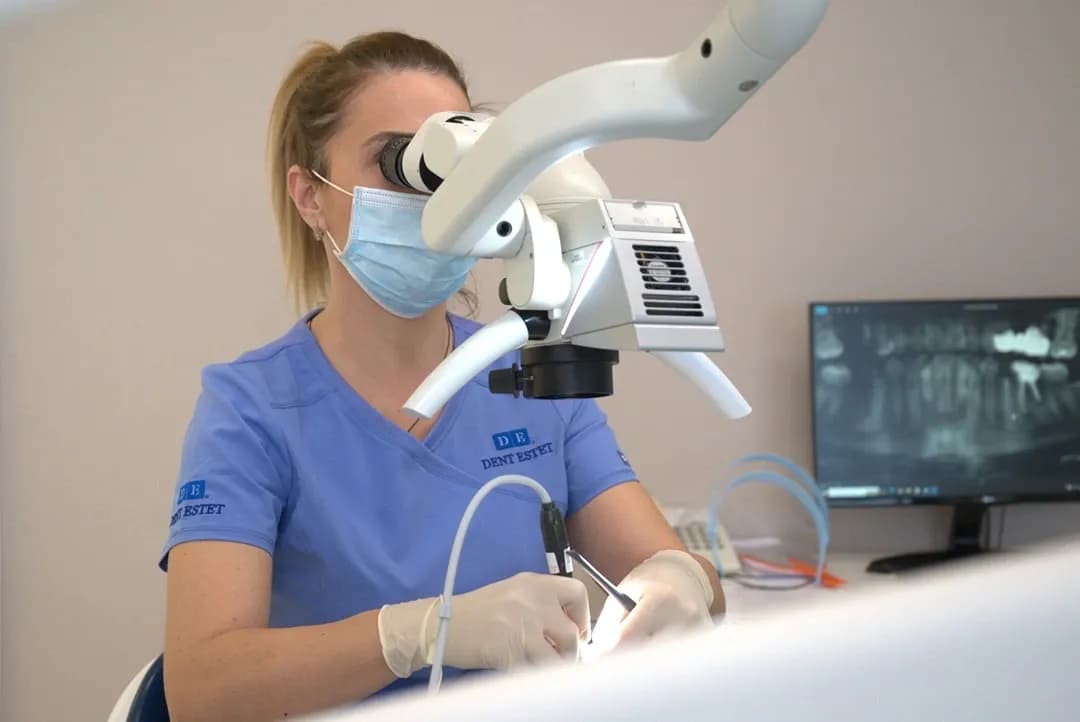
The microscope provides the dentist with a magnified view and better illumination of the inside of the tooth. This makes it possible to identify:
- additional canals;
- entrances that are difficult to see;
- cracks;
- other important anatomical details.
This technology complements the endodontist’s expertise and provides them with greater control at every stage of treatment.
X-rays are used for diagnosis, treatment planning and monitoring. Where necessary, CBCT scanning provides three-dimensional images and additional information about the anatomy of the root canals; it is recommended in cases involving unusual anatomy, persistent symptoms or suspected fractures. CBCT is not routinely necessary, but is carried out on the doctor’s advice.
Frequently asked questions about pain following root canal treatment
Why does a tooth still hurt if the nerve has been removed?
The pain may originate from the living tissues surrounding the root, not from the removed pulp. These tissues may remain temporarily inflamed.
Is it normal to experience pain when biting down after root canal treatment?
Yes, a slight sensitivity when biting may be normal for a few days. If the tooth seems to have grown taller or the pain gets worse, you should have it checked.
How long does the pain last after root canal treatment?
In most cases, the discomfort subsides within three to five days. Severe, persistent or worsening pain should be assessed.
Could the pain return after a few months or a few years?
Yes. A reinfection, a poorly sealed filling, a difficult root canal or a crack can cause delayed symptoms, and the tooth needs to be examined.
Can a tooth change colour after root canal treatment?
Yes, sometimes a tooth can become discoloured. The dentist can assess the cause and recommend a suitable cosmetic solution once the treatment has been finalised.