



 Author:
 October 9, 2026
Many patients say to me, almost apologetically: ‘Doctor, I brush my teeth twice a day and they’re still yellow.’ More often than not, the explanation isn’t simply down to how well or how often you brush your teeth.
Proper brushing is essential for oral health, but it cannot prevent all colour changes. Dental hygiene and the natural colour of your teeth are two different things. Furthermore, a stain on the surface of a tooth is not the same as a colour change that occurs within its structure.
That is why, before any whitening treatment, it is important to identify the cause
Do yellow teeth mean you’re not brushing them enough?
Not always. The natural colour of teeth varies from person to person. Brushing removes bacterial plaque and can reduce some superficial stains, but it does not significantly alter the natural colour of the dentine.
Teeth can also become yellow for reasons not directly related to oral hygiene, such as age, diet, smoking, wear and tear on the enamel, or certain changes occurring inside the tooth.
Where does the natural colour of teeth come from?
The colour we see is not determined solely by the white surface of the tooth. The final appearance results from the interaction between several dental structures, and two people with equally good oral hygiene may naturally have different shades.
Enamel and dentine
Enamel, the outer layer of the tooth, is partially translucent. Beneath it lies dentine, which naturally has a more yellowish hue.
The colour you see in the mirror is the result of the combination of the two. The thickness and degree of translucency of the enamel vary from person to person, and when the dentine is more visible, the tooth may appear more yellowish.
What are the main reasons why teeth turn yellow?
Yellowing can be caused both by the build-up of pigments on the surface of the tooth and by changes to the enamel or the internal structures of the tooth. Sometimes, several factors are involved at the same time.
Coffee, tea and other pigmented foods
Coffee, tea, red wine, cola-type drinks and certain fruits or strongly pigmented foods can, over time, cause extrinsic stains on the surface of the teeth.
These do not necessarily appear overnight, but can build up gradually, especially when the foods or drinks in question are consumed frequently.
Smoking and tobacco products
Tobacco can cause discolouration on the surface of the teeth, and the frequency of use affects the extent to which this becomes visible.
Smoking is also linked to other oral health problems, so its impact is not merely cosmetic.
Ageing
Over time, the enamel can become thinner, and the dentine underneath becomes more visible.
Teeth can therefore take on a yellower or darker shade, even in someone who has consistently maintained good oral hygiene.
Tooth erosion and enamel wear
Enamel can become thinner for reasons other than the natural ageing process.
Repeated exposure to acidic foods and drinks, acid reflux or certain forms of tooth wear can reduce the thickness of the enamel. As it becomes thinner, the dentine becomes more visible, and the tooth may appear more yellow and become more sensitive.
Medicines, injuries or other internal causes
Some discolouration occurs within the tooth itself. It may be associated with certain medicines taken whilst the teeth were forming, dental trauma, changes in the dental pulp, fluorosis or other causes of intrinsic discolouration.
These changes do not disappear simply by brushing.
What is the difference between external spots and internal discolouration?
The difference between the two is important because it influences the choice of the right treatment. Extrinsic stains are found on the surface of the tooth, whilst intrinsic discolouration is present within the structure of the enamel or dentine.
| Characteristic | Extrinsic discolouration | Intrinsic discolouration |
| Location | On the surface of the tooth | Within the structure of the enamel or dentine |
| Common causes | Coffee, tea, tobacco, food colourings | Trauma, certain medicines, developmental changes |
| Can they be removed by brushing? | Some can be reduced | No |
| Does professional cleaning help? | Yes, for many superficial stains | It does not alter internal pigmentation |
| Does teeth whitening help? | It can be helpful, depending on the situation | It may be effective, but the results depend on the cause |
In short, surface stains can be removed or reduced more easily, whilst internal changes require an assessment before choosing a cosmetic treatment.
Why doesn’t brushing twice a day automatically whiten your teeth?
The main purpose of brushing is to control bacterial plaque and maintain oral health.
Brushing can reduce some superficial stains, but it cannot change the natural colour of the dentine, nor can it remove all intrinsic discolouration.
For this reason, brushing more vigorously or aggressively does not automatically result in whiter teeth.
Can aggressive brushing do more harm than good?
Yes. Excessive pressure can damage the gums and, under certain conditions, can contribute to wear on the tooth surfaces and the development of sensitivity.
When trying to achieve whiter teeth, it is important not to turn brushing into an abrasive procedure. The correct technique is more important than the force applied.
Can a professional dental clean restore the colour of your teeth?
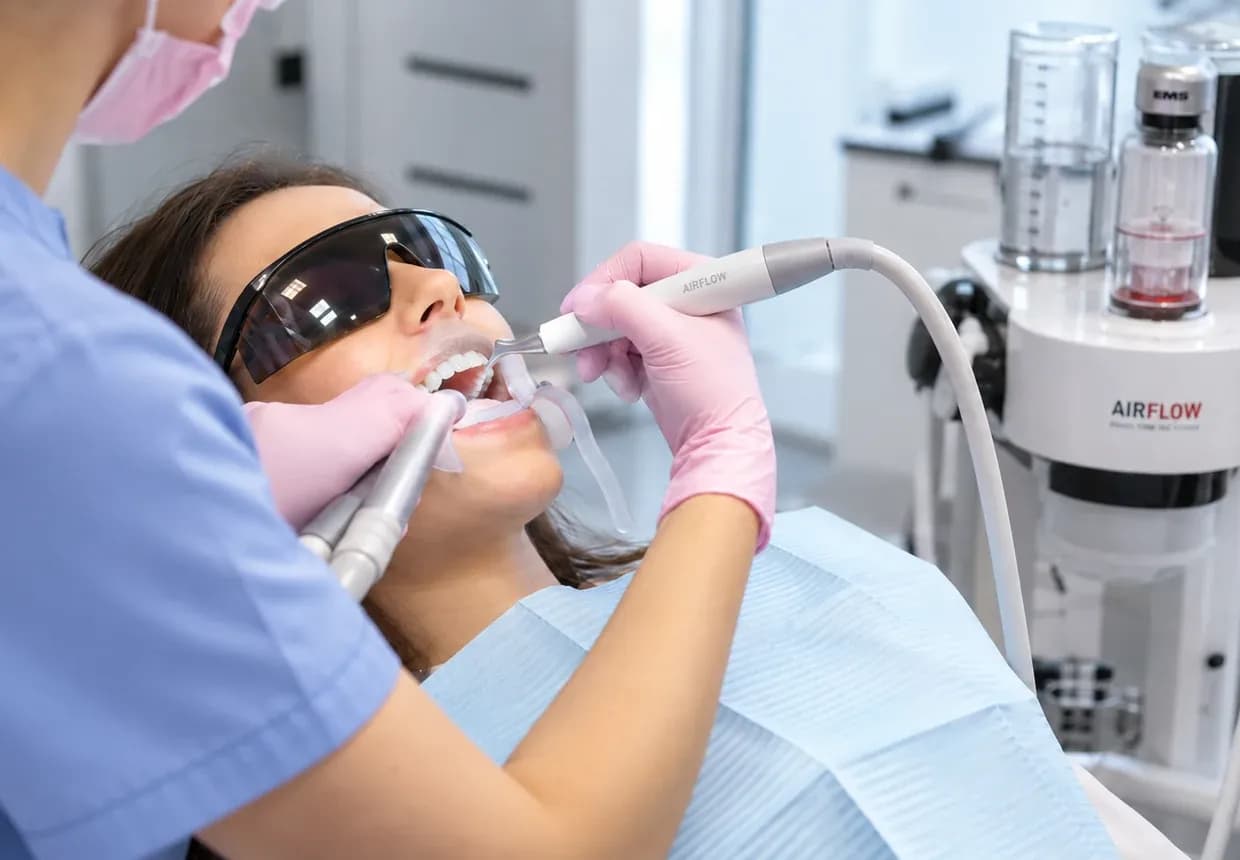
Professional cleaning removes bacterial plaque and tartar and can reduce extrinsic staining.
After the procedure, many patients notice that their teeth look cleaner and brighter.
However, professional cleaning should not be confused with teeth whitening. By removing deposits and superficial stains, the tooth returns to its natural shade. If the patient wishes for a shade lighter than their natural one, this is referred to as a whitening procedure.
When might teeth whitening be recommended?
Teeth whitening is discussed following an assessment of the health of the teeth and gums and, where necessary, after any existing tooth decay or inflammation has been treated.
It may be an option when the patient wishes for a lighter shade, and the method is chosen depending on the type of discolouration and the clinical situation.
It is also important that any existing restorations are assessed before treatment. Crowns, veneers and fillings do not respond to whitening agents in the same way as natural teeth.
| Procedure | Main effect |
| Regular brushing | Removes bacterial plaque and may reduce some superficial stains |
| Professional cleaning | Removes tartar and certain external stains |
| Teeth whitening | Can lighten the natural shade of the teeth through the action of whitening agents |
How can you prevent surface stains and minimise tooth discolouration?
Not all discolouration can be prevented, but certain habits can reduce the build-up of surface stains and help to maintain the natural appearance of your teeth.
It is recommended that you:
- brush your teeth twice a day, using a gentle and careful technique;
- use dental floss or interdental brushes;
- have regular check-ups and professional cleanings;
- reduce frequent exposure to strongly pigmented drinks;
- rinse your mouth with water after drinking coffee, tea or wine;
- give up smoking;
- avoid abrasive home-based whitening methods.
When should a change in the colour of a tooth be assessed by a dentist?
Not every change in colour is purely a cosmetic issue.
A medical assessment is recommended if:
- a single tooth becomes darker;
- a grey or brown tinge appears;
- you have suffered trauma to the tooth;
- you experience pain or sensitivity;
- the colour change is sudden;
- there are stains that do not disappear after cleaning.
A tooth that changes colour on its own may have an internal cause, including a change in the pulp, and simply whitening it will not address the underlying cause.
Frequently asked questions about tooth discolouration
Is it normal for teeth to be slightly yellowish?
Yes. Dentin naturally has a yellowish tint, and the extent to which this is visible varies from person to person.
Why are my teeth yellow even though I brush them twice a day?
This is because brushing controls bacterial plaque, but does not alter the natural colour of the teeth or remove internal staining. Diet, smoking, age and wear and tear on the enamel can also play a part.
Can whitening toothpaste actually whiten your teeth?
It can reduce some superficial stains, but it does not significantly alter the internal colour of the tooth.
Does coffee stain your teeth yellow?
Frequent consumption can lead to the development of extrinsic stains on the surface of the teeth. Good oral hygiene and regular dental check-ups help to control these stains.
Do teeth become more yellow as we get older?
In many cases, yes. As the enamel becomes thinner, the yellowish dentine may become more visible.
Does a professional dental clean-up whiten your teeth?
Not in the sense of a whitening treatment. It removes tartar and certain external stains, allowing the tooth to return to its natural shade.
Can teeth whitening change the natural colour of your teeth?
It can lighten the shade of natural teeth. However, the result varies depending on the type of discolouration and each patient’s individual circumstances.
Do crowns and fillings whiten along with the teeth?
No. Existing restorations do not respond to bleaching agents in the same way as natural dental tissue.
Why is one tooth a darker colour?
There may be a history of trauma, a change in the dental pulp, or another internal cause. The tooth should be assessed, particularly if pain or sensitivity is also present.
The colour of your teeth doesn’t just depend on how often you brush them
Brushing is essential for oral health, but it does not address all causes of yellowing.
Superficial stains and intrinsic discolouration require different approaches, and professional cleaning and teeth whitening serve distinct purposes. Before choosing a cosmetic treatment, it is important to identify the cause of the discolouration.
If you are unhappy with the colour of your teeth or have noticed a change that worries you, book a consultation at DENT ESTET Sibiu for an assessment and to choose the right solution.