




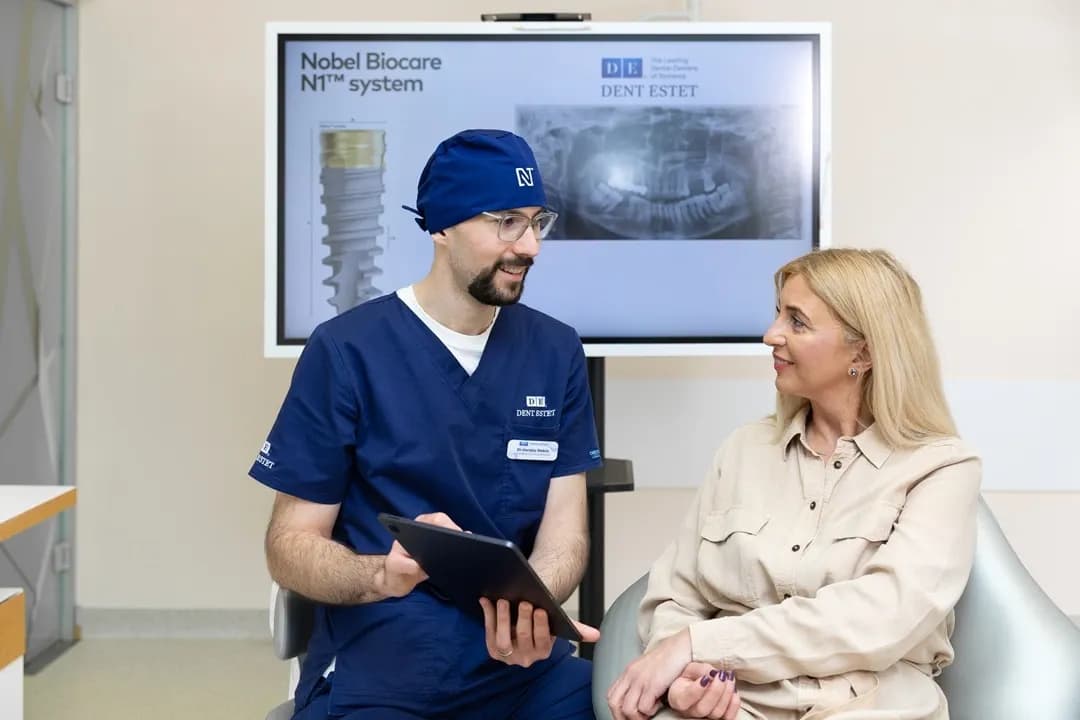
Fixed teeth in a day: when are 4 implants enough, and when are 6 recommended?
 Author: Dr. Horațiu Dobre
 October 5, 2026
The choice between 4 and 6 implants for a ‘Fixed teeth in a day‘ treatment is determined individually, based on each patient’s clinical situation. There is no universally suitable number of implants, and the decision is based on the evaluation of several factors.
Bone density and volume, the anatomy of the treatment area, chewing forces, implant stability, and the design of the final prosthetic restoration are all factors that guide the oral surgeon in determining the appropriate number and positioning of implants.
Who is a candidate for Fixed teeth in 24 hours on 4 or 6 Implants?
The ‘Fixed Teeth in a Day’ procedure using 4 or 6 implants is recommended for patients:
- who have lost all their teeth on one arch (total edentulism);
- whose remaining teeth can no longer be preserved and need to be extracted;
- who suffer from advanced periodontal disease, with tooth mobility;
- who wear removable dentures and would prefer a fixed restoration.
“The treatment involves placing 4 or 6 dental implants in the arch, onto which a fixed prosthetic restoration will subsequently be screwed within 24–48 hours. The implants are placed in such a way as to make the most of the available bone. For the patient, the main benefit is the possibility of having a fixed set of teeth in a short space of time, enabling them to regain their chewing function and comfort in everyday life.” – Dr Horațiu Dobre, specialist in dento-alveolar surgery
How does the dentist decide whether 4 or 6 implants are needed?
The surgeon determines which of the two options is the most suitable, taking into account various factors, such as bone availability, the anatomy of the jaw and risk factors. The assessment is carried out using a computed tomography (CT) scan and other supplementary investigations, such as digital intraoral scanning and MODJAW technology scanning.
Bone quantity, quality and distribution
Computed tomography – CBCT allows for the assessment of the remaining bone structures. Using this investigation, the surgeon will determine:
- the quantity and quality of the bone
- bone density
- the degree of bone resorption
- the presence of bone atrophy
- whether there is any bone loss, which may require bone grafting procedures.
Anatomy of the jaw and the position of important structures
The maxilla contains anatomical structures that must be taken into account for the successful completion of ‘Fixed Teeth in a Day’ treatment.
For example, the maxillary sinuses can serve as an important anatomical landmark in treatment involving 4 or 6 implants, as their position and size influence the amount of bone available for implant placement.
“It is the surgeon’s responsibility to be aware of these factors and to adapt the treatment plan accordingly. The distribution of implants across the arch provides an indication of the long-term stability of the prosthetic restoration.” – Dr Horațiu Dobre
Primary stability of implants
Primary stability of implants refers to the amount of bone engaged by the implant threads at the time of placement.
At DENT ESTET clinics, primary stability is measured during the procedure using the Osstell Beacon device.
Discover the benefits of Osstell Beacon technology
If certain reference values are met using the Osstell Beacon, the dentist can then fit a temporary fixed prosthetic restoration onto the inserted implant, without the patient having to wait, without a crown, for the implant to osseointegrate.
Masticatory forces and bite characteristics
The forces exerted on a fixed implant-supported restoration are influenced by:
- the position of the teeth;
- the occlusal relationship;
- the size of the restoration;
- the patient’s individual characteristics.
The design of the final prosthetic restoration must aim to ensure a controlled distribution of forces across the implants and prosthetic structures. Therefore, the number of implants cannot be determined solely on the basis of bone volume, but must be aligned with the prosthetic plan and the intended function.
Bruxism is a factor that can increase the mechanical stresses on implant-supported restorations.
General health and risk factors
Smoking, diabetes and a history of periodontal disease are factors that must be assessed prior to implant treatment.
Available data indicate an association between diabetes and a higher risk of peri-implantitis, and smoking is also associated with an increased risk of peri-implantitis.
A history of periodontitis must be taken into account, as recent studies indicate a higher risk of peri-implant complications and, in some analyses, of implant loss.
Medication should also be included in the pre-operative assessment. For example, antiresorptive therapies, including bisphosphonates and denosumab, require an individualised analysis of risks and benefits, as the literature on implant survival and the risk of medication-associated osteonecrosis is complex and sometimes contradictory.
Therefore, a comprehensive medical history and the patient’s individual healing capacity must be discussed prior to the procedure.
Fixed dentures on 4 or 6 implants: what’s the difference?
| Criterion | Fixed dentures on 4 implants | Fixed dentures on 6 implants |
| Number of support points | Four | Six |
| Distribution of implants | Posterior implants can be inserted at an angle | May allow for additional distribution across the arch, with straight or angled implants |
| Required bone volume | Can make use of areas with limited available bone | Requires adequate space and bone for two additional implants, as well as expertise on the part of the surgeon. |
| Prosthetic plan | Adapted to a four-point support system | Allows forces to be distributed across six points |
| Complexity of the procedure | Depends on the anatomy of the case | Requires additional training on the part of the surgeon. |
| Indications | Determined solely following assessment | Determined solely following assessment |
When might a fixed bridge on four implants be recommended?
A fixed bridge supported by four implants may be considered when:
- there are adequate areas of bone for implant placement;
- sufficient primary stability can be achieved;
- the patient’s anatomy is conducive to the insertion of posterior implants in the planned position;
- the design of the restoration allows for controlled force distribution.
In certain cases, particularly in the atrophic maxilla, posterior implants may be placed at an angle to utilise the available bone and to avoid certain augmentation procedures. This approach is described in the specialist literature as an alternative to some grafting procedures or sinus lifts.
However, this indication also requires that the future prosthetic restoration be designed in such a way that forces are distributed in a controlled manner. Clinical studies on fixed full-arch maxillary prostheses have shown that restorations supported by four implants can yield favourable results in the medium and long term, but some studies have observed more technical complications compared with groups receiving six implants. Therefore, four implants may be sufficient for certain cases, but they do not represent a one-size-fits-all solution.
When might a fixed bridge on 6 implants be recommended?
A six-implant restoration may be indicated when:
- there is sufficient bone volume for the additional implants;
- their distribution can contribute to the planned prosthetic configuration.
In certain cases, a wider arch, the available anatomy or the specific features of the restoration may make it useful to employ a greater number of abutments. However, the decision is not based solely on the presence of bone, but also on the design of the restoration and its biomechanics.
“Increased masticatory forces, occlusal characteristics or certain features of the restoration may lead the dentist to consider six implants, but the literature does not allow for the formulation of a rule stating that a patient with high masticatory forces must necessarily be treated with six implants. The available comparative data show similar clinical outcomes between the two protocols, which supports the need for an individualised decision.” – Dr Horațiu Dobre
Stages of treatment with fixed dentures supported by 4 or 6 implants
Treatment begins with a clinical and imaging assessment and continues with surgical and prosthetic planning. In the case of full-mouth rehabilitation, the dentist must determine not only the position of the implants, but also the position of the future teeth, their relationship with the soft tissues, and how the restoration will function.
Consultations and 3D investigations
The initial consultation includes a medical history and a clinical examination. The dentist assesses the gums, the bite, the condition of the existing teeth and any potential sources of infection. In the case of a full rehabilitation, the aim is to identify factors that may influence the final outcome.
A CBCT scan provides three-dimensional information about bone volume and anatomy, whilst an intraoral scan can supply the data required for prosthetic planning.
Digital planning
The dentist will determine the number and position of the implants based on the available bone and the planned restoration. The position of the implants must allow for a restoration that meets both functional and aesthetic requirements. In some cases, a surgical guide may be used.
Prior to the procedure, additional treatments may be required, such as the extraction of teeth that cannot be saved or bone augmentation procedures.
Surgical procedure and placement of the temporary restoration
Implants are placed under anaesthesia. If the criteria for immediate loading are met, a fixed temporary restoration can be fitted within the first 24–48 hours.
Studies on full-arch restorations on 4 implants have documented protocols in which the temporary restoration was fixed within a maximum of 24 hours, with favourable clinical results in selected patients.
Osseointegration and monitoring
Osseointegration is the process by which the implant integrates into the bone tissue. During this period, the implants are monitored clinically and, where indicated, radiologically. Stability can be reassessed using devices such as the Ostell Beacon.
The time taken until the final restoration depends on the stability of the implants, the quality of the bone and the protocol used.
Implementation of the final design
Following integration, if the clinical assessment indicates that the implants and surrounding tissues are ready, the final restoration is fitted.
The dentist checks the fit of the prosthetic restoration, as well as speech and function. The patient must also be advised on oral hygiene and regular check-ups, as success depends not only on the implants but also on the management of biological and technical complications.
The benefits of treatment with fixed implant-supported dentures
One of the advantages of rehabilitation concepts involving 4 or 6 implants is the possibility of replacing all the teeth in a dental arch using a limited number of implants.
In certain situations, the strategic placement of implants may make it possible to avoid extensive bone augmentation procedures, particularly when the anatomy allows for the use of available bone areas.
Fixed implant-supported restorations can improve oral function and patient satisfaction in edentulous patients.
Studies on the All-on-4 concept have reported improvements in oral quality of life and satisfaction, whilst comparisons between fixed and removable dentures have shown that fixed solutions may represent an alternative appreciated by patients in certain situations. However, aesthetic benefits, lip support and social integration depend on the design of the restoration and individual characteristics.
Ficsi Dental Treatment in 24 hours at DENT ESTET
At DENT ESTET, there is a well-established digital protocol which the multidisciplinary team follows for internationally recognised implant systems. The integration of this protocol within our in-house ASPEN laboratory, combined with our clinical experience in complex oral rehabilitation, ensures the most comfortable experience possible for the patient.
From a medical perspective, the key point remains that an immediate loading protocol should only be applied when the clinical criteria are met. The literature shows that immediate temporary restoration can be used successfully in selected cases; however, the choice between four and six implants, as well as the decision regarding immediate loading, must be tailored to the individual patient based on bone quality, implant stability, anatomy and the prosthetic plan.
Frequently asked questions about fixed dentures supported by 4 or 6 implants
Are four implants enough for a full arch?
In certain cases, yes. Clinical studies show that a fixed full denture can be successfully supported by four implants, including in the upper jaw, provided there is appropriate patient selection, sufficient stability and a suitable prosthetic plan. However, four implants are not sufficient for every patient, and the decision is based on an individual assessment.
Do six implants always give a better result?
There is no evidence to support this conclusion as a general rule. Clinical studies have reported similar results for numerous clinical parameters, although there may be differences regarding certain technical complications and prosthetic considerations. The choice between four and six implants should be made on a case-by-case basis.
Can 4 implants be used on one arch and 6 on the other?
Yes, the number of implants may differ between the two arches when the anatomy, bone volume, occlusion and prosthetic plan differ. The maxilla and mandible have distinct anatomical and biomechanical characteristics, and planning should not assume that the same configuration is mandatory for both arches.
Is bone grafting necessary?
Not in all cases. Some implant configurations, particularly those that make strategic use of the available bone, may reduce the need for extensive augmentation procedures. In other situations, a lack of sufficient bone volume may necessitate augmentation or another reconstructive procedure. The decision is based on imaging studies and the planned position of the implants.
How long does osseointegration take?
The duration varies depending on the clinical situation and the protocol. There is no single timeframe applicable to all patients. Some research protocols have involved periods of several months prior to definitive restoration, including approximately six months in certain studies involving immediate temporary loading.
What happens if an implant does not osseointegrate?
The loss of an implant does not automatically mean the loss of the entire restoration, but the consequences depend on when the loss occurs, the position of the implant, the number of remaining implants and the design of the restoration. The dentist may decide to monitor the situation, remove the implant and, once healing has taken place, replace it or modify the prosthetic plan, depending on the individual case.
What can I eat after the temporary restoration has been fitted?
In the first few days and weeks, dietary recommendations should be determined by the dentist, taking into account the stability of the implants and the type of temporary restoration. In immediate loading protocols, it is important to monitor mechanical stresses, so the diet may need to be temporarily adjusted to reduce the forces exerted on the restoration.
How do you clean a fixed dental restoration on implants?
Oral hygiene must be tailored to the specific configuration of the restoration and must allow for the cleaning of prosthetic surfaces and the areas surrounding the implants. The dentist or dental hygienist may recommend a combination of brushing, interdental brushes, special dental floss or other devices, depending on the access available.
Bibliography
- Shao W-H et al. - All-on-4 and All-on-6 implant-supported fixed prostheses for the edentulous jaw: a systematic review and meta-analysis, International Journal of Oral and Maxillofacial Surgery, 2026
- Toia M et al. - Fixed full-arch maxillary prostheses supported by four versus six implants: 5-year results of a multicentre randomised clinical trial, Clinical Oral Implants Research, 2025
- Chaware SH et al. - Factors that may affect implant and prosthesis survival and complications in maxillary fixed prostheses supported by four or six implants: A systematic review and meta-analysis