




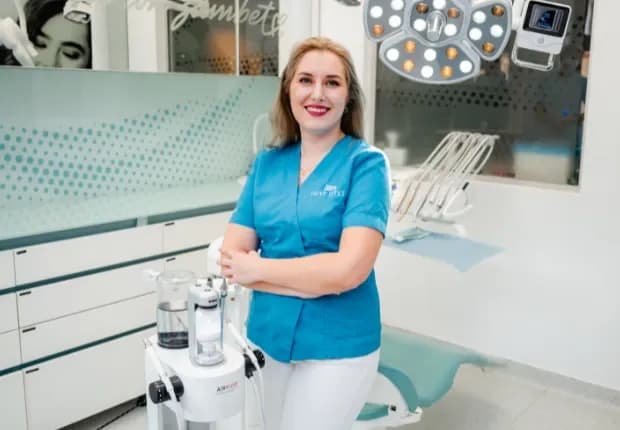
 Author:
  October 1, 2025
In modern dental care, ultrasonic scaling has become the method of choice in many dental practices. The reason is simple: it offers an effective, quick and, generally speaking, more comfortable cleaning experience for the patient compared to traditional methods.
But what makes this method ‘modern’? And how does it differ from conventional scaling?
The traditional (manual) method involves the use of hand-held instruments – scalers, curettes, etc. These require more physical strength, take longer and can be more uncomfortable for both the patient and the dentist/hygienist.
Ultrasonic scaling uses very rapid vibrations (ultrasound), together with a water jet, to remove dental tartar and bacterial plaque.
What is ultrasonic scaling?
How the ultrasonic device works
It is an ultrasonic scaling device containing a metal tip that vibrates at high frequencies (tens of thousands of vibrations per second). These mechanical vibrations, combined with a jet of water, break down tartar (those hard mineral deposits), bacterial plaque and subgingival debris. The water also acts as a coolant to protect against overheating of the dental tissues and to remove debris.
There are two main types of ultrasound used: magnetostrictive and piezoelectric. Each has its own advantages and disadvantages in terms of vibration mode, efficiency and comfort, but both can be effective if used correctly.
Piezoelectric device
- It uses a piezoelectric effect at the tip of the scaling instrument, which vibrates at a high frequency.
- It is effective in removing supragingival and subgingival tartar, being a modern procedure that is well tolerated by patients
Magnetostrictive device
- Uses a magnetic system to generate vibrations.
- Similar to the piezoelectric device, it is an effective method for removing dental tartar.
Ultrasonic scaling: why it is more comfortable for the patient
- Ultrasonic vibrations allow scaling to be performed more quickly than the manual method, especially in areas where tartar is difficult to reach.
- The water jet helps to cool the tooth surfaces, reducing thermal discomfort.
- Patients often experience less pain and sensitivity when the procedure is performed correctly, as the instruments do not need to be as aggressive as with manual scaling.
- After the procedure, the sensation of ‘clean teeth’ and fresher breath is immediate.
Areas where it is effective: visible tartar and subgingival tartar
- Visible dental tartar: located above the gumline, on the surface of the teeth, where scaling is clearly visible and accessible to ultrasound.
- Subgingival tartar: located below the gum line, in the gingival pockets; ultrasonic scaling is useful here because the tip can reach areas where manual instruments struggle to access or cause more discomfort.

The benefits of ultrasonic scaling
Quick and effective removal of dental tartar. Thanks to the combination of vibrations and a water jet, tartar is loosened more easily and thoroughly than with some manual instruments, particularly in hard-to-reach areas.
It is a minimally invasive, less painful procedure As no great force is required and cooling is integrated, patients often experience less discomfort or pain, or the discomfort is more moderate than with aggressive manual scaling.
Protects the gums and reduces the risk of gingivitis/periodontitis. By removing plaque and tartar, gum inflammation is reduced, as are the bacteria that can cause damage to the tissues supporting the teeth. Effective scaling is one of the cornerstones of periodontal disease prevention.
Aesthetic benefits: cleaner teeth, fresher breath Tartar and surface stains (from coffee, tea, tobacco) are removed or reduced, making teeth look whiter and cleaner. Breath also becomes fresher, as bacteria in tartar and plaque contribute to unpleasant odours.
Myths about ultrasonic scaling
Below are some common misconceptions and comments based on the literature and clinical experience:
Myth: “Ultrasonic scaling damages the enamel.”
Fact: Studies show that ultrasound can cause a small degree of abrasion or increased roughness of the enamel, especially if the enamel is already compromised (e.g. cracks, early-stage caries, restorations). However, in healthy teeth, when the scaling device is used correctly (correct pressure, appropriate angle, limited duration), the effects are minimal and acceptable compared to the benefits.
Myth: “Teeth become more sensitive after the procedure.”
Fact: There may be temporary sensitivity – it is normal after scaling, especially if there was a lot of subgingival tartar and the gums were inflamed. But this sensitivity tends to disappear within a few days. It is not a long-term issue, provided the procedure was carried out correctly and the patient maintains good oral hygiene.
Myth: “Ultrasonic scaling is painful.”
Fact: Most patients say that the discomfort is less than with manual scaling, but the perception of pain depends largely on individual tolerance, the severity of tartar build-up and the condition of the gums. A good professional uses local anaesthetic or gels where necessary, adjusts the power of the machine and uses appropriate tips.
Myth: “Dental tartar forms more quickly after scaling.”
Fact: This is usually a misconception. Tartar forms if bacterial plaque is not removed regularly. The procedure does not cause accelerated tartar formation; if good oral hygiene is not maintained, tartar will build up again regardless of the method used. In fact, effective scaling reduces the rate of plaque fermentation and subsequent tartar formation.
Contraindications and precautions
Even with the ultrasonic method, there are situations where the contraindications for ultrasonic scaling must be taken seriously.
Situations in which ultrasonic scaling is not recommended
- Patients with pacemakers or implanted devices that may be affected by electromagnetic fields. Studies show that electronic dental devices such as ultrasonic scalers can cause interference, particularly magnetostrictive ones.
- Acute respiratory problems: severe asthma, bronchitis, other lung conditions where aerosol jets, vapours or sprays may worsen the condition.
- Severely inflamed gums, acute periodontal infections, where bleeding and inflammation must be controlled beforehand.
- Teeth with severely compromised enamel: cracks, untreated caries, fragile restorations. As studies have shown, ultrasonic scaling on enamel with cracks or incipient caries can cause greater enamel loss.
- Very young patients (children), particularly those with deciduous teeth or very young permanent teeth, where the pulp chamber is large and the dental structure is still maturing. Vibrations and heat may be more dangerous.
- Immunocompromised patients or those with infections that can be spread via aerosols, or situations where infection control is difficult.
The importance of a dental consultation before the procedure
It is essential that, prior to dental scaling, the patient undergoes a full consultation: examination of the condition of the enamel, gums and dental restorations, as well as medical history (pacemaker, chronic conditions, allergies, etc.). If any contraindications are identified, the dentist may adjust the power of the equipment, the treatment time, or opt for alternative methods.
Alternatives to ultrasound when there are contraindications
- Manual scaling – this may be slower and somewhat more uncomfortable, but it is the only alternative in certain cases.
- Chemical scaling or chemico-mechanical methods – pastes that dissolve deposits, application of special solutions.
- Polishing with brushes, rubber cups, and the use of prophylactic paste.
- In the case of fragile restorations, protecting their margins through adapted procedures or temporary covering.
Frequently Asked Questions
How often is ultrasonic scaling recommended?
It depends on each person’s oral health: if you have healthy gums and good oral hygiene, usually once every six months. If there are problems such as chronic gingivitis or periodontitis, more frequent visits may be necessary, for example every three to four months. Your dentist or dental hygienist will assess the specifics of each case.
Is ultrasonic scaling better than traditional scaling?
It cannot be said definitively that it is ‘better’ in all situations, but it has clear advantages: efficiency, speed and comfort. In cases involving subgingival tartar or heavy build-up, ultrasonic scaling may be superior. In cases where the enamel is severely compromised or there are delicate restorations, manual scaling may be safer.
Are there any risks to the teeth or gums?
Yes, but the risks are low if the procedure is carried out correctly by a professional:
- Slight increase in enamel roughness, particularly if there are cracks, early-stage decay or large fillings.
- Possible discomfort, temporary sensitivity of the teeth or gums.
- If high power or excessive pressure is used, enamel abrasion or damage to the gum tissue may occur.
- Risk of aerosols – particularly important in the context of respiratory infections, so dental practices must adhere to hygiene and safety protocols.
How do I know whether I need ultrasonic scaling or another procedure?
- If you notice visible tartar, stains, bad breath, bleeding gums when you brush, or swollen gums → you probably need a professional teeth cleaning.
- If your gums have ‘pockets’ and the tartar is subgingival, ultrasonic scaling is very helpful.
- If you have large fillings, severely worn enamel or cavities, it would be best to consult your dentist for an assessment and possibly use alternative methods or adjustments to the procedure.
Conclusion
Ultrasonic scaling is a modern, effective method and, in many cases, more comfortable than traditional scaling. Its benefits in terms of removing dental tartar, protecting the gums, and improving aesthetics and patient comfort are significant. However, it is not a one-size-fits-all method — it must be tailored to each patient’s condition and any potential contraindications, and carried out by experienced professionals.
“A healthy tooth starts with proper cleaning — not with force, but with precision,” recommends Dr Andreea Lascău.
Bibliography
- Kim SY, et al. “Effects of ultrasonic instrumentation on enamel surfaces with various defects (cracks, early caries, and restorations)”. Journal of Periodontology / Wiley. 2018. Available online. ― The study shows significant damage in cases where the enamel is compromised.
- Al Ankily M, et al. “Effect of Different Scaling Methods and Materials on the Surface Properties of Enamel”. Journal of International Oral Health, 2020. ― compares manual scaling vs ultrasonic scaling and the types of tips/instruments.
- Babina K., Polyakova M., Sokhova I., Doroshina V., Arakelyan M., Zaytsev A. & Novozhilova N. “The Effect of Ultrasonic Scaling and Air-Powder Polishing on the Roughness of the Enamel, Three Different Nanocomposites, and Composite/Enamel and Composite/Cementum Interfaces”. Nanomaterials, 2021. ― details how ultrasound affects restorations and the surrounding enamel.
- Walmsley AD. “Potential hazards of the dental ultrasonic descaler”. Ultrasound in Medicine & Biology, 1988. ― warns of biological risks and the necessary protection.
- ADA – Article: “Cardiac Implantable Devices and Electronic Dental Instruments”. American Dental Association, 2023 ― information on patients with pacemakers or other cardiac devices.