




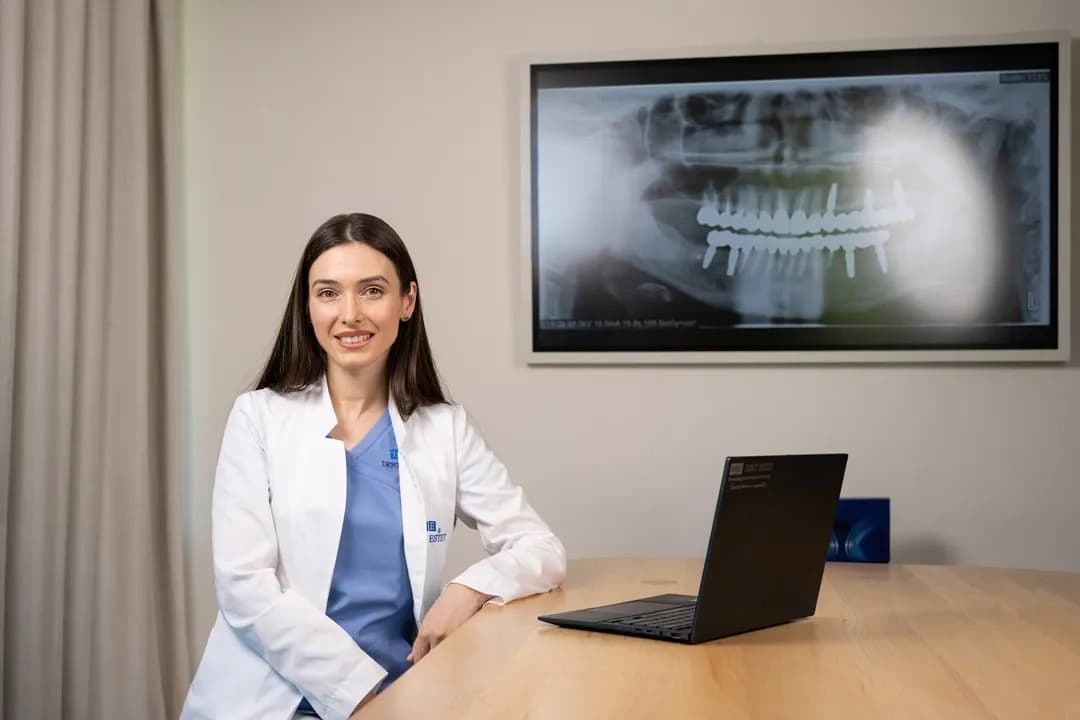
Dental implants in Ploiești: 5 myths about pain, recovery and rejection
 Author: Dr. Doris Turcu
 August 17, 2026
If you’re thinking about having a dental implant in Ploiești, you’ve probably already heard various rumours circulating online: ‘the implant hurts’, ‘your cheek will be swollen for a long time’ or ‘there’s a risk that your body will reject it’. These are common fears, but many stem from incomplete information or confusion between normal reactions following surgery and actual complications.
In this article, Dr Doris Turcu, a specialist in Dento-Alveolar Surgery at the DENT ESTET clinic in Ploiești, explains five of the most widespread myths about dental implants and the medical perspective on each one.
Myth 1: A dental implant is a painful procedure
The reality is that the procedure is performed under local anesthesia. During the procedure, the patient should not feel pain, although they may experience pressure or vibrations associated with the instruments being used. After the procedure, local sensitivity and mild swelling may occur, particularly during the first 24–48 hours.
“Fear of pain is one of the main reasons why people postpone necessary treatment, allowing a minor problem to develop into a more complex one. Most patients who come to us feeling anxious about pain are surprised by how straightforward the procedure actually is. Local anesthesia is effective, and implant placement does not involve greater discomfort than a routine tooth extraction.” - Dr. Doris Turcu, Specialist in Dento-Alveolar Surgery
What studies say about pain during and after the procedure
During implant placement, local anesthesia is used to control pain. Once the anesthetic wears off, moderate discomfort, sensitivity or localized swelling may occur. The intensity varies from one patient to another and depends on the complexity of the procedure.
Depending on the individual case, the dentist may recommend a postoperative medication regimen to manage pain and inflammation. Following the instructions provided after the procedure is important for a comfortable recovery.
“I always tell my patients in Ploiești one simple thing: the pain they anticipate before surgery is almost always greater than what they actually experience afterwards. With an appropriate postoperative medication regimen, most patients return to their daily activities the following day.” - Dr. Doris Turcu
Comparison with other types of dental procedures
Compared with a tooth extraction, implant placement does not necessarily involve greater postoperative discomfort. The intensity of pain depends more on the specifics of each case, the extent of the procedure, and the individual patient’s response.
When it comes to more complex surgical procedures, such as bone grafting or treatments such as Fixed Teeth in 24 Hours, the recovery period may involve more noticeable discomfort than after a straightforward implant placement.
Discover the price of the Fixed Teeth in One Day treatment at DENT ESTET.
It is important to remember that pain perception varies from person to person. An individual’s pain threshold, anxiety related to the procedure, and the complexity of the treatment can all influence how the postoperative period is experienced.
Myth 2: Recovery after a dental implant takes too long
The reality is that there is often confusion between immediate recovery — the period during which local symptoms may occur after the procedure — and osseointegration, the biological process through which the implant becomes stable within the bone. The fact that osseointegration takes several weeks or months does not mean that the patient experiences discomfort throughout this entire period.
What Does the Recovery Process Involve?
Recovery begins immediately after the procedure and primarily involves the gradual reduction of swelling and the healing of the gum tissue around the treated area.
During this stage, following the dentist’s instructions, maintaining an appropriate diet and practising good oral hygiene all play an important role in postoperative recovery. In addition, effective plaque control supports tissue healing and helps reduce the risk of complications such as peri-implantitis.
Learn more about peri-implantitis treatment and the available treatment options.
Realistic recovery times after dental implant placement
In straightforward cases, recovery is relatively quick:
- The first 3–7 days: mild swelling or local sensitivity may occur and can usually be managed by following the dentist’s recommendations and temporarily adjusting the diet.
- The first 2 weeks: the soft tissues continue to heal, while discomfort gradually subsides.
In more complex cases, the healing period may be longer:
- If dental implant placement is combined with bone grafting, the body needs several months for the grafting material to integrate and for the required bone volume to be restored.
If the implant is immediately loaded, meaning that a dental crown is fitted after implant placement, the osseointegration process will still continue for several months.
“It is important for patients to understand the difference: they will not experience pain throughout the months in which osseointegration takes place. After the first few days, life returns to normal. What continues in the background is a silent biological process through which the bone ‘embraces’ the implant.” - Dr. Doris Turcu
The osseointegration process
Osseointegration can take between 2 and 4 months, depending on the specifics of each case.
During this period, the implant becomes firmly integrated into the bone. It is also important to follow the dentist’s recommendations throughout this stage in order to support the long-term success of the treatment.
Once osseointegration is complete, depending on the treatment plan, the prosthetic stage can begin, followed by the placement of the final restoration.
Myth 3: Dental Implants Are Frequently Rejected
The term “rejection” can be misleading. A dental implant is not transplanted biological tissue, so the situation is not comparable to the immune rejection that can occur following an organ transplant. In implant dentistry, the focus is instead on the integration of the implant into the bone and the health of the surrounding tissues.
What does dental implant “rejection” mean?
In certain situations, osseointegration may fail, meaning that the implant does not become sufficiently stable within the bone. However, such cases are relatively rare, with studies reporting dental implant success rates of over 95%.
“The success rate of correctly placed dental implants in patients who have been carefully assessed before the procedure consistently exceeds 95%. When a failure occurs, we can almost always identify a clear local cause rather than the body ‘rejecting’ the implant.” — Dr. Doris Turcu
In the long term, peri-implantitis may develop, causing inflammation of the tissues surrounding the implant. However, this should not be confused with an actual immune-mediated “rejection” of the implant.
Factors that influence dental implant success
The success of dental implant treatment does not depend on a single factor, but rather on a combination of several elements:
- Bone quality and volume – adequate bone support is important for implant stability and successful osseointegration.
- Oral hygiene – plaque accumulation around the implant can promote tissue inflammation and increase the risk of long-term complications.
- Smoking – can affect the healing process and increase the risk of implant-related complications.
- General health – certain systemic conditions, particularly when not properly controlled, can influence healing.
- Periodontal disease – should be diagnosed and brought under control before implant treatment, as inflammation and infection can compromise the health of the tissues surrounding the implant.
- The dentist’s experience – accurate assessment of the case and correct implant positioning contribute to the predictability of the outcome.
- Digital planning – imaging investigations and digital technologies allow the bone structure to be assessed and the implant position to be planned precisely.
- Regular check-ups – implant monitoring and professional dental cleanings help identify potential changes at an early stage and maintain the health of the peri-implant tissues.
Myth 4: Peri-Implantitis means losing the implant
The reality is that peri-implantitis — an inflammatory condition affecting the tissues surrounding a dental implant — does not automatically mean that the implant will be lost.
The chances of preserving the implant depend on the stage at which the condition is detected, the extent of bone loss and the stability of the implant.
Symptoms of peri-implantitis
Peri-implantitis can sometimes progress without causing pain, which is why its symptoms should not be ignored:
- Inflammation can be an early sign of peri-implantitis. The gums may become red, swollen and sensitive, and gum recession may develop over time.
- Bleeding during brushing or chewing may also indicate a possible infection around the implant.
- Bad breath may indicate the presence of bacteria below the gum line.
- Implant mobility is a clear sign that the implant has been affected by peri-implantitis or that the osseointegration process has failed.
Peri-Implantitis Treatment with GalvoSurge® Technology at DENT ESTET
At DENT ESTET clinics, dentists have access to GalvoSurge®, an electrochemical cleaning technology used in the surgical treatment of peri-implantitis.
GalvoSurge® uses low voltage and an electrolyte solution to generate hydrogen microbubbles on the implant surface. These help detach bacterial biofilm, including from areas that are difficult to clean using conventional methods. Once the implant surface has been decontaminated, treatment may be complemented by bone regeneration procedures, where clinically appropriate.
Myth 5: Dental implant placement is too risky
Preoperative assessment and radiological investigations help identify the factors that may influence healing and the prognosis of the treatment.
Assessing the risks associated with dental implants
Daily oral hygiene and regular check-ups are important for monitoring the peri-implant tissues and detecting early signs of inflammation.
Peri-implantitis is an inflammatory condition affecting the tissues surrounding the implant and can compromise its stability if it is not detected and treated.
The risk of osseointegration failure is not the same for every patient and does not occur randomly.
How to choose a dental implant specialist in Ploiești
Choosing the dentist who will perform your dental implant treatment in Ploiești is important both for the safety of the procedure and for the predictability of the long-term outcome.
In addition to experience in implant dentistry, it is important that the dentist carries out:
- a comprehensive assessment of the case;
- imaging investigations to evaluate bone volume and anatomical structures;
- a personalized treatment plan.
The number and position of the implants, the need for additional procedures such as bone grafting, and the different stages of treatment should be determined according to each patient’s individual clinical situation rather than by applying a standard solution.
The technology available at the clinic can also contribute to the accuracy of the diagnosis and the planning of the procedure.
Communication and follow-up care are equally important. The dentist should clearly explain the stages of treatment, its benefits and potential risks, and establish a schedule of regular check-ups to monitor healing and, subsequently, the long-term health of the implant.
Why choose DENT ESTET Ploiești for dental implant treatment?
Dental implant treatment involves much more than the surgical procedure itself.
At DENT ESTET Ploiești dental clinic, each case begins with a comprehensive assessment, allowing dentists to evaluate:
- the patient’s oral health;
- bone structure;
- anatomical characteristics before determining the appropriate treatment.
Patients at DENT ESTET Ploiești also benefit from the expertise of a multidisciplinary team, allowing the surgical and prosthetic stages — as well as periodontal or orthodontic treatment when required — to be integrated into a single treatment plan.
Treatment planning is personalized according to each patient’s needs and supported by modern diagnostic and treatment technologies, including the digital surgical guide, Osstell Beacon®, and Digital Smile Design (DSD), which helps patients visualize the proposed final smile from the planning stage.
Treatment does not end once the implant has been placed. Postoperative monitoring and regular check-ups allow the dentist to follow the healing and osseointegration processes and, subsequently, monitor the health of the tissues surrounding the implant.
The entire treatment is based on an approach focused on procedural safety, restoring function and achieving a natural-looking aesthetic result, with the long-term goal of maintaining good oral health.