





 Author:
  June 17, 2026
Dental injuries in sportspersons and dental implants
Dental injuries are common in contact sports and can result in tooth fractures, tooth displacement or even complete tooth loss. When a tooth cannot be saved, a dental implant is the modern solution for restoring chewing function, aesthetics and long-term oral health.
The impact of a blow to the face is not limited to the appearance of one’s smile. An untreated dental injury can lead to bone loss, changes in the position of neighbouring teeth and difficulties with chewing. For this reason, prompt assessment and appropriate treatment are essential for a favourable prognosis.
Types of dental trauma
According to the recommendations of the International Association of Dental Traumatology (IADT), any dental trauma requires assessment as soon as possible, as the chances of saving the tooth depend on the severity of the injury and the time elapsed before treatment.
Tooth fractures
Tooth fractures are the most common type of trauma encountered in sportspeople and can range from simple chips to the enamel to complex fractures affecting the root of the tooth.
The most common types include:
- fractures limited to the enamel;
- fractures affecting both enamel and dentine;
- fractures with exposure of the dental nerve;
- root fractures.
Whilst some fractures can be restored using conservative treatments, others permanently compromise the structure of the tooth and require extraction.
Injuries to the gums and bone
Sports injuries can affect not only the tooth but also the structures that support it.
These include:
- dental contusions;
- subluxations;
- lateral dislocations;
- intrusions and extrusions;
- dental avulsions (complete dislodgement of the tooth).
Tooth avulsion is one of the most serious dental emergencies. If the tooth is recovered and reimplanted quickly, there is a chance of saving it.
Jaw trauma
Severe impacts can also cause injuries to the facial bone structures, such as:
- fractures of the alveolar bone;
- mandibular fractures;
- maxillary fractures;
- damage to the temporomandibular joint.
These conditions often require multidisciplinary treatment and may influence the planning of future rehabilitation involving dental implants.
When is a dental implant necessary?
A dental implant is recommended when a tooth has been completely lost, has severe root fractures, can no longer be restored, or when conservative treatments do not offer a favourable long-term prognosis.
The main situations in which an implant may be necessary are:
Complete loss of a tooth
When a tooth has been completely extracted and cannot be successfully reimplanted, a dental implant is the current standard of care for its replacement.
Irrecoverable teeth
Some types of trauma cause such extensive damage to the crown or root of the tooth that restoration is no longer possible under predictable conditions.
Severe root fractures
Fractures located deep within the root often have a poor prognosis and may require the tooth to be extracted.
The failure of conservative treatments
In certain situations, a traumatised tooth is initially treated using conservative methods; however, infections, tooth mobility or other complications may subsequently arise, necessitating its extraction and replacement with an implant.
“For athletes, the main aim is to save the natural tooth wherever possible. If the injury is too severe, a dental implant allows for the predictable restoration of function and aesthetics, with long-term results comparable to those of a healthy natural tooth.” - Dr. Horațiu Dobre - Specialist in Dentoalveolar Surgery
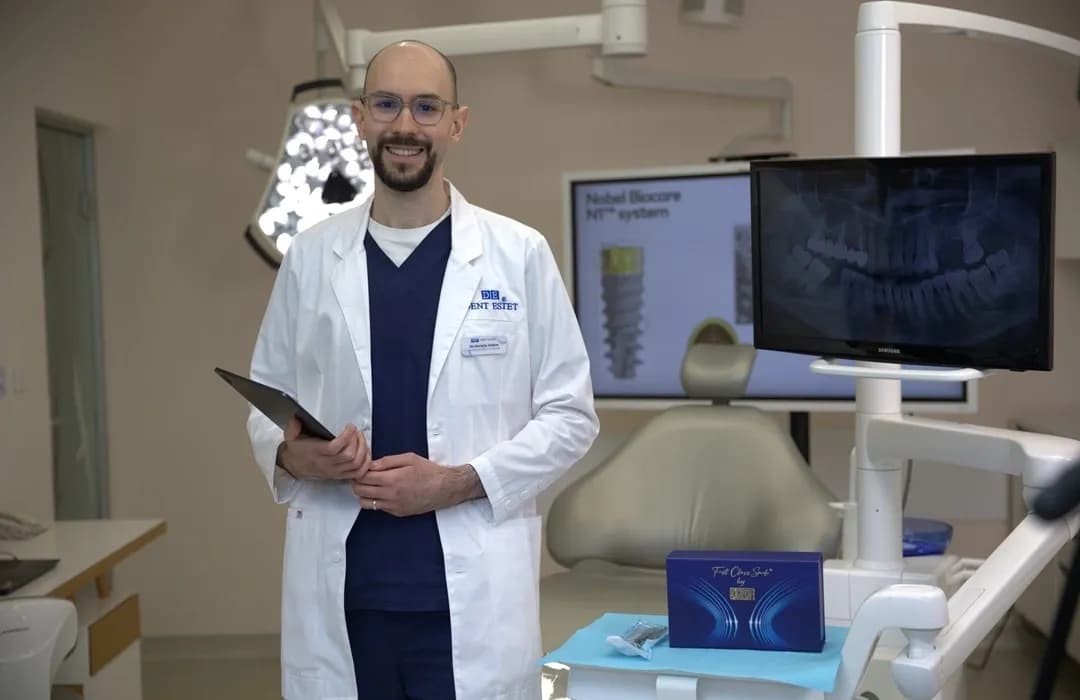
Stages of dental implant treatment following trauma
A dental implant is the modern solution for restoring function and aesthetics following the loss of a tooth whilst playing sport.
Treatment begins with a detailed clinical and imaging assessment, which enables the dentist to determine whether the implant can be placed immediately or whether a healing period is required.
The main stages are:
- Consultation and imaging investigations.
- Extraction of the irrecoverable tooth, if necessary.
- Bone preservation or reconstruction where bone defects are present.
- Placement of the dental implant.
- Osseointegration of the implant into the bone.
- Fitting of the permanent crown.
Proper planning is essential for achieving a functional and aesthetic result in the long term.
Can an implant be fitted immediately after an injury?
Yes, in certain situations a dental implant can be placed immediately following trauma or after the extraction of the affected tooth. The decision depends on the available bone volume, the absence of infection, the stability of the implant and the condition of the gum tissue.
Situations in which immediate implantation is possible
Immediate implantation may be considered when:
- there is sufficient bone to stabilise the implant;
- there is no active infection;
- the gums and surrounding tissues are healthy;
- the dentist can achieve adequate primary stability.
In certain cases, a temporary crown may also be fitted at the same stage.
Situations in which the implant must be postponed
The implant may require an additional healing phase when:
- there is an active infection;
- there has been significant bone loss;
- there are fractures of the alveolar bone;
- bone augmentation is required;
- the patient is still growing.
In these situations, the dentist determines the optimal time for implant placement.
Treatment options prior to implantation
When an implant cannot be fitted straight away, there are solutions that allow function and aesthetics to be maintained until the final treatment is carried out.
Temporary dentures
Temporary prostheses can temporarily replace the missing tooth and help maintain the appearance of your smile.
Dental bridges
Dental bridges are an alternative for replacing a lost tooth, but they require support from the neighbouring teeth.
Bone preservation
Following extraction, the dentist may recommend bone preservation procedures to reduce resorption and facilitate future implant placement.
This stage is particularly important for front teeth, where aesthetics play a major role.
Prevention of dental injuries in sport
Many dental injuries can be prevented by taking simple and effective measures.
Mouthguard
A mouthguard is the most effective way of preventing dental injuries in contact sports.
The benefits of a custom-made mouthguard include:
- absorbing impact forces;
- reducing the risk of tooth fractures;
- protection of the gums and soft tissues;
- superior comfort during sporting activities.
The mouthguard is recommended for both professional and amateur sportspeople.
Regular check-ups
Regular dental check-ups enable the early detection of dental problems and allow the condition of the protective mouthguard to be checked.
For active sportspeople, regular check-ups help maintain oral health and reduce the risk of complications.
Complications if not treated properly
Untreated dental trauma can have significant consequences for oral health.
Bone resorption
Following the loss of a tooth, the bone begins to gradually lose volume due to a lack of functional stimulation.
Tooth movement
Neighbouring teeth may shift into the gap left behind, affecting the bite and tooth alignment.
Chewing problems
The absence of a tooth can reduce chewing efficiency and place excessive strain on the remaining teeth.
Aesthetic issues
The loss of a tooth, particularly in the front, can affect the appearance of your smile and your self-confidence.
Implant recovery and integration
Osteointegration is the process by which a dental implant becomes biologically anchored in the bone. In most cases, full integration takes between 3 and 6 months, depending on the area being treated and the patient’s individual circumstances.
Osseointegration
At this stage, bone forms around the implant and stabilises it in the long term.
The success of osseointegration is essential for the long-term success of the treatment.
Healing time
The healing period varies from patient to patient, but is usually between a few months and six months.
In cases requiring bone grafting, treatment may take longer.
Returning to sport
A return to sporting activities should be gradual and in accordance with your doctor’s recommendations.
Sports involving a risk of facial impact should be avoided until the healing process is complete and the implant is fully stabilised.
Oral hygiene
Maintaining rigorous oral hygiene is essential for the health of the dental implant.
Proper brushing, the use of oral hygiene aids and regular check-ups help to prevent complications and maintain long-term results.