




 Author:
  October 28, 2025
More and more patients coming to the clinic who need orthodontic treatment are now looking for a modern and aesthetic solution – clear aligners that straighten teeth without the visual and functional discomfort of metal braces.
For them, the Invisalign system represents one of the most advanced options for invisible orthodontic treatment, based on custom-made aligners produced digitally. Using 3D technology, we can plan the entire treatment from the outset and offer the patient a comfortable, discreet and predictable experience.
“Patients appreciate the fact that they can continue their social and professional lives without the treatment being visible — a huge advantage over traditional braces. Invisalign offers freedom, comfort and precise results, without compromise.” — Dr Marius Ion, Specialist in Orthodontics and Dentofacial Orthopaedics at DENT ESTET
DENT ESTET clinics where we provide treatment with Invisalign invisible aligners: Bucharest, Brașov, Sibiu, Ploiești, Craiova, Arad and Oradea, with Invisalign-certified orthodontists.
What sets Invisalign apart from other types of braces
Compared to metal, ceramic, sapphire or lingual braces, treatment with clear aligners offers a much more comfortable, modern and aesthetically pleasing experience for the patient.
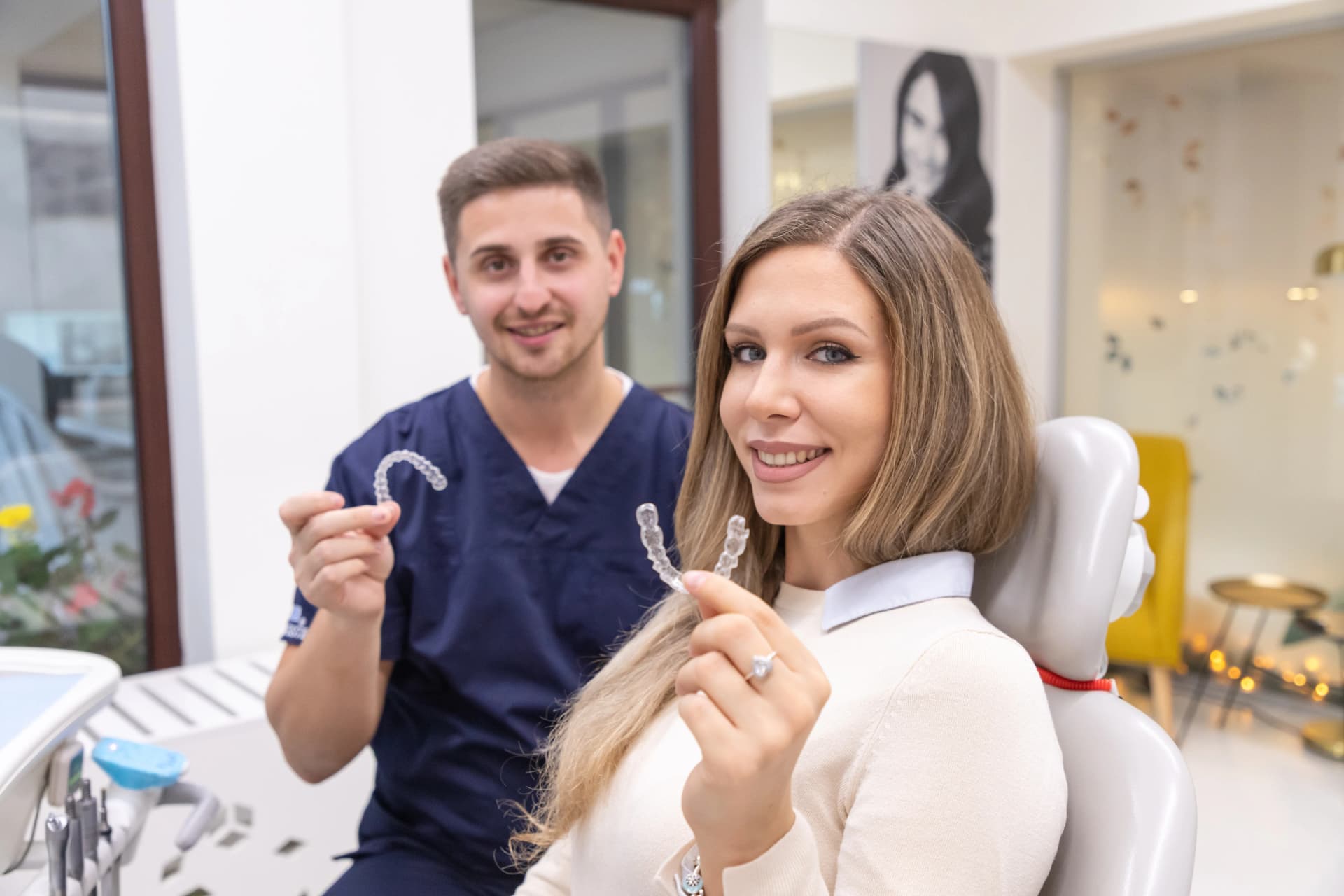
Invisalign braces consist of clear, digitally customised aligners that are changed at regular intervals to gradually move the teeth into the correct position.
This system eliminates the discomfort of traditional braces and allows for superior oral hygiene, whilst being virtually invisible.
Invisalign vs. metal braces
Metal braces are effective and durable, but they are visible and, due to the fixed brackets and wires that can restrict oral hygiene at home, may cause irritation to the oral mucosa or tartar build-up. In contrast, Invisalign offers complete discretion, unrestricted oral hygiene and superior aesthetics, making it the preferred choice for adult patients and those with active social lives.
Invisalign vs. ceramic braces
Ceramic braces are less visible than metal ones, but the brackets can become discoloured over time, especially when in contact with strongly pigmented foods. Invisalign does not stain, is completely transparent and can be removed at any time during meals or when cleaning your teeth.
H3: Invisalign vs. sapphire braces
Sapphire braces are very aesthetic, but they remain fixed to the teeth and require careful cleaning to prevent build-up. Invisalign aligners are easily removable, so the patient can maintain impeccable oral hygiene without any extra effort.
Invisalign vs. lingual braces
Lingual braces are fitted to the back of the teeth and are invisible from the outside, but they can cause discomfort to the tongue and speech difficulties in the first few weeks. As a clear aligner, Invisalign offers the same aesthetic advantage, without the discomfort of lingual braces and without affecting pronunciation.
The main advantages of the Invisalign system
- Transparency and aesthetics – the aligners are almost invisible, making them the ideal choice for adults and teenagers who want a discreet smile.
- Increased comfort – no wires, no sharp edges that can cause injury.
- No dietary restrictions – the aligners are removed before meals, with no dietary limitations.
- Impeccable oral hygiene – brushing and flossing are carried out as normal, as the aligners are removed during your dental care routine.
- No orthodontic emergencies – no brackets that can come loose or wires that snap.
- Shorter treatment time – in many cases, treatment is faster than with fixed braces.
According to a study published in ScienceDirect (2023), patients treated with clear aligners reported significantly greater comfort and higher aesthetic satisfaction compared to those wearing fixed braces.
The stages of orthodontic treatment with Invisalign aligners
Treatment with Invisalign aligners begins with a detailed assessment, followed by a personalised digital plan for tooth movement. Each stage is designed to offer the patient comfort, precision and predictable results.
1. Initial consultation and clinical assessment
It all starts with an orthodontic consultation during which the condition of the teeth is analysed and a complete set of photographs, X-rays and digital models is taken.
The aim is to identify issues with alignment, bite and function, as well as to establish treatment objectives.
2. 3D digital scan
A key stage in the planning process is the 3D intraoral scan, a modern and comfortable method that replaces traditional impressions.
Using the scanner, the dentist obtains a detailed image of the dental arch, and the patient can see a digital simulation of their future smile right from the first appointment.
3. Digital treatment plan (ClinCheck®)
Based on the scan, a personalised digital plan is created in the Invisalign ClinCheck® software, where the exact movements of each tooth and the estimated duration of treatment are determined.
The patient can see, step by step, how the teeth will move, right up to the final result.
At this stage, the number of aligners required is also determined.
4. Handing over the first aligners and fitting the attachments
Once the plan has been confirmed, the patient receives the first sets of Invisalign aligners.
During the same appointment, the dentist applies the attachments – small composite geometric shapes bonded to the teeth, which help to transmit the force required for tooth movement.
The patient receives detailed instructions on how to wear and clean the aligners.
5. Wearing the aligners
Each set of Invisalign aligners is worn for 1–2 weeks, approximately 20–22 hours a day.
They are only removed during meals and when brushing teeth.
Adhering to the recommended wearing time is essential for achieving the results set out in the digital plan.
6. Regular check-ups
Every 8 weeks, the patient returns for a check-up to monitor progress.
If an attachment has come loose or there is a discrepancy between the aligners and the teeth, the dentist adjusts the plan to maintain controlled movement.
7. Cleaning and maintenance of aligners
The aligners are cleaned daily with a toothbrush and toothpaste, just as in your usual oral hygiene routine. Special effervescent tablets (e.g. Corega) can also be used for a deep clean.
When not being worn, the aligners are stored in the special Invisalign case for protection and hygiene.
“I always explain to my patients that Invisalign treatment requires responsibility: the results depend 100% on how consistently the Invisalign aligners are worn. If you wear them correctly, the results will be exactly as planned digitally.” — Dr Marius Ion, Specialist in Orthodontics and Dentofacial Orthopaedics, DENT ESTET
How much do Invisalign braces cost?
The cost of Invisalign treatment varies depending on the complexity of the case, the duration of the treatment plan and the number of aligners required. Each patient receives a personalised digital treatment plan, and the final cost is determined following an analysis carried out using the ClinCheck® software, which shows exactly how many aligners are needed and how long the treatment will take.
Invisalign Express or Lite is recommended for mild cases, where only minor corrections or the alignment of a few slightly crowded teeth are required. In these situations, the price ranges from 10,500 to 22,500 RON.
For patients with moderate crowding or mild occlusal deviations, the Invisalign Moderate package is recommended, which involves a greater number of aligners and an extended treatment plan. The average cost for this option is approximately 24,000 RON.
For complex treatments, which involve the complete alignment of both arches and bite correction, the dentist recommends the Invisalign Comprehensive (or Full) package. This offers maximum control over tooth movement and the possibility of interim adjustments, at a price of approximately 27,500 RON.
“I encourage patients to view Invisalign as an investment in long-term comfort, aesthetics and functionality. It is a modern, precise and extremely comfortable treatment that offers predictable results without the discomfort of traditional braces.” — Dr Marius Ion, Specialist in Orthodontics and Dentofacial Orthopaedics at DENT ESTET
The full treatment includes consultations, 3D digital scanning, simulation of the final result, delivery of custom aligners, regular check-ups and any necessary replacement of attachments, if required.
For detailed and up-to-date information on costs, visit the dedicated page on braces prices.
What dental problems can Invisalign braces correct?
Although it is a discreet system, the Invisalign treatment is not just an aesthetic solution, but also a functionally effective one. The clear aligners can correct a wide range of dental issues, from straightening teeth to improving the bite and facial symmetry.
“Invisalign is not just a set of braces, but a fully digitalised experience — from scanning to planning and monitoring. The patient knows from the outset what their final smile will look like.” — Dr Marius Ion, orthodontist at DENT ESTET
Crooked or crowded teeth
Invisalign applies gentle, controlled pressure to gradually move the teeth into the correct position.
Generally, each set of aligners produces movements of 0.2–0.25 mm, allowing for precise and predictable movements.
It is an effective option for both mild and moderate cases of dental crowding, as well as for more complex cases, when the treatment is correctly planned digitally.
Spaces between teeth
Invisalign aligners can also correct diastemas (visible gaps between teeth), provided that the bite and bone structure allow these gaps to be closed.
The treatment is comfortable and delivers excellent aesthetic results, without the need for brackets or metal wires.
Occlusion
Invisalign can correct deep, reverse, open or crossbites.
In more complex cases, the orthodontist may combine aligners with auxiliary elements such as buttons, orthodontic mini-implants (TADs), elastic chains or hooks, to achieve complete biomechanical control.
Correcting the occlusion not only improves the aesthetics of the smile, but also the functional balance of the entire oral cavity.
Bruxism
Although Invisalign is not a dedicated treatment for bruxism (read the article “What is bruxism?” for other treatment methods for bruxism), in certain cases, by aligning and balancing the bite, the treatment can indirectly help reduce the occlusal stresses that exacerbate bruxism. However, the underlying causes – such as stress, anxiety or sleep disorders – must be addressed separately.
Facial symmetry
By correctly aligning the teeth and balancing the bite, Invisalign can improve facial harmony.
In many cases, subtle changes to the facial contour are observed, and the smile becomes more symmetrical and natural.
In addition to the aesthetic benefit, a uniform distribution of masticatory forces is achieved, which contributes to long-term dental health.
“A beautiful smile isn’t just about straight teeth, but also correct occlusion and a harmonious facial expression. With Invisalign, we can digitally control every tooth movement and predict the final result, making the treatment extremely precise.” — Dr Marius Ion, orthodontist at DENT ESTET
Frequently asked questions about Invisalign braces
How much do Invisalign braces cost?
The cost of Invisalign treatment ranges from 10,000 to 27,500 RON, depending on the complexity of the case, the duration of the treatment plan and the number of custom-made aligners.
How much does it cost to get braces?
The total cost of orthodontic treatment varies depending on the type of braces chosen:
- traditional braces, whether metal or ceramic, are more affordable;
- clear aligners, such as Invisalign, involve a greater investment but offer significantly superior benefits in terms of aesthetics, comfort and oral hygiene.
How long do you have to wear Invisalign aligners?
The duration of treatment varies from patient to patient, but generally ranges from 6 to 24 months. Mild
cases can be completed in as little as less than a year, whilst complex cases may require a longer period.
The results depend largely on the patient’s discipline – the aligners must be worn for 20–22 hours a day, being removed only during meals and when brushing teeth.
How much will braces cost in 2025?
In 2025, the cost of braces in Romania varies depending on the type of treatment and the complexity of the case. Metal braces remain the most affordable option, with prices ranging from 4,000 to 7,000 RON per arch, followed by ceramic braces, with prices ranging from 6,000 to 9,000 RON. Sapphire braces, which are more aesthetic and durable, cost between 7,000 and 10,000 RON. For patients seeking a modern, digital and virtually invisible solution, treatment with invisible braces costs between 10,000 and 27,500 RON, depending on the duration and complexity of the personalised treatment plan.
You can view the full, up-to-date list on the Orthodontic Treatment Prices page – DENT ESTET.