



Invisible braces vs traditional braces – key differences for the patient
 Author: Dr. Dr Liana Andruseac
 July 25, 2025
Achieving a harmonious smile and correct bite is essential not only for aesthetic reasons, but also for oral and general health. And the solution to enjoying such a smile is orthodontic treatment, whether we’re talking about fixed braces, commonly known as ‘braces’, or clear aligners, such as ClearCorrect. Our article explores these two treatment options in detail, providing evidence-based information to guide you in choosing the right orthodontic treatment for you.
Traditional braces – how they work
Fixed or traditional braces are orthodontic appliances which, by applying a controlled and continuous force, gradually move the teeth into the desired position.
A fixed orthodontic appliance consists of a number of components:
- brackets – small plates bonded to the surface of the teeth, each with different specifications for each tooth
- orthodontic wires – which pass through the brackets and apply the force required to reposition the teeth
- ligatures – elastic or metal bands that secure the archwire to the brackets.
Orthodontic treatment begins with a comprehensive assessment carried out by the orthodontist, who evaluates the patient’s medical history and dental condition and recommends specific investigations (photographs, X-rays, digital scans). All of this is done to draw up a personalised treatment plan.
Next comes the choice of braces (fixed or invisible), depending on the diagnosis, the patient’s lifestyle and preferences. An essential step before fitting the braces is professional dental cleaning, to ensure a clean and healthy foundation, thereby preventing problems from arising during treatment.
Once the braces have been fitted, regular visits to the orthodontist become crucial. These check-ups allow for close monitoring of progress, any necessary adjustments and the maintenance of rigorous oral hygiene.
The completion of treatment marks the point at which the teeth have reached their desired position. To maintain these results in the long term and prevent any unwanted movement, the orthodontist will recommend the use of a retainer.
Types of conventional braces
Depending on the material from which the brackets are made, there are several types of conventional or traditional braces, as follows:
- Metal braces: These are the most common and oldest type of braces. Made from high-quality stainless steel or nickel-titanium alloys, metal brackets are extremely durable and effective at correcting a wide range of malocclusions, from mild to severe.
- Ceramic braces: These offer an aesthetic alternative to metal braces. The brackets are made from transparent or tooth-coloured materials, such as polycrystalline aluminium oxide. Ceramic braces are less visible, but may be more fragile and may become discoloured over time, depending on the patient’s oral hygiene and diet.
- Sapphire braces: These are made from monocrystalline sapphire crystals, a transparent ceramic material that is almost invisible on the teeth. Sapphire brackets are more transparent than those made from ceramic and take on the natural colour of the tooth. Furthermore, sapphire is a very hard material that is resistant to scratches and deformation, almost as hard as diamond. This reduces the risk of breakage or chipping. It should be noted, however, that at the end of treatment, sapphire brackets may be more difficult to remove.
- Lingual braces: Lingual brackets are placed on the inner (lingual) surface of the teeth, making them completely invisible from the outside, which offers a major aesthetic advantage. However, they may temporarily affect speech and may require a longer adjustment period for the patient.
- Self-ligating braces: Unlike metal braces, which require ligatures to hold the archwire in place, self-ligating braces incorporate an integrated locking mechanism. This can reduce friction between the archwire and the bracket, potentially shortening the duration of some treatments and reducing the number of clinic visits. Self-ligating braces are available in metal and ceramic versions.
Traditional braces – who are they ideal for?
Traditional braces are a suitable solution for addressing a wide range of issues, from crowded or spaced-out teeth to complex malocclusions, which can affect both the aesthetics of the smile and essential functions such as chewing and speaking.
- Teenagers: Who require extensive correction of the position of their teeth and jaws (deep bite, open bite, reverse bite, crossbite) as they develop
- Adults: Who are seeking a solution for a healthy and harmonious smile, by correcting orthodontic problems that were not resolved during adolescence or have arisen since then.
- Complex cases: Patients with major skeletal problems (in combination with orthognathic surgery), severe malocclusions, large interdental spaces (diastemas and tremas), pronounced dental crowding, or impacted or retained teeth, where other treatment options may be less effective.
Traditional braces – advantages and disadvantages
Traditional braces remain a benchmark solution in orthodontics, as they offer tangible benefits that have established their reputation over time. Here’s why fixed braces are an option for achieving your desired smile:
- Effectiveness: Traditional braces can correct a wide range of orthodontic problems, from minor malocclusions to severe cases of misaligned teeth and skeletal discrepancies.
- Control: Conventional braces allow the orthodontist very precise control over the movement of each tooth.
- Compliance: As they are fixed, they do not require the patient’s active involvement in terms of wearing them.
- Cost: Generally speaking, metal braces are the most cost-effective option.
Although effective, fixed braces do have certain drawbacks that are worth considering before making a decision. Find out what challenges might arise during treatment:
- Aesthetics: Metal brackets are visible and may affect some patients’ self-image, presenting an aesthetic challenge during treatment.
- Oral hygiene: With traditional braces, maintaining rigorous oral hygiene is more difficult because of the brackets and wires, which cannot be removed for thorough cleaning. For this reason, without paying particular attention to oral hygiene, the risk of bacterial plaque build-up increases and, with it, the risk of developing tooth decay and gingivitis.
- Time commitment: If you choose fixed braces, you will need to attend monthly appointments at the orthodontist’s surgery to monitor the treatment plan and the progress of tooth alignment.
- Dietary restrictions: You’ll need to avoid hard, sticky or crunchy foods that could damage the braces.
- Discomfort: Metal or ceramic brackets may cause initial discomfort, irritation of the oral mucosa and tooth sensitivity following adjustments.
ClearCorrect aligners – Invisible braces
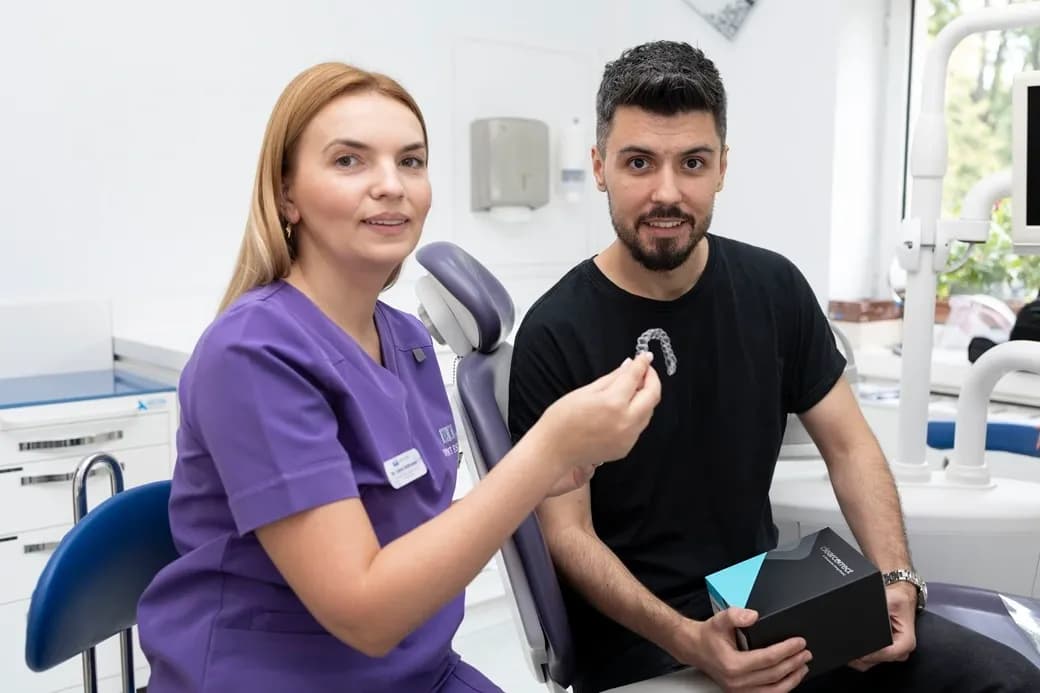
ClearCorrect is a system of dental aligners, offering a modern alternative to fixed braces. These aligners are custom-made, removable and made from a transparent thermoplastic material that fits perfectly over the teeth.
How it works and the stages of treatment
ClearCorrect aligners stand out in the market for invisible braces thanks to the material from which the aligners are made – ClearQuartz®. This is made up of three layers, which give it strength and stain resistance, whilst also allowing for the application of gentle, constant forces.
Thanks to the innovation of this material, ClearCorrect aligners contribute to greater patient comfort and the durability of the aligners. Furthermore, by incorporating Performance Trimline technology, the unique design of the aligners allows for precise control of tooth movement throughout treatment, making it easier to achieve the set objectives.
At the start of the treatment plan finalised by your orthodontist, you will receive a set of ClearCorrect aligners, each designed to move your teeth in short, controlled stages.
Stages of treatment with ClearCorrect aligners
The first stage of the treatment plan involves a series of imaging and digital assessments to establish a comprehensive diagnosis. Following a series of examinations, which involve X-rays and intraoral and extraoral photographs, and sometimes a CT scan if recommended by the dentist, a digital impression (intraoral scan) or physical impression of the dental arches is also taken.
Based on this data, a virtual 3D treatment plan is created, which simulates the gradual movement of the teeth to their desired final position. This plan is used to manufacture a sequential series of aligners.
Each aligner should be worn for approximately 1–2 weeks (depending on the orthodontist’s instructions), for 20–22 hours a day. The gentle, constant pressure exerted by each aligner guides the teeth towards the planned position before the patient moves on to the next set of aligners. Before the first set of aligners is fitted, a visit to the dental practice is required so that the orthodontist can attach the brackets to the teeth, which are necessary for securing the aligners.
Thanks to the use of advanced technologies that enhance precision and predictability, treatment with clear aligners is often much faster than traditional orthodontic treatment with fixed braces.
ClearCorrect aligners – who are they ideal for?
ClearCorrect aligners are effective in correcting a variety of malocclusions, from mild crowding to more severe cases, with the aligners being supported by additional anchorage devices, such as orthodontic mini-implants.
Most commonly, ClearCorrect aligners are used for:
- Minor or moderate crowding;
- Gaps between teeth (diastemas);
- Mild to moderate occlusal anomalies (deep bite, open bite, crossbite);
- Post-orthodontic relapse;
- Patients requiring aesthetic corrections;
- Creating space for dental implants.
Complex surgical-orthodontic cases treated during the orthodontic phase using invisible braces are also common.
ClearCorrect aligners – advantages and disadvantages
ClearCorrect is an increasingly popular option in modern orthodontics, as it offers an innovative approach to correcting tooth alignment. Discreet and comfortable, this system of clear aligners brings a number of significant benefits for those who want a harmonious smile.
- Aesthetics: They are virtually invisible, offering a significant aesthetic advantage
- Comfort: Made from a smooth plastic material, ClearCorrect aligners generally cause less irritation to soft tissues (gums, cheeks) compared to braces. In terms of comfort, clear aligners have been shown to be more comfortable than traditional braces with brackets and wires.
- Oral hygiene: As they are removable, the aligners allow for normal oral hygiene (brushing and flossing), reducing the risk of tooth decay and periodontal disease associated with the difficulties of cleaning fixed braces.
- No dietary restrictions: You will be able to continue with your usual diet, as the aligners are removed during meals.
- Less frequent check-ups: These are arranged with your dentist depending on the procedures required;
- Visualise the results: The 3D technologies used allow you to visualise the final result before starting treatment.
Like any orthodontic treatment, ClearCorrect also involves certain factors to consider. To make an informed decision, you need to ensure that this method perfectly aligns with your expectations and lifestyle.
- Compliance: Failure to wear the aligners for the recommended period (20–22 hours a day) may prolong the duration of treatment or compromise the results.
- Limitations in complex cases: Although technology is advancing rapidly, in very complex cases involving extensive tooth movement or severe skeletal problems, fixed braces may be more effective.
- Risk of loss: As they are removable, there is a risk of losing a set of aligners, which entails additional costs for replacement and a delay in treatment.
Comparative analysis: Traditional braces vs ClearCorrect aligners
Type of appliance
Visibility
Removability
Oral hygiene
Dietary
restrictions Initial comfort
Patient compliance
Degree of complexity
Regular check-ups
Orthodontic
emergencies
Fixed braces
Visible (metal), or more discreet (ceramic, sapphire)
Fixed, permanently attached to the teeth
More difficult to clean, requiring special brushing techniques and accessories
Yes (avoid hard, sticky foods)
May cause irritation, abrasions to the gum tissue, pain
Require monthly check-ups for adjustment (as they are fixed)
Complex cases, including surgical procedures
Monthly or every 6 weeks
May occur (broken wires, loose brackets)
ClearCorrect Alignment
Virtually invisible
Removable; can be taken out for meals and oral hygiene
Allows for normal oral hygiene
No (the mouthguards are removed at mealtimes)
Less irritation, reduced discomfort
Requires compliance (worn for 20–22 hours a day)
Mild to moderate cases
Less frequently, every 2 months depending on the procedure
Less frequent (loss of the mouthguard)
Myths about treatment with braces
1. “Braces treatment is painful”
This is a widespread myth. The reality is that patients may experience some initial discomfort or pressure, particularly after the braces are fitted or following adjustments. This sensation is the result of the biological forces that begin to act on the teeth to move them.
The pain is usually mild to moderate and lasts for a few days (2–3), and can be managed with over-the-counter painkillers. Modern braces and advanced orthodontic techniques are designed to minimise discomfort.
2. “ClearCorrect is only suitable for simple cases”
In the past, clear aligners were indeed limited to simple orthodontic cases. However, technology has advanced significantly. Thanks to progress in the materials used to manufacture invisible aligners, 3D planning techniques (planning software), and the use of dental attachments (small, enamel-coloured protrusions bonded to the teeth to facilitate complex movements), the ClearCorrect aligner and other systems of this type, such as Invisalign®, the FAS Aligner System® or Spark™, can now treat a much wider range of malocclusions, including cases previously considered moderate or even complex.
In addition, orthodontic mini-implants can be used to provide additional support and better control during orthodontic treatment. However, for certain severe dento-maxillary anomalies, particularly those involving major skeletal discrepancies or impacted teeth, fixed braces may remain the superior option. The final decision always rests with the specialist in Orthodontics and Dentofacial Orthopaedics, who will assess the complexity of the case.
3. “Only teenagers wear braces”
This is a complete myth. Although orthodontics is often associated with adolescence, an increasing number of adults are opting for orthodontic treatment. Statistics show a steady rise in the proportion of adult patients at orthodontic clinics.
The reasons vary: correcting issues left unresolved in childhood, improving the aesthetics of one’s smile, resolving functional problems (such as joint pain) or preparing for other dental procedures (e.g. implants).
The aesthetic options currently available, such as ceramic braces and clear aligners, have contributed significantly to the popularity of orthodontics amongst adults. There is no upper age limit for orthodontic treatment, provided that periodontal health (the gums and bone supporting the teeth) is good.
In conclusion, both fixed braces and ClearCorrect aligners are powerful tools in the modern orthodontic arsenal, each with its own unique set of advantages and disadvantages. Choosing the most suitable option depends on an individualised assessment of your clinical needs, the complexity of your malocclusion, your aesthetic preferences and your lifestyle.
A thorough discussion with a specialist orthodontist is essential to determine the most effective and comfortable treatment plan for achieving a healthy and harmonious smile for you.
Bibliography
1. Flores-Mir, C., et al. (2013) – "Aesthetic perceptions of orthodontic appliances: A systematic review", Journal of Orthodontics
2. Wiechmann, D. (2002) - “Lingual orthodontics: A new approach”, American Journal of Orthodontics and Dentofacial Orthopaedics
3. Thiruvenkatachari, B., et al. (2010) – “A review of randomised controlled trials on the effectiveness of orthodontic appliances”. Journal of Orthodontics
4. Nanda, R. (2005) - Biomechanics in Clinical Orthodontics, Elsevier Saunders.
5. Unlock the potential of your smile, www.straumann.com
6. Buschang, P.H., et al. (2018) – “Treatment outcomes of clear aligner versus fixed appliance therapies”, Angle Orthodontist
7. T. Weir, "Clear Aligners in Orthodontic Treatment" (2017)
8. White, D.W., et al. (2016) – "The effect of patient compliance on orthodontic treatment outcome: A systematic review.", American Journal of Orthodontics and Dentofacial Orthopaedics