



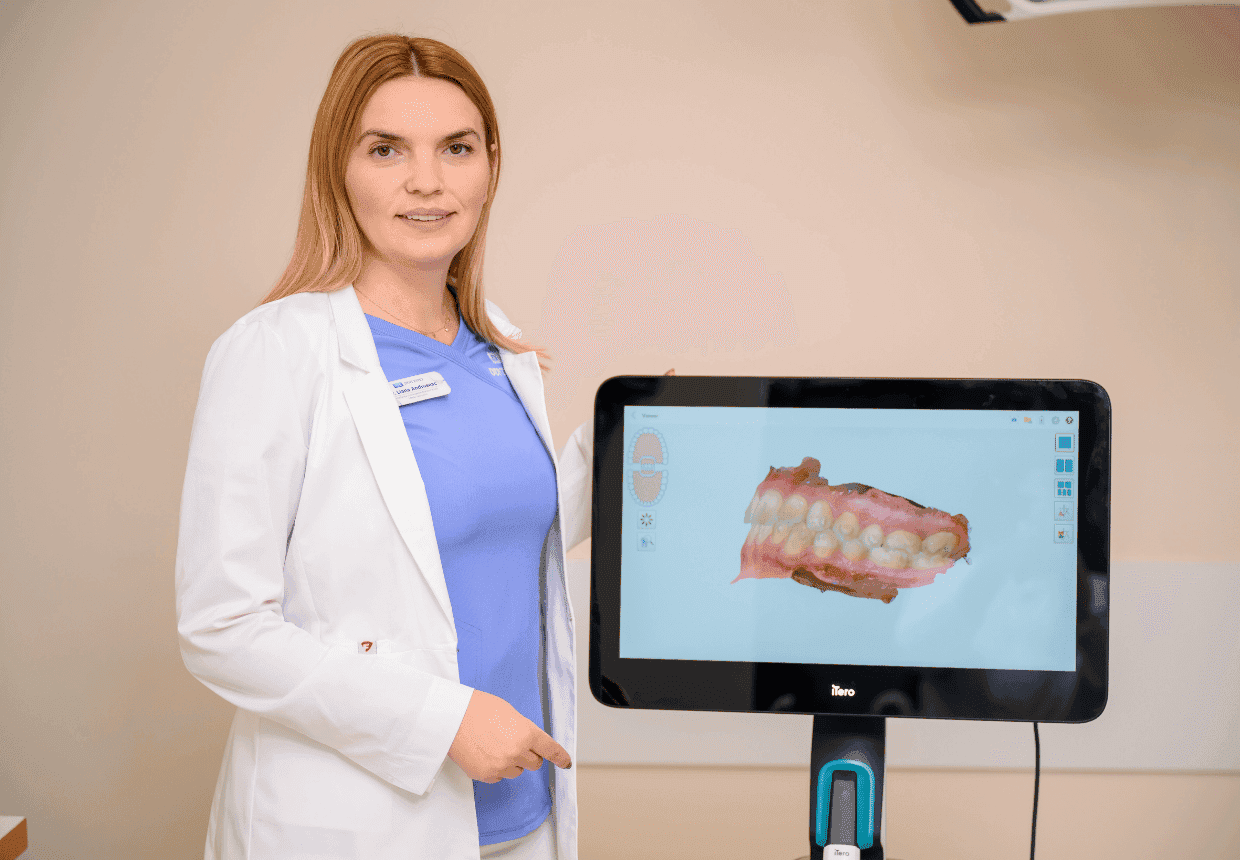
When is an orthodontic mini-implant required as part of orthodontic treatment?
 Author: Dr. Dr Liana Andruseac
 October 29, 2026
An orthodontic mini-implant may be required when the orthodontist needs additional support to move the teeth in a controlled manner, without undesirably altering the position of other teeth. It is used in complex orthodontic treatments, for example to close gaps between teeth, move molars or correct bite problems.
Not all patients wearing braces need mini-implants. The recommendation depends on the position of the teeth, the specific characteristics of the bite and the objectives of the treatment plan.
In short:
- An orthodontic mini-implant is a temporary device used for anchorage during orthodontic treatment.
- It may be recommended for closing gaps between teeth, moving molars, expanding the jaw or correcting complex bite problems.
- It is usually fitted under local anaesthetic and removed once it is no longer required.
- It is not mandatory for all patients wearing braces.
- The need for one is determined on a case-by-case basis following an orthodontic assessment.
What is an orthodontic mini-implant and what role does it play in braces treatment?
An orthodontic mini-implant is a small, screw-like device, usually made of titanium or a titanium alloy. It is temporarily fixed into the maxillary or mandibular bone and provides a point of support for moving the teeth. Its dimensions may, for example, be 6–10 mm in length and 2–2.5 mm in diameter. It is also known as an orthodontic mini-screw or a temporary anchorage device (TAD).
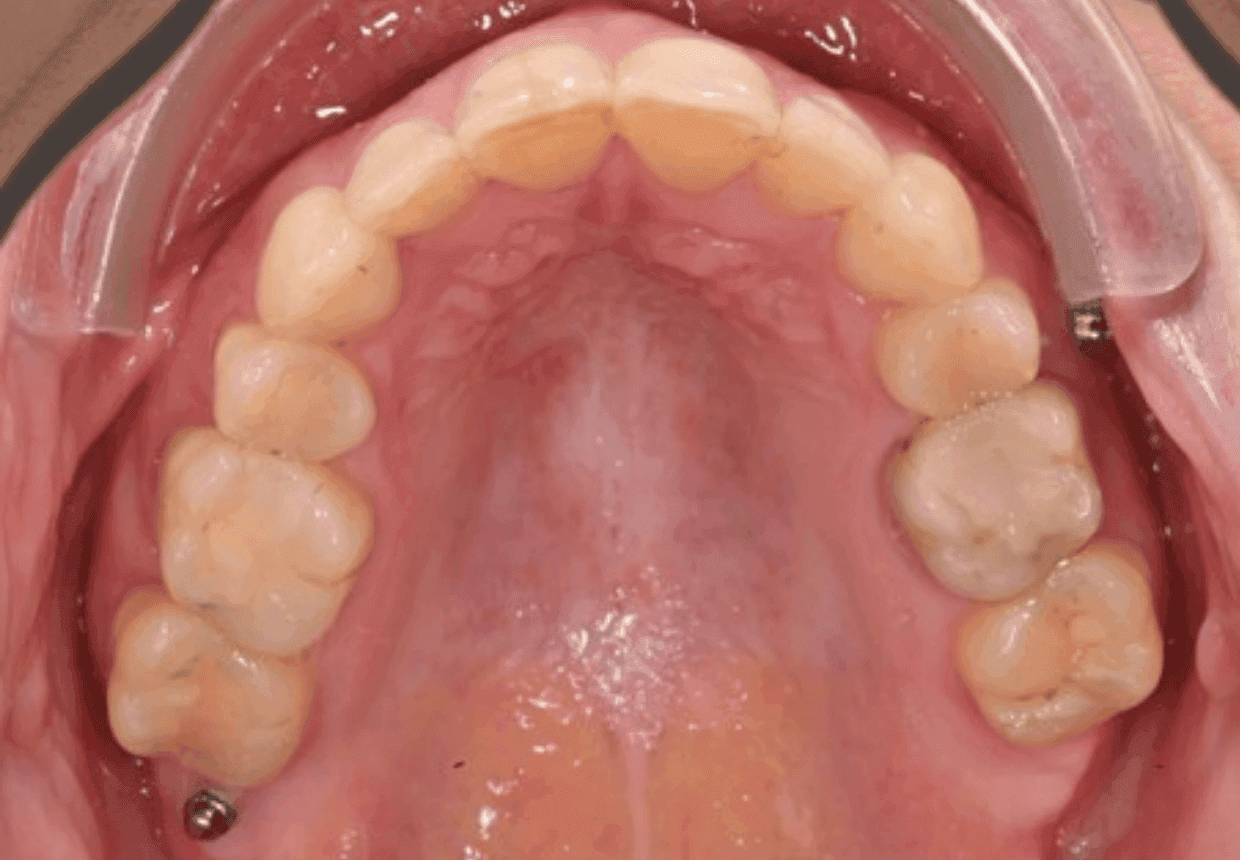
During orthodontic treatment, the braces apply forces to move the teeth into their planned positions. Usually, other teeth are used as anchor points. In certain situations, however, these forces can also cause teeth that should remain in place to move.
The mini-implant provides an additional anchor point, independent of the teeth normally used for support. This allows the dentist to better control the direction of tooth movement.
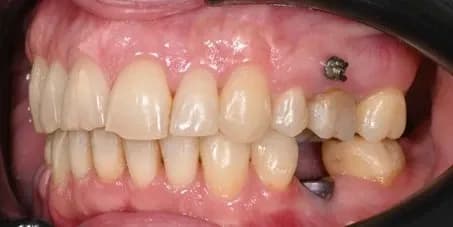
Unlike a conventional dental implant, which replaces the root of a missing tooth and supports a prosthetic restoration, the orthodontic mini-implant serves a temporary purpose. It is removed once it is no longer required for treatment.
| Characteristics | Orthodontic mini-implant | Dental implant |
| Function | Provides an anchor point for the controlled movement of teeth during orthodontic treatment. | Replaces the root of a missing tooth and supports a prosthetic restoration, such as a dental crown. |
| Duration of use | Temporary – remains in place for as long as necessary to achieve the planned orthodontic movements, usually several months. | Long-term – designed to remain in the bone and support the dental restoration for many years. |
| Osseointegration | Osteointegration is not the aim. Stability is primarily mechanical, to allow the device to be removed after use. | Osteointegration is essential for the stability of the implant, as it forms a direct bond between the bone and the implant surface |
When is an orthodontic mini-implant needed?
Orthodontic mini-implants are particularly recommended when certain tooth movements require additional anchorage, which is difficult to achieve using only braces and the existing teeth.
| Clinical situation | The role of the mini-implant |
| Closing gaps following extractions | Limits unwanted movement of the teeth used for support |
| Movement of molars or premolars | Allows forces to be applied with additional anchorage |
| Narrow upper jaw | Can support a skeletal expansion appliance |
| Open or deep bite | May facilitate certain vertical tooth movements |
| Preparation for a dental implant | Can help achieve the necessary space and tooth positions |
To close gaps between teeth, including after extractions
In certain orthodontic treatments, the extraction of some teeth may be necessary to create the space required for the other teeth to align.
Closing these gaps involves controlled tooth movement.
‘To move the teeth into the desired position, we need a fixed anchor point. Sometimes, the support provided by neighbouring teeth is not sufficient. In these situations, orthodontic mini-implants placed in the anchorage area provide us with stable support, which helps us to better control the movements. If we need to move the front teeth without the molars moving forward, an orthodontic mini-implant can be a real help,” explains Dr. Liana Andruseac. “In certain cases, this additional support can also help to shorten some stages of treatment,” adds the doctor.
For the controlled movement of molars and premolars
“Sometimes, we need to move the molars or premolars in the anteroposterior direction (from front to back). These teeth in the lateral areas have long, strong roots, and molars even have two or three roots. To achieve safe, controlled and faster movement, we can use orthodontic mini-implants.”
These movements can be difficult to achieve when neighbouring teeth do not provide stability or when their movement needs to be avoided.
Orthodontic mini-implants can facilitate the movement of molars and premolars, providing a more secure and stable anchor point.
For palatal expansion
When the upper jaw is too narrow, the dentist may recommend a device to widen it. “If we wish to widen the dental arch at the level of the maxillary bone base (by widening the palate), in adolescents or adults, we use orthodontic appliances with skeletal anchorage.”
“These orthodontic appliances are anchored to mini-implants, which provide us with stable bony support. In this way, we minimise adverse effects on the teeth and promote new bone formation within the dental arch, even after bone growth has ceased.”
In this way, we are able to create additional bone and widen the maxillary arch by applying forces to the midline suture (located in the roof of the mouth). This allows us to avoid tooth extractions or correct the bite more effectively.
In certain cases, skeletal-anchored orthodontic appliances allow us to treat patients even after the growth period has ended, not just adolescents or children.
For the correction of complex bite problems
In certain bite problems, such as open bite, deep bite or other occlusal imbalances, the dentist may need to move the teeth vertically as well.
For example, in an open bite, some teeth do not touch when the mouth is closed. In a deep bite, the upper front teeth cover the lower ones too much.
“Sometimes, we need to move a tooth or a group of teeth in a controlled manner deeper into the bone that supports them. This movement is called dental intrusion.”
In certain cases of an open bite, we use mini-implants to achieve this movement in the teeth at the sides of the dental arches, so that the front teeth can make contact.
“In deep or collapsed bites, we need to open the bite, and the support provided by mini-implants is very useful, reducing the duration of treatment. Tooth movements are easier to control, thereby minimising side effects. The anchor teeth are subjected to fewer forces and are not under as much strain,” explains Dr Andruseac.
Mini-implants can provide the necessary anchorage to achieve these movements, depending on the specifics of the case and the orthodontic plan.
When existing teeth do not provide sufficient support for treatment
We usually use existing teeth as anchor points. However, this solution is not always sufficient.
For example, in patients who have lost one or more teeth, the options for anchorage may be limited. At other times, the treatment requires moving certain teeth in a specific direction without altering the position of the surrounding teeth.
In such situations, a mini-implant can provide an additional point of support, without relying solely on the existing teeth.
To prepare the space required for a dental restoration
Orthodontic treatment can form part of a wider dental rehabilitation plan, particularly when the patient is missing teeth and the existing gaps need to be corrected before a dental implant is inserted.
“We often use mini-implants to create the space required for the correct placement of the dental implant. The correct positioning of the teeth adjacent to the dental implant allows a crown of the correct shape and size to be fitted,” explains Dr Andruseac.
In these cases, orthodontics, implantology and dental prosthetics are planned together, so that each stage prepares the way for the next.
DENT ESTET clinical case study: how an orthodontic mini-implant was used
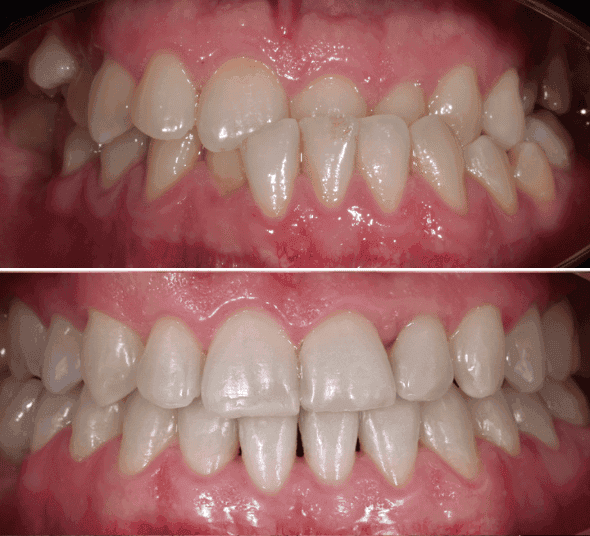
In the case of patient C.A., dental crowding and the absence of a tooth required a multidisciplinary treatment plan, which integrated orthodontics, periodontology, implantology and dental prosthetics.
“In this case, we needed space both to correct the dental crowding and to correct the occlusion, and the specific characteristics of the jawbones limited the treatment options. We therefore decided to extract two upper premolars, and the patient wore a self-ligating metal brace. The orthodontic mini-implant provided support for the controlled movement of the teeth and for creating the space required for a dental implant.”
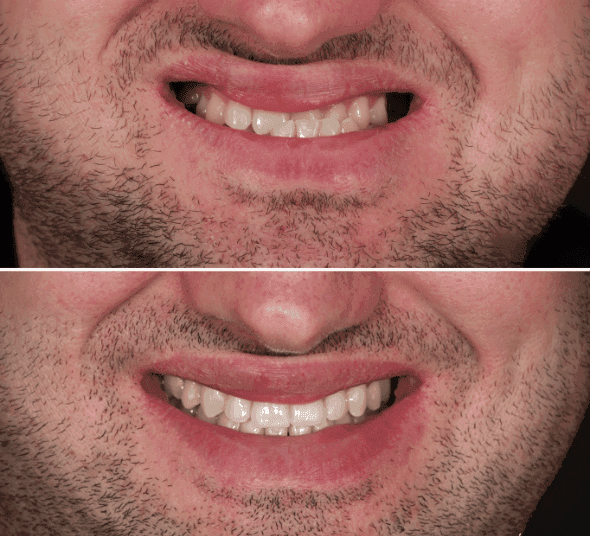
We avoided orthognathic surgery on the jawbones by achieving dental correction. The benefits are significant. Chewing, phonation and speech are corrected, and the aesthetic appearance is greatly improved. The teeth are subjected to balanced forces and the patient has the chance to keep their natural teeth for life,” explains Dr Liana Andruseac.
Following the orthodontic phase, the missing tooth was replaced with a Straumann® Roxolid® SLActive® implant, and the treatment was completed with prosthetic restorations using premium crowns.
This case demonstrates how the orthodontic mini-implant can play an important role in a complex treatment plan, where the objective is not only to align the teeth but also to create the conditions for restoring dental function and aesthetics.
How does an orthodontist determine whether you need a mini-implant?
The need for an orthodontic mini-implant is determined following a clinical assessment and treatment planning.
The dentist analyses the position of the teeth, the relationships between the dental arches, the available space and the movements required to achieve the desired result. An important aspect is identifying anchorage sites and assessing the possibility of controlling tooth movement without additional support.
Where indicated, imaging investigations provide information about the anatomical structures and the area where the mini-implant could be positioned. The recommendation may be made at the start of orthodontic treatment or at a later stage, depending on the planned tooth movements.
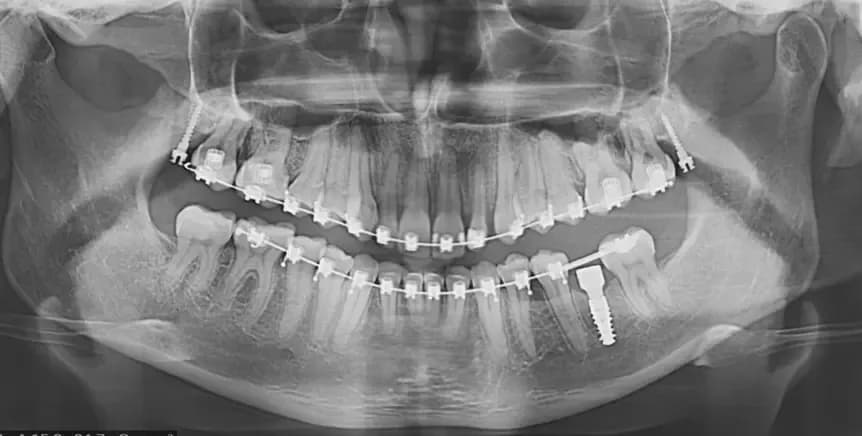
For example, computed tomography helps us to identify areas of higher bone density that are suitable for the insertion of mini-implants. These can be placed between or above the tooth roots, depending on the individual case.
“In adults, we most commonly use mini-implants to create space between teeth for prosthetic purposes, to allow for the insertion of dental implants. In adolescents, we often use mini-implants to expand the upper jaw or to move the teeth backwards – a movement known as distalisation.”
What are the benefits of orthodontic mini-implants?
The main advantage of orthodontic mini-implants is the ability to control certain tooth movements more precisely, without relying solely on existing teeth for anchorage.
More precise control of tooth movement
The mini-implant provides a stable anchor point for the application of orthodontic forces. This allows the dentist to limit unwanted movement of other teeth and to better control the direction of the required movements.
The ability to perform complex orthodontic movements
Certain movements, such as tooth intrusion or the controlled movement of molars, may require additional anchorage.
The use of mini-implants can expand treatment options in cases where conventional anchorage is insufficient.
Can mini-implants reduce the duration of orthodontic treatment?
In certain situations, mini-implants can streamline the stages of treatment by providing better control over tooth movement.
However, the use of a mini-implant does not guarantee a shorter duration of orthodontic treatment. The total duration depends on the complexity of the case, the biological response of the tissues and the objectives set by the dentist.
Orthodontic mini-implants versus other anchorage methods: what are the differences?
In conventional orthodontic treatment, teeth are frequently used as anchor points to move other teeth. Depending on the case, auxiliary devices such as elastics or certain anchorage appliances may also be used.
Mini-implants offer an alternative form of temporary skeletal anchorage that does not rely solely on the support provided by the other teeth.
This difference is important in treatments that require additional control of forces or the prevention of unwanted tooth movement.
However, mini-implants involve a surgical procedure and require monitoring. They do not replace braces, but can be used in conjunction with them when the treatment plan so requires.
How is an orthodontic mini-implant fitted?
The insertion of an orthodontic mini-implant is a minor procedure, carried out following an assessment of the area where the device is to be placed.
Generally, the procedure involves the following steps:
- Planning the position of the mini-implant. The dentist determines the insertion site based on the local anatomy and the required anchorage.
- Administration of local anaesthesia. The area is numbed to prevent pain during the procedure.
- Insertion of the mini-implant. The device is fixed into the bone using a technique tailored to the area and the type of mini-implant.
- Connection to the orthodontic system. The mini-implant can be used to apply orthodontic forces immediately or at a later stage, depending on its stability and the treatment plan.
The procedure does not usually require extensive surgery, and the patient can resume their normal activities in accordance with the dentist’s recommendations.
Does it hurt to have an orthodontic mini-implant fitted?
The insertion of the orthodontic mini-implant is carried out under local anaesthetic. During the procedure, the patient may feel a sensation of pressure, without any significant pain.
Once the anaesthetic has worn off, temporary local sensitivity or discomfort may occur. The intensity and duration of this vary from patient to patient.
The dentist will provide advice for the period immediately following the insertion. If the pain persists, worsens or is accompanied by significant inflammation, the area will need to be re-assessed.
What are the risks and contraindications associated with orthodontic mini-implants?
Orthodontic mini-implants are frequently used for temporary anchorage, but their insertion and use may be associated with certain risks.
These include:
- Inflammation or irritation of the tissues surrounding the mini-implant.
- Local sensitivity and discomfort following insertion.
- Loosening or loss of stability of the device.
- The possibility of damage to tooth roots or other neighbouring anatomical structures.
The risk of complications may be influenced by the positioning of the device, the quality and quantity of bone, oral hygiene and the patient’s medical history.
Active periodontal disease, certain systemic conditions or medication may require additional precautions and an individualised assessment.
The orthodontist determines whether a mini-implant is appropriate and whether any additional measures are required prior to insertion.
How do you look after an orthodontic mini-implant after it has been fitted?
- Oral hygiene is essential in the area around the mini-implant to reduce the risk of inflammation.
- Dental hygiene is carried out as normal using a toothbrush, toothpaste and dental floss.
- Use additional hygiene aids, such as a mouthwash, around the mini-implant.
- You can use mouthwash twice a week.
- Do not apply pressure to the mini-implant with your fingers or tongue.
- Attend your regular orthodontic check-ups to check the stability of the device and adjust the forces applied
- If you notice that the mini-implant is moving or if you experience persistent pain and severe inflammation, contact your orthodontist.
For further advice, find out how to maintain good oral hygiene during orthodontic treatment.
Frequently asked questions about orthodontic mini-implants
How long does an orthodontic mini-implant need to be worn?
The mini-implant remains in place for as long as is necessary to achieve the planned tooth movements. Depending on the complexity of the case, it may be used for a few months or for a longer period. It does not necessarily have to remain in place until the entire orthodontic treatment is complete.
How is an orthodontic mini-implant removed?
Once it is no longer needed for anchorage, the mini-implant is removed by the dentist in a simple procedure, usually without the need for major surgery. The area usually heals quickly, and the dentist will provide the necessary aftercare advice.
Can an orthodontic mini-implant be used with aligners?
Yes. In certain cases, mini-implants can also be used in orthodontic treatment with aligners, when tooth movements requiring additional anchorage are necessary. The indication depends on the specific details of the case and the treatment plan drawn up by the orthodontist.
What happens if the orthodontic mini-implant moves?
Movement of the mini-implant may indicate that it has lost its stability. It needs to be assessed by your orthodontist, who will decide whether the device can be left in place, needs to be removed, or needs to be repositioned or replaced. Do not try to adjust it yourself.
How much does an orthodontic mini-implant cost?
According to the price list published by DENT ESTET, the price of an orthodontic mini-implant is 1,000 lei. The total cost of orthodontic treatment depends on the type of braces, the complexity of the case and the procedures required.
For up-to-date information, please consult the orthodontics price list.
Conclusion: when might an orthodontic mini-implant be the right solution?
An orthodontic mini-implant may be recommended when treatment requires additional control over tooth movement, particularly in cases of insufficient anchorage or complex tooth movements.
It is not a mandatory step for all patients wearing braces. The need for it is determined on a case-by-case basis, following an orthodontic assessment and analysis of the treatment objectives.
Book an orthodontic consultation at DENT ESTET to find out which solutions are suitable for straightening your teeth and correcting your bite.