




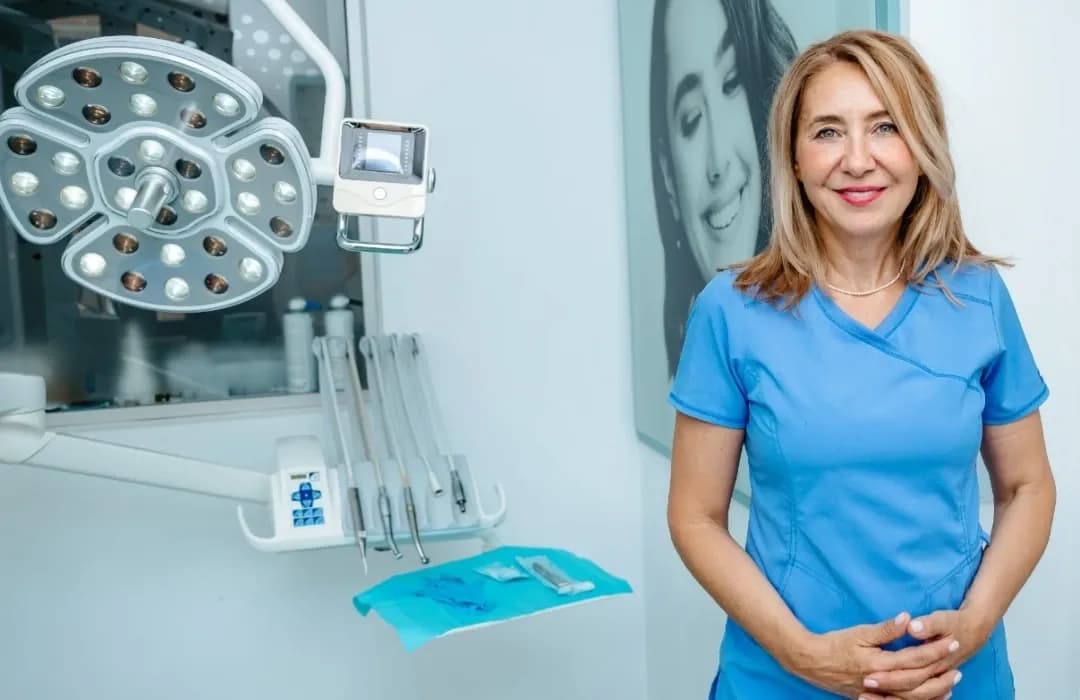
Dental implants in Brasov: 7 criteria for choosing the right clinic and dentist
 Author: Dr. Codruța Ciurescu
 October 2, 2026
If you have started searching for “dental implants in Brașov”, you have probably already come across numerous clinics and different offers. Prices can vary, as can what is included in each treatment plan, and the important differences are not always obvious from an online advertisement.
Your decision should take into account the dentist’s training and experience, the initial assessment, the necessary investigations, how the implant treatment is planned, and long-term follow-up. A dental implant is not simply a surgical procedure, but part of a treatment that needs to be carefully planned from the outset through to the final restoration.
In short, here are the 7 criteria worth considering:
| Criterion | What to check |
| 1. The dentist’s qualifications | Training in implant dentistry, surgical expertise, and experience with similar cases |
| 2. Comprehensive assessment | Medical history, gum health, available bone and risk factors |
| 3. Diagnostic investigations | The imaging required for accurate case planning |
| 4. Treatment planning | Implant positioning in relation to the final restoration |
| 5. Multidisciplinary team | Access to oral surgery, periodontology, and prosthodontics when required |
| 6. Treatment plan and costs | Clearly defined treatment stages and information about what is included |
| 7. Follow-Up care | Regular check-ups and maintenance after treatment is completed |
How do you choose a clinic and a dentist for dental implants in Brașov?
Price may be one of the factors to consider, but it should not be the only one.
Implant treatment involves a diagnostic phase, planning, the procedure itself, healing and the fitting of the prosthetic restoration. In some cases, additional procedures may be required, such as bone augmentation or treatment of periodontal conditions, before the implant is placed.
Therefore, when comparing clinics in Brașov, it is useful to consider both the dentist’s qualifications and the way in which your case is assessed and planned.
Criterion 1: The doctor’s training and experience
Treatment involving dental implants requires specific training and clinical experience.
In Romania, implantology must be distinguished from medical specialities as such. Therefore, when checking a dentist’s qualifications, you should look for a certificate or training in implantology, as well as any relevant specialisations, such as in dento-alveolar surgery or periodontology.
What should you check?
- the dentist’s training and qualifications in implantology;
- their surgical experience;
- the types of cases they usually treat;
- participation in continuing professional development programmes;
- experience in managing cases requiring additional procedures.
Experience is not just about the number of implants placed. What also matters is the ability to identify risk factors and to adapt the treatment plan to the patient’s specific anatomical and medical characteristics.
Criterion 2: Comprehensive assessment prior to implantation
Implant treatment should not be planned solely on the basis of a discussion about the missing tooth.
The initial assessment looks at both the local situation and general factors that may influence the treatment.
What needs to be assessed?
Depending on the case, the dentist will examine:
- the patient’s medical history and medication;
- the condition of the existing teeth;
- the health of the gums and periodontal tissues;
- the available bone in the implant site;
- the bite and how the teeth function;
- smoking;
- bruxism and other factors that may influence treatment.
Why does the treatment plan need to be tailored to the individual?
There is no single plan that is the same for all patients.
The position of the missing tooth, bone anatomy, gum health, the type of final restoration and any existing problems can affect both the procedure and the duration of treatment.
A personalised treatment plan allows for the early identification of risk factors and the selection of an approach suited to the clinical situation.
Criterion 3: Investigations required for implant planning
Successful planning of dental implant treatment requires a number of investigations, such as computed tomography (CBCT) and digital scans.
What role does CBCT play?
CBCT, or cone-beam computed tomography, provides a three-dimensional image of the area to be treated.
The dentist can thus analyse:
- the height and thickness of the available bone;
- the shape of the alveolar ridge;
- the position of important anatomical structures;
- the relationship to the maxillary sinus or mandibular canal;
- the space available for implant placement.
CBCT should not be presented as an investigation that measures ‘bone density’ with absolute precision. Its main role in implantology is the three-dimensional assessment of the anatomy and the available bone volume.
How are imaging studies used for planning?
Imaging information is correlated with the clinical examination and the prosthetic plan.
The aim is not merely to find a place where ‘the implant will fit’, but to identify a suitable position for the implant in relation to the patient’s anatomy and the future tooth.
Criterion 4: The implant must be planned with the final restoration in mind
A dental implant is not the end result. It will subsequently support a crown, a bridge or, in the case of extensive restorations, a fixed restoration supported by several implants.
Why does the position of the future crown matter?
The position of the implant affects:
- the function of the future tooth;
- aesthetics;
- access for cleaning;
- its relationship with neighbouring teeth;
- the way in which masticatory forces are distributed.
For this reason, implant planning must also take into account the prosthetic restoration that the implant will support.
What needs to be established before the procedure?
Depending on the case, it is useful to know the following as early as the planning stage:
- the type of final restoration;
- the number of implants required;
- their position;
- any preparatory procedures;
- the stages of treatment;
- the estimated healing time.
Criterion 5: Access to a multidisciplinary team
Some cases can be resolved relatively easily. Others require the collaboration of several doctors.
| Specialism | Possible role in treatment |
| Oral and maxillofacial surgery / implantology | Implant planning and placement, associated surgical procedures |
| Periodontology | Assessment and treatment of the gums and supporting tissues |
| Dental prosthetics | Planning and fabrication of crowns, bridges or final restorations |
| Orthodontics | May be necessary in certain cases to achieve the correct space or tooth position |
In complex cases, collaboration between specialities ensures that the surgical stage is coordinated with the intended prosthetic outcome.
Criterion 6: A treatment plan and a clear cost
The price of an implant, on its own, does not always represent the full cost of the treatment.
What might the treatment involve?
Depending on the patient’s situation:
- consultation and diagnostic tests;
- the dental implant;
- surgical procedure;
- the abutment or prosthetic components;
- temporary restoration, where indicated;
- crowns or permanent restorations;
- any bone augmentation procedures;
- post-operative check-ups.
Before treatment begins, the patient should understand which stages are recommended and what each of them involves.
Criterion 7: Follow-up after completion of treatment
Treatment does not end with the fitting of the permanent crown.
The implant and the surrounding tissues must be monitored over time. Daily oral hygiene, regular check-ups and professional cleanings help to maintain the health of the peri-implant tissues.
The frequency of check-ups is determined on a case-by-case basis, depending on the patient’s risk factors and clinical condition.
Monitoring enables the early identification of changes such as inflammation of the tissues surrounding the implant, before they progress.
What questions should you ask during a dental implant consultation?
If you’re looking for a dentist specialising in dental implants in Brașov, you might want to go to your consultation with a few questions prepared:
- What training does the dentist have in implantology?
- What tests are required in my case?
- Do I have enough bone for an implant?
- Are there any gum problems that need to be treated first?
- How is the position of the implant determined?
- What type of restoration will I have in the end?
- Are any additional procedures required?
- How many stages does the treatment involve?
- How long is it likely to take?
- What does the financial plan include?
- Who will carry out the surgical stage and who will carry out the prosthetic stage?
- How will the implant be monitored once treatment is complete?
How do you compare the costs of dental implants in Brașov?
When comparing two quotes, try to compare the full treatment, not just the price of the implant.
| Point | What to check |
| Consultation and investigations | Are they included or are they charged separately? |
| The implant | Which system is used? |
| Prosthetic components | Are the abutment and other necessary components included? |
| The final crown | Is it included in the quoted price? |
| Temporary restoration | Is this required and is it included? |
| Additional procedures | Are bone grafting or a sinus lift charged separately? |
| Check-ups | What post-operative and follow-up appointments are included? |
An apparently lower quote is not necessarily better value if it only covers one stage of the treatment.
Dental implant treatment at DENT ESTET Brașov
At the DENT ESTET dental clinic in Brașov, patients interested in dental implant treatments benefit from medical expertise, advanced digital planning and the integration of laser technologies, which contribute to the precision of implant placement and support the healing process.
Dr Codruța Ciurescu: dento-alveolar surgery, implantology and periodontology
Dr Codruța Ciurescu is a Senior General Dentist and a Specialist in Dento-Alveolar Surgery, with certification in Implantology and Periodontology.
Her training in implantology and periodontology included a course at Paul Sabatier University in Toulouse, and her clinical practice is complemented by her surgical experience and a multidisciplinary approach to complex cases.
Individualised assessment and treatment planning
At DENT ESTET Brașov, treatment begins with a clinical and imaging assessment of the patient.
In cases where digital planning is indicated, imaging data can be integrated with the patient’s digital records to determine the position of the implants and create a surgical guide.
The aim is to plan the procedure in accordance with the patient’s anatomy and the final prosthetic restoration.
Multidisciplinary approach
Depending on the complexity of the case, treatment may involve clinicians specialising in surgery, periodontology and dental prosthetics.
This collaboration is particularly important when the implant forms part of a more comprehensive treatment plan, which involves both the surgical stage and the functional and aesthetic restoration of the smile.
Frequently asked questions about choosing a dentist for dental implants in Brașov
How can I check a dentist’s qualifications in implantology?
You can check the doctor’s professional profile and their training in implantology, as well as any specialisms that may be relevant to your case. During the consultation, you can also ask what types of cases they usually treat.
Is a CBCT scan necessary before having an implant?
For pre-operative assessment, imaging appropriate to the clinical situation is important, and CBCT provides very useful three-dimensional information for planning. The indication and the area to be examined must be determined on a case-by-case basis by the doctor, following a clinical examination.
Why do prices for dental implants vary in Brașov?
This is because the two figures shown may cover different items. The implant system, diagnostic tests, prosthetic components, the crown, any additional procedures and follow-up care can all affect the total cost.
How long does dental implant treatment take?
The duration depends on the specific circumstances of each case. Some treatments involve only the insertion of the implant and the osseointegration period, whilst others require bone grafting, periodontal treatment or other procedures prior to the final restoration.
What happens after the crown has been fitted onto the implant?
Next comes the maintenance phase. The implant, the restoration and the surrounding tissues must be checked regularly, and the patient must maintain appropriate oral hygiene.
Choosing a dental implant in Brașov starts with a proper assessment
When choosing a clinic or dentist for dental implants in Brașov, try to look beyond the advertised price. The dentist’s qualifications, the initial assessment, planning the implant to achieve the desired outcome, and long-term monitoring are all factors worth discussing before starting treatment.
If you need a dental implant and want to find out which option is right for your situation, you can book a consultation at DENT ESTET Brașov. Following a clinical and imaging assessment, the medical team can set out the stages of a treatment plan tailored to your case.