




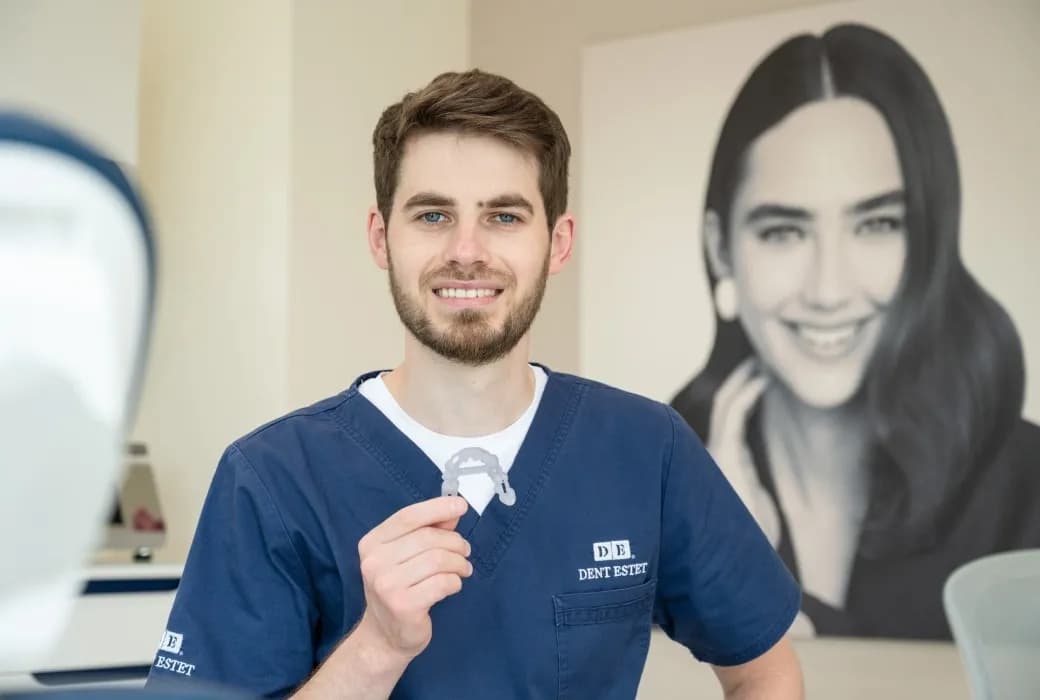
 Author:
  February 10, 2026
Dental implants are now one of the most popular and effective solutions for replacing missing teeth. They offer patients not only functionality but also a natural appearance, contributing to a better quality of life.
However, despite significant technological advances, many people still speak of negative experiences or unfounded fears, often based on incomplete information or baseless myths.
In this article, we invite you to discover the most common myths about dental implants and what the correct information actually is, based on medical reality, clinical experience and current scientific literature.
Fact or fiction in dental implantology
Myths surrounding dental implants can create unfounded fears and prevent patients from choosing a treatment that could significantly improve their quality of life.
Accurate information, based on evidence and consultation with a specialist, is essential for making the best decision.
“In my clinical practice, dental implants have proven to be a safe and effective solution, and for many patients this treatment has meant not only restoring their teeth, but also regaining the comfort and confidence to smile,” says Dr Cătălin Mărtișcă, a specialist in Oral and Maxillofacial Surgery.
Myth: Dental implants do not last long
Myth: Dental implants are painful
This is perhaps one of the most common fears. However, the truth is that the surgical procedure for dental implants is normally carried out under local anaesthetic, so the patient feels no pain during the insertion of the implant.
After the procedure, it is normal to experience some discomfort, similar to that felt after tooth extractions. This discomfort subsides within a few days and can be managed with standard painkillers.
“Clinical experience shows that most patients report only mild or moderate pain in the first 24–72 hours, and this is temporary and treatable,” explains Dr Cătălin Mărtișcă, a specialist in dento-alveolar surgery at the DENT ESTET clinics in Bucharest, Sibiu and Arad.
Myth: Dental implants do not last long
Another extremely widespread myth is that implants “don’t last long”.
Studies on the lifespan of dental implants show that, in fact, implants have very high survival rates over time, exceeding 90% at 10 years.
It is important, however, to note that the lifespan of an implant depends on several factors, including oral hygiene, regular check-ups, lifestyle (smoking, bruxism) and general health. With proper care, implants can last 15–25 years or even longer.
If you would like to find out more about the factors that influence the lifespan of a dental implant and how you can extend it, book a consultation with an implantologist.
Myth: The implant may be rejected by the body.
Myth: The implant can be rejected by the body
There is often confusion between what happens at a biological level and the concept of immunological ‘rejection’.
made from biocompatible materials (such as titanium or zirconium), which allow for osseointegration, resp
In reality, modern implants are effectively the process by which the implant integrates directly into the bone without an immune rejection response.
“Implant failures are rare and, in most cases, the causes can be easily identified. These may include peri-implantitis, an infection affecting the gum and bone surrounding a dental implant, as well as poor oral hygiene or smoking. It is important to follow the dentist’s post-implant recommendations to ensure the treatment lasts as long as possible,” says Dr Cătălin Mărtișcă.
Find out more about situations in which a dental implant may be rejected and the signs indicating a possible complication.
Myth: Anyone can undergo implant treatment
The reality is that not every patient is suitable for an implant. A thorough medical assessment, bone density levels and general health are essential factors in determining whether dental implant treatment can be undertaken to replace a missing tooth.
If there is insufficient bone, or if certain medical conditions or medication are present, alternative solutions or complementary procedures, such as bone augmentation, may be necessary.
“Each case must be carefully analysed. At DENT ESTET clinics, individualised assessment and proper planning are key elements for a safe and long-lasting result,” explains Dr Cătălin Mărtișcă.
Myth: Anyone can undergo implant treatment
Myth: The procedure is very complicated and risky
The procedure for inserting an implant may seem complex, but when performed by an experienced specialist, it is considered minimally invasive and safe.
At DENT ESTET, digital treatment planning and the modern technologies available in all our clinics, such as guided surgery, help to increase precision and reduce risks.
Clinical experience confirms that significant risks arise particularly in cases of inadequate planning or the absence of a comprehensive assessment.
Myth: Recovery takes a very long time
The duration of recovery varies from patient to patient, but in most cases, significant discomfort lasts only a few days to a few weeks, not months.
It is important to understand that the period of biological osseointegration can usually take several months, but this does not mean that the patient cannot function normally during this period.
Myth: The procedure is very complicated and risky.
Myth: Dental implants are very expensive
The cost of dental implants is often perceived as high, especially when compared strictly with seemingly more affordable solutions, such as removable dentures or dental bridges.
However, when we take into account durability, functional stability and long-term benefits — including the preservation of alveolar bone, the prevention of adjacent teeth shifting and the maintenance of correct occlusion — dental implants can prove to be a more cost-effective investment over time, both medically and functionally.
“In our practice, we frequently observe that alternative solutions with a lower initial cost require repeated repairs, replacements or adjustments, which can lead, over time, to cumulative costs comparable to or even higher than those of a properly placed dental implant,” explains Dr Cătălin Mărtișcă.
If you would like to find out more about dental implant prices in Romania, please visit our dental implant pricing page.
Myth: Recovery takes a very long time
Myth: A crown can be fitted immediately in any patient
There is often confusion between the possibility of immediate loading and its general indication.
In certain selected cases, with good initial stability and favourable conditions, it is possible to fit a temporary crown within 24–72 hours of implant placement. However, this option is not suitable for all patients. The decision depends on specific clinical factors.
Myth: No special care is needed after an implant
After implant placement, rigorous oral hygiene, regular check-ups and avoiding risk factors (smoking, excessive alcohol consumption, untreated periodontal disease) are essential.
Without proper care, complications such as peri-implantitis, bone resorption or implant loss may occur – complications that can be difficult to treat.
Myth: Dental implants are very expensive
Myth: Dental implants don’t look natural
Modern technology allows for the creation of highly aesthetic and customised crowns and prosthetic work, with shapes and shades tailored to each individual smile.
The customised design and modern materials (zirconia, high-quality ceramic) ensure a natural result that is difficult to distinguish from your own teeth.