




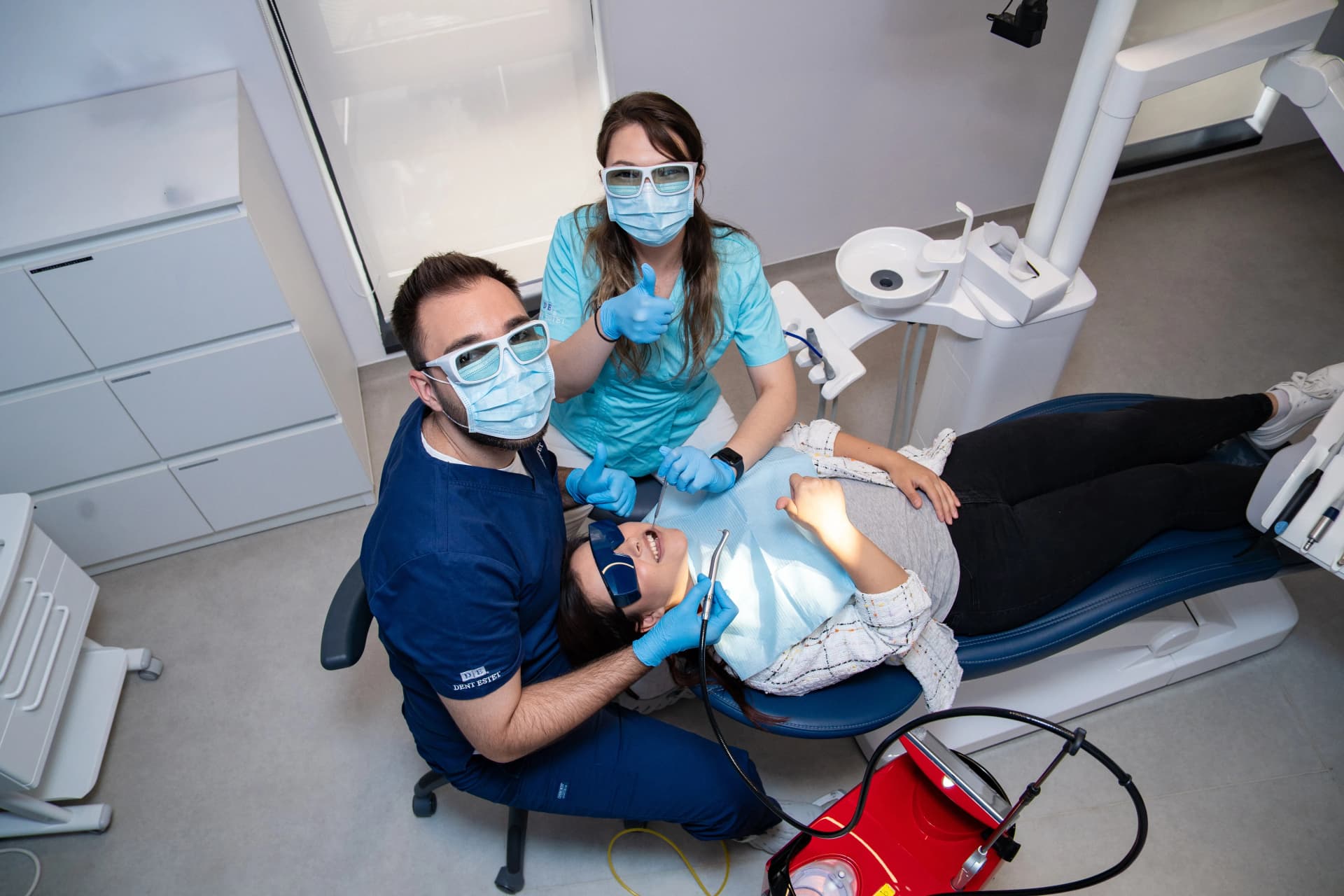
Treatments using the Biolase Waterlase dental laser
 Author: Dr. Constantin Budescu-Stănică
 October 26, 2025
In recent years, the dental laser has become an essential solution for clinics wishing to offer patients modern, safe and comfortable treatments. Among the world’s most advanced technologies is Biolase Waterlase, a revolutionary system that combines light energy with a fine jet of water, enabling precise and minimally invasive procedures.
This patented technology redefines how dental treatments are carried out — without the familiar noise of the drill, without vibrations and, in many cases, without anaesthesia. Waterlase acts gently on tissues, protecting healthy structures and significantly reducing inflammation and the risk of post-operative infections.
For patients, the benefits are clear: pain-free treatments, faster healing and a fear-free experience. Compared to traditional methods, the laser allows for superior precision, easier recovery and aesthetic results that remain stable over time.
“I firmly believe that the Biolase Waterlase dental laser represents the standard of the future in dentistry. Patients deserve gentler, faster and more effective treatments.” — Dr. Constantin Budescu-Stănică, Specialist in Periodontology, DENT ESTET Genesys Arad.
At DENT ESTET clinics, we have been using Biolase technology for over eight years in periodontal, conservative and surgical treatments. Every procedure follows clear and safe protocols, designed to offer patients comfort, precision and long-lasting results — in a modern environment where dentistry becomes a positive experience.
How the Biolase Waterlase dental laser works
Biolase Waterlase is an erbium-based dental laser designed to act precisely and gently on dental tissues. Its patented HydroPhotonics™ technology combines light energy with a fine spray of water, enabling the cutting and shaping of tissues without direct contact and without excessive heat.
Instead of cutting or burning, the laser beam gently fragments the affected tissues, whilst the water continuously cools the surface. This unique combination ensures gentler, safer procedures and a natural healing process that is much faster than with traditional methods.
Unlike a conventional drill or scalpel, the dental laser produces no vibrations, noise or pressure. Patients often describe the treatment as comfortable and pain-free, and in many cases, local anaesthesia is not even required.
Another major advantage of the Biolase Waterlase laser is its versatility. It can be used on both hard tissues – such as enamel, dentine or bone – and soft tissues – such as the gums and oral mucosa.
For this reason, it is used in a wide range of treatments: from treating dental caries and professional whitening, to periodontal disease therapy, biopsies or oral surgery. It is also valuable for disinfecting bone prior to the insertion of a dental implant or for the atraumatic removal of a compromised implant.
Furthermore, the laser beam has a natural antibacterial effect, decontaminating the treated area without the use of chemicals. For clinicians, this means greater precision and control, and for patients — a modern dental experience that is pain-free, fear-free and with a rapid recovery.
Treatment of dental caries with Biolase
Treating tooth decay becomes a much more comfortable experience with the help of the Biolase Waterlase dental laser. Instead of the traditional drill, which produces noise, vibrations and discomfort, the laser works gently, without pressure and without heating the treated area.
The laser beam has a precision of a few microns, allowing the dentist to remove only the tissue affected by tooth decay, without touching the healthy enamel. By comparison, drill bits come in standard sizes and cannot be adjusted as finely, meaning the laser removes exactly what is needed — no more, no less.
This high precision reduces unnecessary loss of healthy tissue and the risk of recurrence, thanks to the simultaneous sterilisation of the treated area. In many cases, when the decay is superficial, the procedure does not require anaesthesia and is completely painless.
This method is ideal for children and patients with dental anxiety, as it eliminates the main sources of psychological discomfort during treatment — noise, vibrations and pain.
According to studies published in Lasers in Medical Science and the Journal of Clinical Pediatric Dentistry, the use of dental lasers significantly reduces anxiety levels in children and pain-sensitive patients, due to the absence of the auditory and vibrational stimuli specific to the drill. Furthermore, procedures are shorter, and the lack of need for local anaesthesia contributes to a more relaxed and easily tolerated experience.
Laser treatment for periodontitis – a modern approach to gum health
Periodontitis (periodontal disease) is a serious condition affecting the gums, caused by the build-up of bacteria in the mouth. Over time, chronic inflammation leads to the destruction of the supporting tissues and, if left untreated, can result in tooth loss.
Conventional treatments involve mechanical scaling or surgical procedures, which are effective but often perceived as painful and invasive. By comparison, the Biolase Waterlase dental laser offers a minimally invasive and precise approach, successfully used in the non-surgical stage of periodontal treatment.
The laser beam allows for deep cleaning and decontamination of periodontal pockets without incisions and without damaging healthy tissue. In most cases, a single decontamination session with the erbium laser (Waterlase) is sufficient, followed by maintenance sessions every 3–6 months using the Biolase Epic diode laser.
In addition to cleaning, the laser has an antibacterial and bio-stimulating effect, stimulating collagen production and the natural regeneration of the gums. Compared to traditional scaling, patients recover more quickly, without pain or sensitivity, and can resume their daily activities on the very same day.
“I have noticed that my patients who opt for Biolase Waterlase laser treatments recover more quickly, experience less discomfort and return to the clinic with confidence. It is a technology that has completely changed the way we approach periodontal treatments – gentler, more precise and with visible results from the very first session.” — Dr. Constantin Budescu-Stănică, Specialist in Periodontology, DENT ESTET Genesys Arad
The clinical results are also confirmed by international research. Studies published in Applied Sciences (2023) and Lasers in Medical Science (2021) show that treating periodontitis with a dental laser significantly reduces the depth of periodontal pockets and offers more stable results over time, compared to traditional methods.
In conclusion, the Biolase Waterlase laser represents a safe, painless and predictable solution for treating periodontal disease — a modern method, without invasive surgery and with accelerated healing.
Laser teeth whitening
A bright smile is often the first step towards confidence. Using Biolase Waterlase technology, laser teeth whitening delivers visible results from the very first session, in a safe and controlled manner.
The procedure involves applying a special gel to the teeth, which is activated by the laser beam. In just 30–60 minutes, the teeth become visibly whiter, without damaging the enamel.
The effect lasts, on average, between 12 and 24 months, depending on dietary habits and oral hygiene. Reduced consumption of coffee, tea or red wine, as well as regular dental scaling, helps maintain the results for a longer period.
The treatment is completely safe. The laser energy acts only on the whitening gel, not directly on the tooth, which eliminates the risk of overheating the enamel or damaging the dental pulp — risks frequently associated with conventional whitening methods. According to studies (De Moor et al., Scientific World Journal, 2015), the laser preserves the integrity of the enamel and does not alter the surface structure of the tooth, delivering aesthetic results without side effects.
The laser beam is precisely controlled, maintaining a constant temperature and protecting the internal tissues. Unlike traditional methods, laser teeth whitening causes little or no sensitivity, and most patients experience no discomfort after treatment.
As for laser teeth whitening – price, the cost varies between 800 and 2,500 lei, depending on the clinic, the type of laser and the services included in the treatment package.
Other treatments for which the Biolase laser can be used in the dental practice
The Biolase Waterlase dental laser is also used successfully in surgery, endodontics and biostimulation, offering dentists precision and patients greater comfort.
In endodontic treatments, the laser ensures thorough disinfection of the root canals, eliminating bacteria resistant to conventional treatments and removing the risk of reinfection.
Biolase Waterlase is also effective in treating mouth ulcers and oral herpes, reducing pain and accelerating healing, whilst providing a biostimulation effect.
In oral surgery, the laser enables gentle procedures with minimal bleeding and accelerated healing. It is used for frenectomies, gingivectomies, gingival reshaping, exposure of impacted teeth or abscess drainage, all performed with clean incisions and without post-operative discomfort.
In cases of peri-implantitis, Biolase Waterlase cleans and decontaminates the tissues surrounding the implants without affecting their surface. The laser beam has an antibacterial and biostimulating effect, reducing inflammation and promoting tissue regeneration, thereby increasing the chances of saving the affected implant.
When an implant can no longer be saved, the laser offers a modern method of atraumatic removal, preserving the bone for future rehabilitation. Healing is faster, pain-free and without inflammation, and the area remains perfectly decontaminated, ready for any future bone grafting.
The Biolase Waterlase laser is also used successfully for biopsies. The procedure is quick, precise and requires no scalpel or sutures, resulting in much easier healing. The samples taken have clear margins, which increases the accuracy of the histopathological diagnosis.
“I know that many patients get scared when they hear the word biopsy, but the procedure itself is not painful at all. With the help of the Biolase Waterlase laser, the sample is taken gently, without bleeding or discomfort, and healing is quick and easy.” — Dr. Constantin Budescu-Stănică, Specialist in Periodontology, DENT ESTET Genesys Arad
Combining precision, instant sterilisation and the stimulation of tissue regeneration, the Biolase dental laser offers a safe and effective solution for a wide range of modern treatments.
Frequently asked questions about Biolase laser treatments
Is dental laser treatment painful?
No. Most patients do not feel any pain, just a slight sensation of warmth or a gentle vibration. In many cases, treatments are carried out without local anaesthetic.
Can deep tooth decay be treated with the Biolase Waterlase laser?
Yes, but it depends on the extent of the damage to the tooth. In some cases, the dentist may combine the treatment with conventional methods to achieve the best possible result.
Does the laser also treat advanced periodontitis?
Yes. The Biolase Waterlase laser is effective in both the early and advanced stages of periodontal disease. It cleans and disinfects periodontal pockets without incisions, reducing inflammation and stimulating gum regeneration.
How long does the effect of laser teeth whitening last?
The results last between 12 and 24 months, depending on dietary habits and oral hygiene. Avoiding coffee, tea or smoking helps maintain the results for longer.
Is there any sensitivity after laser whitening?
Very rarely. The laser beam acts only on the whitening gel, not directly on the enamel, making the procedure safe and well-tolerated even by patients with sensitive teeth.
Are there any contraindications for dental laser treatments?
Laser treatments are safe for most patients. However, they may be avoided in cases of photosensitising treatments or in special medical situations, on the doctor’s advice.
How long does a session with the Biolase Waterlase laser take?
The duration varies depending on the type of treatment. For example, teeth whitening takes approximately one hour, whilst a periodontal decontamination session can be completed in 30–60 minutes.
Bibliography
- Biolase. (n.d.). Why laser dentistry?
- De Moor RJ, Verheyen J et al. – Laser teeth bleaching: evaluation of potential side effects on enamel and pulp and efficacy in vitro and in vivo, Scientific World Journal
- Huang N et al. – The clinical efficacy of laser in the non-surgical treatment of peri-implantitis: a systematic review and meta-analysis, Int J Implant Dent
- Lin GH, Suárez López Del Amo F, Wang HL - Laser therapy for the treatment of peri-implant mucositis and peri-implantitis: An American Academy of Periodontology best evidence review, J Periodontol, 2018
- Ting M, Alluri LSC, Sulewski JG, Suzuki JB, Paes Batista da Silva A. Laser Treatment of Peri-Implantitis: A Systematic Review of Radiographic Outcomes. Dent J (Basel), 2022
- Saneja R, Bhattacharjee B et al. - Efficacy of different lasers of various wavelengths in the treatment of peri-implantitis and peri-implant mucositis: A systematic review and meta-analysis. J Indian Prosthodont Soc, 2020
- Lerario F, Roncati M et al. - Non-surgical periodontal treatment of peri-implant diseases with the adjunctive use of a diode laser: a preliminary clinical study. Lasers Med Sci, 2016